




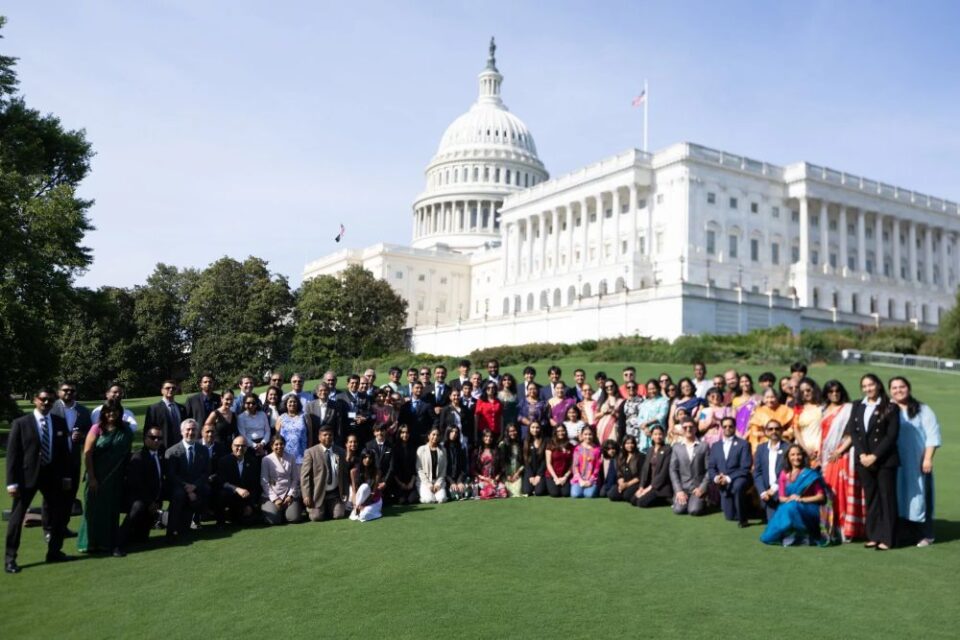
WASHINGTON, D.C., July 4, 2026 — As the United States marks its 250th anniversary, more than 130 Hindu Americans from 15 states gathered on Capitol Hill to celebrate the nation’s history, reflect on their place in the American story, and urge lawmakers to address rising incidents of anti-Hindu hate.
The event, organized by the Coalition of Hindus of North America (CoHNA), combined patriotic celebrations with advocacy, bringing together students, veterans, entrepreneurs, researchers, and community leaders. Seven members of Congress and a dozen congressional staffers from both political parties participated in the fifth annual CoHNA Advocacy Day, which highlighted both America’s 250-year democratic journey and the growing civic engagement of Hindu Americans.
Ahead of the gathering, delegates met with congressional staff in more than 50 meetings and visited over 120 congressional offices to discuss issues affecting the Hindu American community.
“It was a powerful day on Capitol Hill. We came together as Americans, sharing stories, building relationships, and singing the national anthem,” said Nikunj Trivedi, president of CoHNA.
Trivedi said Hindu Americans represent every profession and walk of life—from students, entrepreneurs, and engineers to veterans, scientists, homemakers, and retail workers—and that the event reflected their commitment to both their faith and the nation.
The program emphasized America’s founding ideals of religious liberty and civic participation. Speakers from the Armenian and Jewish communities joined the event, while members of the CoHNA Youth Action Network (CYAN) described their efforts to combat anti-Hindu bias on college campuses, advocate for representation, and organize academic discussions on Hinduism.
One of the day’s most personal addresses came from Hindu veteran Ruchir Bakshi, who spoke about serving in combat in Afghanistan and Iraq. He said the teachings of the Bhagavad Gita had guided him toward disciplined public service while remaining true to his Hindu identity.
Lawmakers from both parties used the occasion to celebrate America’s semiquincentennial while acknowledging concerns about rising Hinduphobia.
Buddy Carter described freedom of religion as one of America’s greatest constitutional rights and condemned attacks on Hindu temples, thanking Hindu Americans for their contributions to what he called “this great experiment of democracy.”
Shri Thanedar praised immigrant communities for helping build America’s success and encouraged Hindu Americans to demand recognition for their contributions in science, medicine, academia, and public service.
Addressing younger attendees, Suhas Subramanyam urged Hindu students not to remain silent in the face of prejudice.
“Embrace who you are as Hindus,” he said, adding that “being different becomes cool later in life—be proud now.”
Several lawmakers also pointed to recent legislative efforts addressing anti-Hindu discrimination.
Sanford Bishop said “Hinduphobia is un-American” and noted that Georgia became the first state to formally condemn Hinduphobia. Fellow Georgia Congressman Brian Jack said the state’s actions demonstrated how community advocacy could translate into public policy, while Rich McCormick praised Hindu Americans as hardworking, family-oriented, and representative of the American Dream.
Meanwhile, Zoe Lofgren cautioned that proposed caste-based legislation could unintentionally deepen discrimination rather than address it.
The event also featured presentations from researchers examining anti-Hindu bias in the United States.
Joel Finkelstein of the Network Contagion Research Institute discussed research questioning efforts to incorporate caste into U.S. policymaking, arguing that policymakers should require stronger evidence before adopting activist narratives into law or educational curricula.
NCRI researcher Prasiddha Sudhakar presented findings suggesting that online hostility framed as anti-Indian sentiment often disproportionately targeted Hindu religious identity, festivals, and temples. According to the research, coordinated online campaigns and geopolitical influences contributed to the spread of anti-Hindu rhetoric.
Political strategist Anang Mittal introduced the Citation Integrity Dashboard, a nonpartisan initiative designed to evaluate whether widely cited reports on Hindu Americans and India are supported by verifiable evidence.
Concluding the event, Sudha Jagannathan said bipartisan participation demonstrated growing recognition of concerns surrounding anti-Hindu hate.
“It was gratifying to see so many lawmakers—both Democrats and Republicans—unite against temple attacks and anti-Hindu hate, and speak up for religious freedom for American Hindus,” she said. “The future belongs to those who show up and advocate.”
Held against the backdrop of America’s 250th anniversary celebrations, the event underscored how Hindu Americans are increasingly framing their civic engagement not only as advocacy for their community, but also as participation in the broader American democratic tradition.
