





How one fruit became a symbol of India’s history, diversity, innovation, and enduring connection with its global diaspora
BY JYOTHSNA HEGDE
A Summer Ritual Arrives in Atlanta
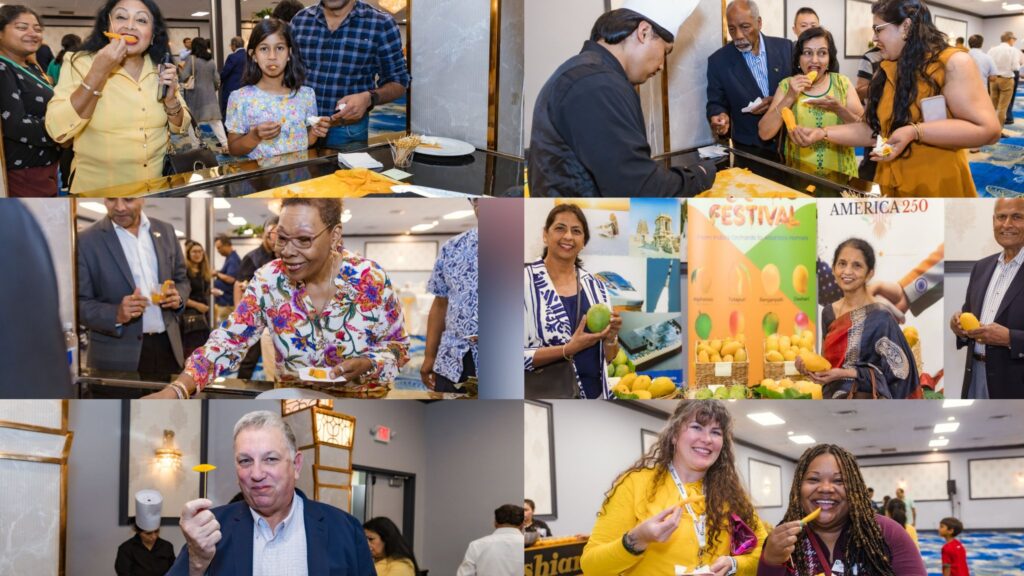
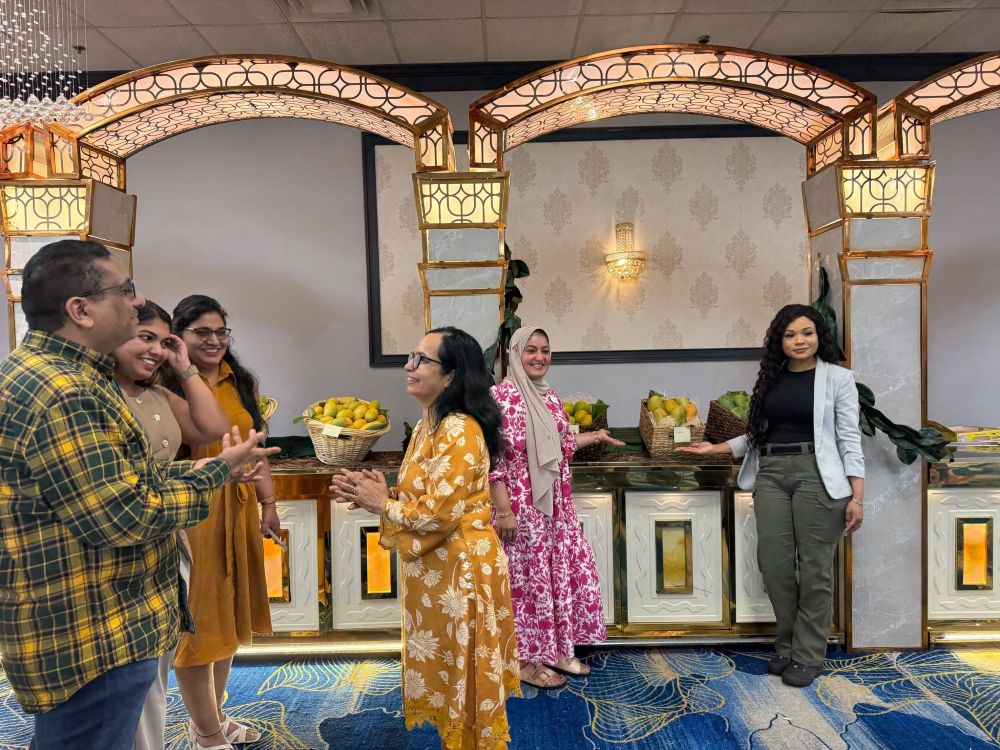
Long before the first mango was sliced, visitors walking into Global Mall in Norcross knew summer had arrived. Golden fruit in shades of yellow, amber, and green lined the display tables as families paused to admire familiar favorites and discover new varieties. Conversations quickly turned into animated debates. Which mango was the sweetest? Which tasted just like the ones back home? Which truly deserved the title of India’s “King of Fruits”?

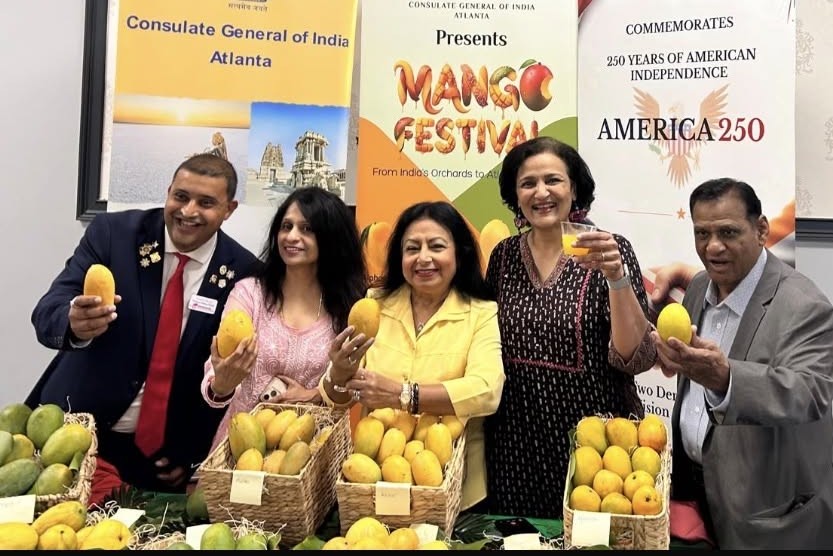
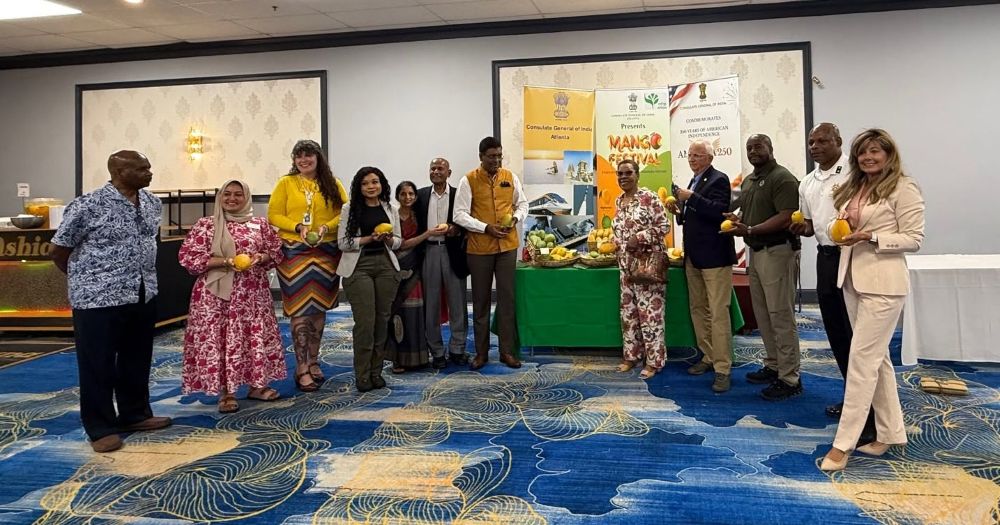
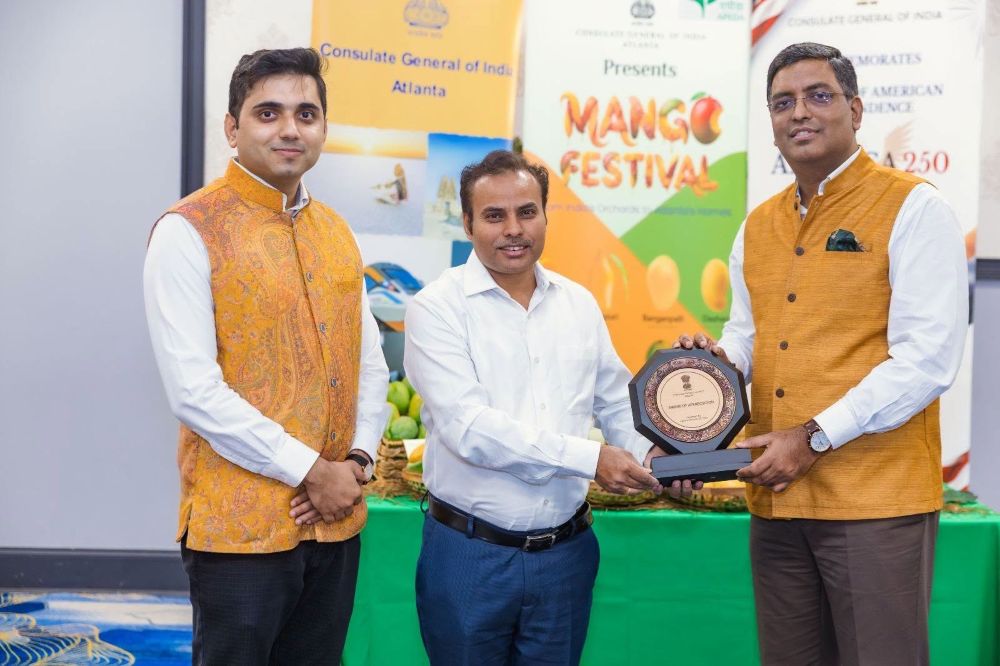
This summer, the Consulate General of India in Atlanta transformed metro Atlanta into a celebration of India’s most beloved fruit through two Consulate-led Mango Mania Atlanta 2026 events. The flagship gathering at Global Mall brought together community members, elected officials, business leaders, importers, and mango enthusiasts for an afternoon of tastings, culinary demonstrations, and conversations about India’s extraordinary mango heritage. Addressing the gathering were Hon. Consul General Ramesh Babu Lakshmanan, Georgia State Representative Matt Reeves, Fulton County Commissioner Bridget Thorne, internationally renowned marketing scholar Dr. Jagdish “Jag” Sheth, and representatives from the mango import and export community.
Later that evening, the celebration continued at Suvidha International Market in Alpharetta, where the Consulate inaugurated a Mango Experience Zone. Joined by Deputy Consul General Mr. Sreejan Shandilya, State Senator Josh McLaurin, and Representative Long Tran, visitors sampled premium Indian mangoes alongside an array of mango-inspired beverages, desserts, and savory dishes, highlighting both the fruit’s remarkable diversity and its growing popularity in the United States.
Together, the two celebrations honored far more than the arrival of mango season. They showcased India’s agricultural heritage, encouraged appreciation for its remarkable range of mango varieties, and strengthened cultural and commercial ties between India and the United States.
“India is the origin of the mango,” Hon. Consul General Ramesh Babu Lakshmanan told the gathering. “The mango originated in India 5,000 to 6,000 years ago. It is native to India, and just as India is incredibly diverse, so are its mangoes.”
His remarks set the tone for an afternoon that celebrated history, culture, agriculture, and the enduring connection that millions of Indians continue to share with a fruit that has become part of their collective identity.

Where the Story Began
Long before mangoes appeared in American supermarkets or gourmet desserts, they flourished across the Indian subcontinent. Botanists recognize India as the birthplace of Mangifera indica, the species that would eventually spread across the tropics through ancient trade routes. Buddhist monks carried mangoes into Southeast Asia centuries before Portuguese explorers introduced them to Africa and South America, allowing the fruit to travel the world while remaining deeply rooted in its Indian origins.
Today, mangoes are cultivated in more than a hundred countries, yet India remains their undisputed heartland, producing nearly half of the world’s harvest and nurturing more than 1,500 named varieties. Even the English word mango reflects that journey. It evolved from the Malayalam word māṅṅa, adopted by Portuguese traders as manga before entering the English language during the sixteenth century.
For Hon. Lakshmanan, the fruit’s astonishing diversity mirrors the character of India itself.
“Every region has its own mango,” he said. “Even if you grow the same variety in another place, the taste changes. Travel just 100 kilometers, and you’ll find a different flavor.”
Those few words captured one of India’s greatest agricultural wonders. Differences in soil, rainfall, altitude, humidity, and generations of cultivation shape each harvest, giving every region its own distinct expression of the same fruit.
More Than a Fruit
Few foods are woven into India’s cultural fabric as deeply as the mango. Its leaves adorn entrances during weddings, festivals, and housewarming ceremonies as symbols of prosperity and good fortune. Ancient Sanskrit literature, Buddhist texts, and Mughal chronicles celebrate its beauty, while poets from Kalidasa to Rabindranath Tagore found in mango blossoms enduring symbols of love, hope, and renewal.
The fruit has also left its imprint on Indian art. The graceful paisley motif, known as ambi or mankolam, is widely believed to have been inspired by the mango’s elegant curve and continues to appear in textiles, jewelry, temple carvings, and embroidery across the country.
Yet the mango’s greatest legacy is found not in literature or palaces, but around family dining tables.
For generations of Indians, summer was announced not by a calendar but by the first ripe mango of the season. Kitchens filled with the fragrance of freshly cut fruit, jars of tangy pickles, glasses of cooling aam panna, generous servings of aamras, and desserts prepared only during those precious weeks when orchards reached their peak. Children waited eagerly for the season’s first mango while grandparents quietly passed down recipes and traditions that had endured for decades.
Across India, every household has its own rituals, favorite varieties, and cherished memories. Together, they have transformed the mango from a seasonal delicacy into one of the country’s most enduring cultural symbols.

A Journey Across India, One Mango at a Time
To understand Indian mangoes is to appreciate the extraordinary diversity of the country itself. From the Himalayan foothills to the tropical coast, India’s varied landscapes have produced an astonishing range of flavors, textures, and aromas. The fragrant Dasheri of Uttar Pradesh, the silky Himsagar of West Bengal, Karnataka’s beloved Raspuri, Tamil Nadu’s richly flavored Imam Pasand, and the late-season Neelam each reflect the character of the regions where they are grown. Alongside them are cherished local favorites such as Langra, Chausa, Benishya, Dudhiya Malda, Zardalu, and Rajapuri, many of which remain little known outside India.
One visiting exporter believes that is beginning to change.
“We have more than a thousand varieties in India,” the exporter said. “Many have exceptional flavor but have never reached international markets. This year we introduced varieties such as Himsagar, Dudhiya Malda, and Zardalu, and the response has been tremendous.”
Behind every box of mangoes reaching American shelves lies months of careful work. After harvesting, the fruit is sorted, inspected, and irradiated to meet stringent U.S. import regulations before beginning its journey across continents. India’s mango industry supports millions of farmers, orchard workers, transporters, exporters, and retailers, each playing a role in bringing the country’s finest produce to international markets.
“For years, Alphonso, Kesar, and Banganapalli dominated the market,” the exporter explained. “But India has hundreds of outstanding varieties that many people outside the country have never experienced. Our goal is to bring more regional varieties to the United States, expand distribution across more cities, and eventually make these premium mangoes available at more affordable prices.”
Hon. Lakshmanan echoed that vision, sharing encouraging news for mango lovers.
“What we want,” he said, “is for people not to eat the same mango every week. India has so many varieties. Every mango tells a different story.”
He noted that Kesar mangoes have recently made their way into Costco stores in several American markets, with discussions underway to expand availability through other major retailers. Looking ahead, he shared an even more ambitious dream.
“We had ambitious plans this year,” he said. “Next year, we hope to celebrate on a much larger scale.”
As the United States commemorates its 250th anniversary, he hopes Atlanta’s Mango Mania will feature 251 varieties of Indian mangoes, each representing the richness of India’s orchards.
Every Indian Has a Mango Story
Perhaps no speaker captured the emotional significance of the fruit quite like internationally renowned marketing scholar Dr. Sheth. Drawing a comparison familiar to every Atlantan, he observed that just as Coca-Cola is inseparable from Atlanta, the mango has become inseparable from India’s identity.
“More varieties mean more wisdom and more experience,” Dr. Sheth remarked.
Then, with characteristic humor, he recalled climbing mango trees as a boy and occasionally returning home with scratches and bruises after attempting to steal mangoes from neighborhood orchards. Nearly everyone seemed to recognize a piece of their own childhood in the story.
I certainly did.
My summer vacations were spent in Gudekote, my grandparents’ village in Karnataka, where cousins competed to climb mango trees. My grandmother tucked the fruit into soft hay to ripen, and we loved checking on them every day, watching them shift from green to light yellow, and finally to bright gold. Yet, while my family waited for that sweetness, my own heart belonged strictly to the crisp, tangy bite of raw mangoes. Looking back, those simple afternoons remain among my most treasured memories.

Like many attendees, I too received a complimentary box of mangoes to take home. Mine contained Rajapuri, a variety I knew only by name. Curious, I decided to learn more about it.
Traditionally associated with Gujarat but also cultivated in parts of Maharashtra and Karnataka, Rajapuri is prized for its generous size, thin skin, abundant flesh, and beautifully balanced sweetness. It is equally at home on the dining table as it is in juices, preserves, and the beloved summer favorite, aamras.
As I read more, I found myself reflecting on Hon. Lakshmanan’s observation that the same variety changes with the place where it is grown. Rajapuri offers a perfect example. In Gujarat’s hot, dry climate and fertile black cotton soils, it develops rich sweetness and a full-bodied flavor. Along Karnataka’s humid coast, nurtured by laterite soils and monsoon rains, it becomes juicier, with brighter acidity and delicate floral notes. In Maharashtra, warm days and cooler nights produce fruit with a deeper aroma and firmer texture. Climate, soil, rainfall, elevation, and generations of cultivation leave their signature on every harvest.
Holding that box of Rajapuri, I realized I had brought home more than a mango. I was holding a small expression of India’s remarkable geographic and cultural diversity.
Building Bridges Through a Mango
Throughout the afternoon, speakers returned to a simple but powerful idea: food has an extraordinary ability to bring people together. Georgia State Representative Matt Reeves reflected on the growing partnership between India and the United States.
“I’ve celebrated India’s Constitution Day, International Day of Yoga, and now the Mango Festival,” Representative Reeves said. “The world needs more health, more wellness, and more friendship. Mango Day celebrates all three.”
Raising what he jokingly called “a glass of mango,” Reeves offered a toast to the enduring friendship between the two nations, reminding the audience that shared traditions often build connections more naturally than diplomacy alone.
Fulton County Commissioner Bridget Thorne, attending her first mango festival, admitted she had never imagined the sheer diversity of Indian mangoes.
“I learned today that there are so many different kinds of mangoes,” Commissioner Thorne said.
Representing one of metro Atlanta’s most diverse districts, Thorne praised celebrations that encourage people to discover one another’s cultures through shared experiences. She expressed her hope of one day traveling to India to taste its many mangoes in the regions where they are grown.
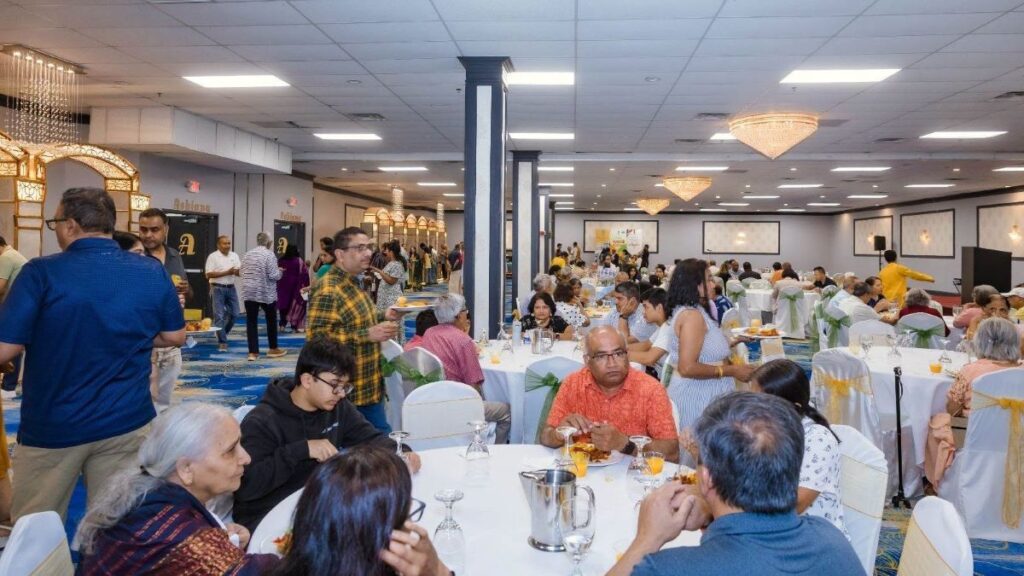
The festival itself reflected that spirit.
The Fruit That Gives Everything
The mango’s remarkable versatility has helped secure its place at the heart of Indian cuisine. Raw mangoes become tangy pickles, chutneys, curries, dals, and the refreshing summer drink aam panna. Ripe fruit is transformed into aamras, shrikhand, juices, milkshakes, jams, desserts, and ice creams. During peak season, many families happily build entire meals around it.
Hon. Lakshmanan smiled as he recalled that during his childhood there were days when mangoes alone made up an entire meal.
Beyond the fruit itself, the mango tree continues to enrich everyday life. Its leaves decorate homes during weddings and festivals as symbols of prosperity and auspicious beginnings, its wood is used in traditional ceremonies, and even the seed kernel finds applications in food processing, cosmetics, and traditional medicine.
An old Hindi proverb captures that enduring usefulness perfectly: “Aam ke aam, guthliyon ke daam.” Every part of the mango has value.
A Fruit That Connects Continents
As the celebrations drew to a close at Global Mall and later at Suvidha International Market, visitors lingered over one final taste, reluctant to let the afternoon end. They had come for mangoes, but left with something richer: stories of orchards and monsoons, of farmers and families, of childhood summers and distant homes.
For India’s farmers, the mango remains a source of livelihood passed from one generation to the next. For exporters, it is an opportunity to introduce the world to the country’s extraordinary agricultural heritage. For millions of Indians living overseas, however, it represents something even more enduring—a taste that bridges continents and quietly reconnects them with home.
That was the deeper significance of Mango Mania Atlanta 2026. The two Consulate-led celebrations did more than showcase exceptional fruit. They celebrated India’s biodiversity, honored the hands that cultivate its orchards, encouraged cultural exchange, and reminded the diaspora that even thousands of miles from home, familiar traditions continue to flourish.
More than five thousand years after the first mango trees took root on the Indian subcontinent, the fruit continues to carry India’s history, craftsmanship, and traditions across oceans. And perhaps that is its greatest gift. Long after the sweetness has faded, the mango leaves behind something far more enduring—a reminder that home is sometimes rediscovered in the simplest of tastes.
