




NRI PULSE STAFF REPORT
WASHINGTON, D.C., September 4, 2026— Nearly 90 elected officials and political candidates across the United States have signed a pledge to reject campaign contributions linked to the Rashtriya Swayamsevak Sangh (RSS) and its affiliates, a move supporters describe as an effort to limit the influence of the Indian organization in American politics and critics say could unfairly subject Hindu-American donors to scrutiny.
The “Nonviolence Pledge,” announced Aug. 31 by Hindus for Human Rights Action and the South Asian American Coalition to Renew Democracy, or SACRED Acts, includes elected officials and candidates at the federal, state and local levels across eight states. Organizers describe the initiative as nonpartisan and say its signatories include members of both the Democratic and Republican parties.
Among the most prominent names on the list are U.S. Reps. Ro Khanna of California, Pramila Jayapal of Washington and Robin Kelly of Illinois. Other signatories include Michigan U.S. Senate candidate Abdul El-Sayed and Brad Lander, the Democratic nominee for New York’s 10th Congressional District.
The list released by the organizers contained 90 names as of Aug. 28, although the groups described the number in their announcement as “nearly 100.” It includes current officeholders as well as candidates and former candidates.
Under the pledge, signatories make three commitments: reject political violence and intimidation; refuse donations linked to the RSS and its affiliates; and return or redirect such contributions to organizations the organizers describe as supporting democracy.
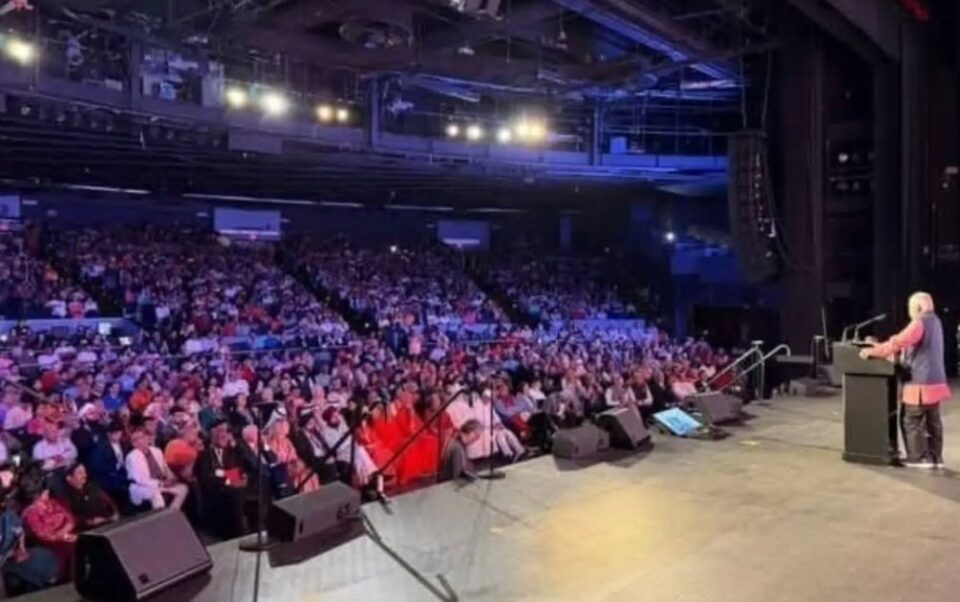
The initiative was announced as RSS chief Mohan Bhagwat visited the United States and Canada. Bhagwat addressed the “Universal Oneness Celebration” at Madison Square Garden in New York on Aug. 29, an event organized by American Hindus for Engagement and Dialogue and attended by thousands. His appearance also drew protests and opposition from several civil rights and interfaith groups.
The RSS, founded in India in 1925, is a Hindu nationalist volunteer organization and is widely regarded as the ideological parent of India’s ruling Bharatiya Janata Party. Its supporters describe it as a cultural and service organization dedicated to Hindu society and Indian national identity, while critics accuse it of promoting a Hindu majoritarian ideology that marginalizes religious minorities.
Organizers of the U.S. pledge contend that RSS-affiliated individuals and organizations have developed networks in the United States capable of influencing American political campaigns.
Hindus for Human Rights Action and SACRED Acts said the pledge was intended to prevent that influence from translating into political power through campaign contributions.
“We must reject right-wing organizations that seek to destabilize and undermine democracy — whether it’s the far-right movement in the U.S. or the R.S.S. in India,” Jayapal said in a statement released by the organizers. She pledged not to accept RSS-affiliated money and encouraged other politicians to do the same.
Khanna went a step further, announcing that he would give away a $6,600 campaign contribution that he said he had recently discovered came from a “pro-MAGA billionaire with ties to the R.S.S.”
Khanna said he signed the pledge because he does not want the RSS to create a political action committee or influence American elections.
But the initiative has prompted objections from some Hindu-American organizations, which argue that the term “RSS-linked” is broad and could result in individual American donors being judged according to their religious, cultural or organizational associations.
The Hindu American Political Action Committee, a registered federal PAC that describes itself as independent and nonpartisan, called the pledge discriminatory and said it could amount to imposing a “loyalty test” on Hindu Americans. The organization has urged Hindu Americans to continue participating in the political process and to report instances in which their campaign contributions are rejected because of alleged RSS affiliations.
Suhag Shukla, executive director of the Hindu American Foundation, has also criticized the initiative, arguing that it could result in Hindu-American campaign contributors being investigated for presumed connections to a foreign organization.
Shukla described such scrutiny as “un-American,” arguing that Hindu-American citizens should not be presumed to have divided loyalties because of their associations.
The organizers, however, reject the suggestion that the initiative targets Hindu Americans as a religious community. Hindus for Human Rights Action itself identifies as a Hindu organization and says it seeks to challenge Hindu nationalism while promoting democracy, pluralism and human rights.
“For far too long, R.S.S.-affiliated organizations and individuals have represented themselves as the only advocates for Hindu Americans in US politics,” Ria Chakrabarty, executive director of Hindus for Human Rights Action, said in announcing the pledge. She described the signatories as part of a multifaith and multiracial coalition opposed to religious majoritarianism.
SACRED Acts Executive Director Pushkar Sharma said individuals tied to the RSS have contributed at least $2.5 million to political campaigns in Illinois over the past decade across both major parties. The organization says those contributions demonstrate why greater scrutiny of RSS-related political influence is warranted.
The current dispute also raises a broader question about what constitutes an “RSS-linked” contribution.
The pledge states that signatories will refuse donations linked to the RSS and its affiliates, but the public announcement does not spell out a uniform standard campaigns would use to determine when an individual American donor should be considered sufficiently connected to the RSS for a contribution to be rejected.
The controversy comes amid growing political engagement by Indian Americans, including as candidates, campaign donors and advocacy organizations representing differing positions on U.S.-India relations and Indian domestic politics.
