




BY VEENA RAO
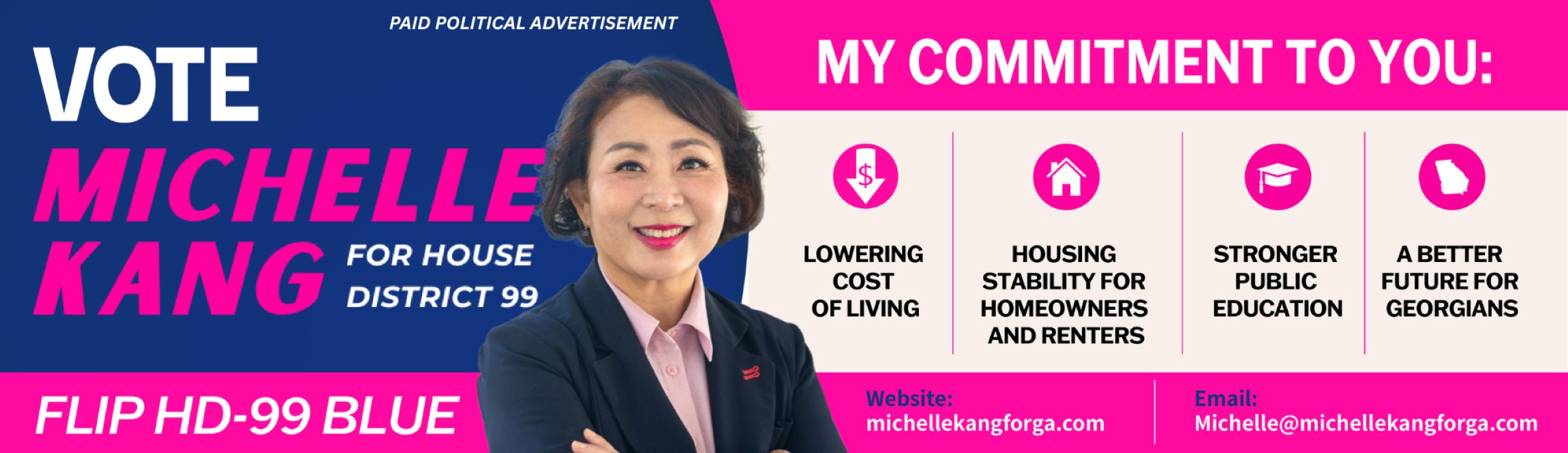
In 2024, Michelle Kang came within 621 votes of winning Georgia House District 99. Now, the Korean American Democrat is making another bid for the seat, hoping to turn a narrow defeat into a victory.
A first-generation immigrant who moved to Georgia in 1992, Kang is a former small-business owner, mother of three and longtime community advocate. Her campaign focuses on the rising cost of living, housing affordability, public education, healthcare and immigration enforcement.
In this interview with NRI Pulse, Kang discusses why she is running again, her proposal to limit rent increases by large corporate landlords, her opposition to Georgia’s immigration enforcement policies and what she believes lawmakers should do about rising anti-Asian and anti-immigrant hate.
Here are excerpts from the interview, edited for length and clarity.
You came within 621 votes of winning this seat in 2024. What made you decide to run again, and what did you learn from that race?
I decided to run again because I believe we need to change who has the power to set the agenda in Georgia.
Republicans have controlled the governor’s office and held majorities in both chambers of the General Assembly for more than two decades. During that time, Democratic legislators have introduced and fought for policies like Medicaid expansion, raising Georgia’s minimum wage, investing in public education, and strengthening gun safety. But when one party controls the leadership and the legislative agenda, it also controls which issues receive a hearing, which bills come to the floor, and ultimately what gets a vote.
Georgia’s minimum wage is still $5.15 an hour under state law, although the federal minimum wage generally applies to covered workers.
Republicans currently hold majorities in both chambers. That is why I decided to run again. In 2024, we came within 621 votes of flipping HD99. This race is an opportunity to change the representation of our community and take one more step toward changing the balance of power in the State House.
I’m running because I want the issues families are discussing around their kitchen tables, affordable housing, childcare, healthcare, education, wages and public safety, to have a real voice in the State House.
Flipping HD99 is not the finish line. It is one important step toward building a State House majority that can actually bring these issues to the floor and give them the debate and votes they deserve.
What are you hearing most often from people in House District 99? What are they worried about right now?
The biggest concern I’m hearing from people across HD99 is the rising cost of everyday life.
Almost every voter I talk to tells me the same thing: they are struggling to keep up with their bills and put food on the table. Gas, insurance premiums, property taxes, healthcare, and childcare are all getting more expensive. Families with children are especially feeling the pressure of childcare costs, while renters are dealing with constant rent increases.
And the problem is that people’s incomes are not keeping up with the cost of living. Even families who are working full time and earning a decent income are finding it harder to get ahead.
That’s why affordability is at the center of my campaign. People aren’t asking for anything extravagant. They want to be able to pay their bills, buy groceries, afford childcare and healthcare, keep a roof over their heads, and give their children a good education without constantly worrying about how they’re going to make ends meet.
When I talk to voters in HD99, I hear a clear message: people are working hard, but they are falling behind. I’m running to make sure their voices are heard in the State House and to fight for policies that actually make life more affordable for working families.
You support a 3% annual cap on rent increases. How would that work, and what would you say to landlords concerned about rising property taxes, insurance and maintenance costs?
I want to be clear: my 3% annual rent cap is aimed at large corporate and institutional companies that own and control apartment communities, not small, mom-and-pop landlords.
When a corporation raises rent 8%, 10%, or 15% in one year, families are the ones who pay the price. Their wages don’t automatically go up by the same amount.
I understand that property taxes, insurance, and maintenance costs can increase. That’s why I support a transparent exception process for documented extraordinary costs.
The goal isn’t to punish responsible landlords. It’s to prevent large corporate owners from using their market power to impose unpredictable rent increases. Families deserve to know that their rent won’t suddenly become unaffordable the next year.
You say healthcare is a human right. What specific changes would you push for to make healthcare more affordable and accessible in Georgia?
I support expanding Medicaid so more working Georgians can have reliable health coverage.
Medicaid expansion means expanding eligibility for Medicaid so more low-income working adults can qualify for health coverage.
In Georgia, specifically, it would generally mean:
- Covering more uninsured adults, especially people whose income is too high for traditional Medicaid but too low to afford private insurance.
- Reducing out-of-pocket costs for people who otherwise delay doctor visits, prescriptions, or preventive care because of cost.
- Helping rural hospitals and clinics by giving them more insured patients and reducing uncompensated care.
- Improving access to preventive care, so health problems can be treated earlier instead of becoming expensive emergencies.
- Providing more continuous coverage for working adults whose income fluctuates.
Georgia currently has limited Medicaid expansion through Georgia Pathways, which covers certain adults up to 100% of the federal poverty level who meet qualifying activity requirements. Full Medicaid expansion under the Affordable Care Act would cover adults up to 138% of the federal poverty level, without the work/activity requirement.
You want to end cooperation between local law enforcement and ICE. What would you like to see change?
We saw Georgia State Patrol participate in the Hyundai-LG raid on September 4, 2025, providing support to federal immigration authorities. That is exactly why I believe we need to change Georgia law.
Our state and local law enforcement resources should be focused on protecting our communities and responding to crime, not carrying out federal immigration enforcement. As a legislator, I will work to repeal HB 1105 and end this use of Georgia resources for federal immigration operations.
There is already legislation in the 2026 session, including HB 1053, that proposes repealing Georgia laws requiring local law enforcement involvement in federal immigration enforcement. As a legislator, I will push for HB 1053 to be enacted.
Georgia has been debating school funding, teacher pay, school safety and preparing students for an AI-driven economy. What do you think needs the most urgent attention?
The most urgent priority is making sure every public school has the teachers, support staff, and resources students need to succeed.
I strongly oppose school vouchers because they are not equitable. Public dollars should strengthen the public schools that serve all Georgia students, not create a system where families with more resources have more choices while other students are left behind.
I want to point to several specific state-level funding mechanisms:
- Use a portion of the state surplus for one-time investments in school facilities, safety, technology, and classroom resources.
- Increase the Quality Basic Education (QBE) formula to provide more recurring funding for schools, especially for teacher compensation and student services.
- Target funding to high-need schools for counselors, special education, mental-health services, and support staff.
- Create dedicated grants for AI and digital literacy and career and technical education, so schools can prepare students for an AI-driven economy.
- Fully fund transportation, school safety, and other mandated costs instead of shifting those costs to local school districts.
- Use state funds to support teacher recruitment and retention, including higher salaries, housing assistance in high-cost areas, and paid student-teaching and residency programs.
As a former small-business owner, what challenges did you face, and what would you change to make it easier to run a business in Georgia?
As a former small-business owner, I know firsthand that running a business is not just about having a good idea. You have to worry about rent, payroll, insurance, healthcare, taxes, licensing, regulations, and finding enough customers to keep the doors open.
At the state level, I would work to simplify licensing and permitting, reduce unnecessary fees and paperwork, and create a true one-stop system so small-business owners don’t have to navigate multiple agencies just to open or expand a business.
I also want to expand access to affordable capital, especially for small businesses and entrepreneurs who don’t have large assets or established banking relationships. And we should strengthen state programs that provide technical assistance, mentorship, and workforce support.
We can fund these efforts without creating a huge new bureaucracy.
First, we can dedicate a portion of Georgia’s existing surplus to a revolving small-business loan fund. Instead of simply giving grants, the state can provide low-interest loans and loan guarantees, so the money can be recycled and help more businesses over time.
Second, we can strengthen existing programs through the Georgia Department of Economic Development and local development authorities rather than creating entirely new agencies. We can provide targeted grants for technical assistance, mentorship, workforce training, and help navigating licensing and permitting.
And simplifying licensing and creating a one-stop system is largely an administrative investment, not an expensive ongoing program. We can use existing state technology and agencies to make the process faster and less costly.
There’s growing concern about anti-Asian and anti-immigrant hate. As a Korean American immigrant, how does this affect you personally, and what should Georgia lawmakers be doing about it?
As a Korean American and immigrant, this issue is personal to me. But as a legislator, I want to focus on what Georgia can actually do.
First, I will strengthen Georgia’s hate-crime laws and make sure law enforcement consistently identifies, documents, and prosecutes crimes motivated by race, ethnicity, or national origin. Georgia already requires bias-crime reporting in certain circumstances, so we should strengthen enforcement and training.
Second, I will expand language access. State agencies and law enforcement should provide meaningful interpretation and translated information so immigrants can report crimes, access emergency services, and understand their rights.
Third, I will protect victims and witnesses. People should never be afraid to report a crime because of their immigration status. Local law enforcement should be able to investigate crimes and protect victims without turning routine interactions into immigration enforcement.
And finally, I will work to repeal policies that divert Georgia law-enforcement resources into federal immigration enforcement. HB 1105 requires Georgia law enforcement to work with federal immigration authorities and ties compliance to certain state funding.
Our state should use its resources to protect people from violence and hate, regardless of where they were born. That makes every Georgia community safer.
Finally, what would you say is the strongest reason voters should choose Michelle Kang?
I believe the strongest reason to support me is that I bring both lived experience and more than a decade of community leadership to this job.
I’m a first-generation Korean American immigrant who came to Georgia in 1992, raised three daughters here, ran a small business, earned my MPA from UGA at age 43 and spent years working directly with families and immigrant communities in Gwinnett. I’ve seen firsthand the challenges people are facing, from housing and childcare to healthcare, education, and the cost of living.
I’m not coming to the State House just to talk about these issues. I’m bringing the experience of someone who has been doing this work in our community for years, and I’m ready to turn that experience into policy.
My focus is simple: make Georgia more affordable, protect our communities, strengthen public schools, expand healthcare access, and make sure every family has a fair opportunity to succeed.
This is the year we must bring real change to address the challenges families are facing every day: basic living costs, housing, food security, and healthcare.
To turn that change into meaningful policies and laws, we need to build a Democratic majority in the Georgia State House. Flipping HD99 is an important step toward building that majority and giving these issues the attention and action they deserve.
I’m asking the voters of HD99 to support me so I can take your voices to the State House, fight for a better quality of life for our families, and work toward a better Georgia for all of us.
