



NRI PULSE STAFF REPORT
Atlanta, GA, September 30, 2026: This autumn, the Bengali Association of Greater Atlanta (www.BAGA.net) will welcome Durga Ma, her children, and Kali Ma in a new form—crafted thousands of miles away in Kolkata’s historic Kumartuli and brought to Atlanta through the collective vision, patience, generosity, and devotion of the BAGA community.
The new Durga and Kali idols mark an important moment for BAGA. After 14 years, the organization has commissioned new idols, not as off-the-shelf creations, but as carefully designed embodiments of the community’s shared aesthetic, spiritual connection, and respect for Bengali artistic tradition. When devotees gather for BAGA’s Durga Puja from October 16–18 and Kali Puja on November 7, they will see more than beautifully crafted idols. They will see the result of a journey across generations, continents, technologies, and a community united by faith and culture.
A Living Heritage in Kumartuli
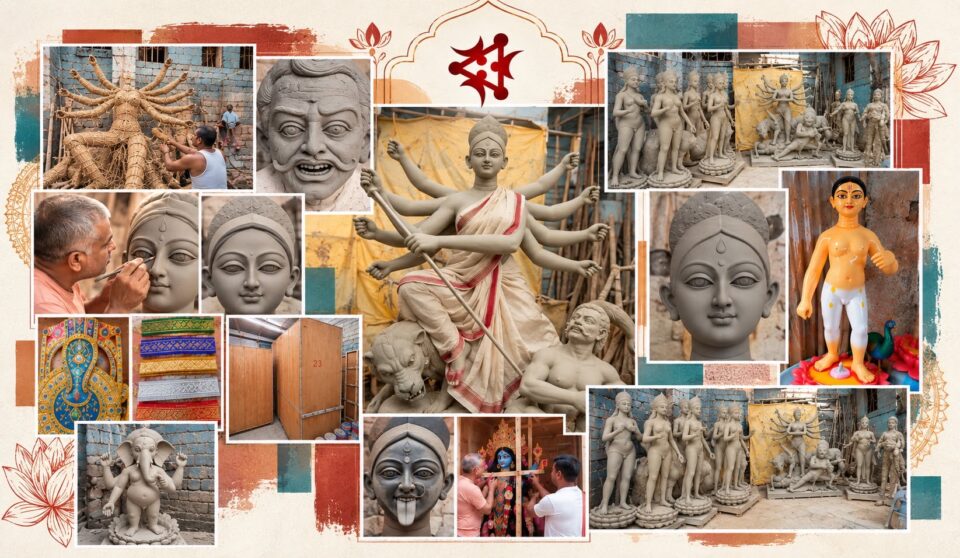
The story begins in Kumartuli, Kolkata’s celebrated potters’ quarter. For generations, this neighborhood has been one of the spiritual and artistic hearts of Bengal. Its narrow lanes, workshops, bamboo frames, clay figures, painted eyes, and rows of divine forms come alive every year in the months before Durga Puja.
Kumartuli is not simply a place where idols are made. It is a living tradition, sustained by families of artisans who have passed their craft from one generation to the next. Their work brings together devotion, sculpture, painting, artistry, ornamentation, and extraordinary attention to detail. From the first shaping of clay and straw to the final brushwork around the eyes, each idol carries a blend of artistic discipline and spiritual reverence.
In Kolkata and throughout India, Durga idols are traditionally made from clay and immersed in rivers or lakes after the festival, symbolizing the cycle of creation, return, and renewal. For Bengali communities overseas, however, the realities of distance, shipping, storage, and annual logistics have created a different practice. Idols sent to the United States, Europe, Japan, and other parts of the world are often made in durable fiberglass so they can be preserved and used for years.
That practical adaptation does not diminish the tradition. Instead, it shows how a centuries-old art form continues to travel, evolve, and remain meaningful wherever Bengalis build a community.
BAGA’s Search for the Right Vision
BAGA’s effort to bring new Durga and Kali idols to Atlanta began last year. A core evaluation team took on the demanding task of researching, interviewing, and assessing artists and idol makers. The work required more than simply selecting a vendor or choosing from a catalog.
The team wanted something distinctive: idols created according to BAGA’s own specifications and reflective of the community’s sense of beauty, tradition, and devotion. They did not want a standard, readily available model. They wanted to collaborate with an artist from a traditional family of idol makers—one whose work carried the craftsmanship and continuity of Kumartuli itself.
The planning involved many choices that may seem small individually but became deeply meaningful when considered together: the design of Durga Maa’s face, the shape and expression of the eyes, the colors and style of the sarees, the ornaments and jewelry, the backdrop, and the visual harmony of the entire tableau.
In a particularly inclusive step, BAGA members were invited into the process. Several face designs were shortlisted, and members had the opportunity to vote and help select the final design. That decision reflected an important BAGA value: the idols would not simply belong to a committee or a small group of organizers. They would belong to the community.
The final result is therefore the product of both artistic expertise in Kumartuli and the collective voice of Bengali families in Greater Atlanta.
Tradition Meets Technology
The making of the idols also tells a modern story. Not long ago, such a project would have required frequent travel, reliance on mailed photographs, delayed communications, and a great deal of trust placed in images sent across oceans. Today, technology has made collaboration more immediate while preserving the handmade character of the work.
WhatsApp messages, photographs, videos, and video calls allowed BAGA’s evaluation team to follow the idols’ progress closely from Atlanta. At times, conversations took place across challenging time zones, with the artist joining video calls from sourcing locations to show different choices of ornaments, jewelry, saree colors, decorative falls, and other materials.
The process also demonstrated how traditional artisans are adapting to a changing world. Many Kumartuli families are embracing digital tools, websites, English-language communication, and global relationships while continuing the craft their ancestors practiced for generations. This fusion of heritage and technology has enabled their work to reach Bengali communities far beyond Kolkata.
BAGA’s team also used emerging technology, including AI-assisted review, to refine measurements and dimensions related to the face, eyes, and smaller artistic details. Technology did not replace the artisan’s hand or vision. Rather, it became another tool that helped the community communicate its preferences with greater clarity and precision.
The process remained fundamentally human: an artist’s skill, a community’s devotion, patient dialogue across continents, and a shared determination to create something worthy of worship.
From Clay, Straw, and Fiberglass
The idols’ creation followed an intricate process rooted in the traditional techniques of Kumartuli. The initial form begins with clay and straw, which establish the shape and structure of the divine figures. A mould is then developed, and fiberglass is used to create the final durable shell and structure appropriate for international transport and long-term use.
After the structure is complete comes the painstaking finishing work: painting, facial expression, color, clothing, jewelry, ornaments, and the many details that transform a structure into a sacred and artistic presence.
For BAGA, every element was reviewed with care. The project became a dialogue between the artisans’ time-honored expertise and the Atlanta community’s particular vision. What emerged was not merely a product ordered from abroad, but an idol designed through collaboration.
A Voyage Across Continents
Once the idols were completed, another journey began—one involving far more than devotion and artistry. The idols had to be protected, packed, documented, shipped, transported, and delivered safely to Atlanta.
Custom boxes and careful packing were essential. Freight-forwarding arrangements required detailed coordination to ensure that the delicate idols could withstand a long overseas passage. The journey took them from Kolkata’s port, through Sri Lanka and around the Cape of Good Hope, onward to New York, and finally by land to Atlanta.
For the organizers, this was a second major phase of planning, filled with logistics, shipping timelines, freight discussions, and the natural uncertainty that comes with transporting treasured works of art across the world.
At every stage, the goal remained the same: to ensure that the goddesses, her children and Ma Kali arrived safely at their new home in Atlanta.
A Community’s Generosity
While the artists in Kumartuli worked and the logistics team arranged the idols’ passage across the oceans, BAGA members responded with generosity. A voluntary appeal for donations was made to the community, and members contributed willingly to make the project possible.
Their support was not only financial. It represented a shared belief that preserving cultural and spiritual traditions matters, especially for a community living far from Bengal. The new idols are therefore a tribute to the donors, volunteers, planners, families, and members who recognized that Durga Puja is more than an annual event. It is a bridge between generations and a way to pass heritage, values, art, and belonging to children growing up in America.
The kindness of BAGA’s members turned a vision into reality.
A New Chapter in Atlanta
Now, after a long journey from the workshops of Kumartuli to the homes and hearts of the Bengali community in Greater Atlanta, the new idols have arrived.
This Durga Puja, devotees will have the opportunity to see the new Durga idol during BAGA’s celebration from October 16 through October 18. The new Kali idol will be unveiled and worshipped during Kali Puja on November 7.
Their arrival is a reminder that tradition does not remain fixed in one place. It travels with people. It takes root in new communities. It is renewed by artists, sustained by volunteers, supported by donors, and enriched by the participation of every member.
From the clay and straw of Kumartuli to the fiberglass form prepared for a global journey; from centuries-old craftsmanship to WhatsApp calls and AI-assisted design review; from Kolkata’s artisans to Atlanta’s families—the new BAGA idols carry a story of devotion, resilience, collaboration, and cultural continuity.
They have crossed oceans. But for the BAGA community, they have come home.
