






BY ANISH AGARWAL, FOUNDER, YOURTRAINER*
South Asians tend to carry less muscle for their size, and muscle is where most of our blood sugar goes. Three short home sessions a week can change that.
Most South Asians I coach in the US start with the same plan: walk more, eat less rice. Walking is good. But the most useful thing many of us can do for our long-term health is something we were rarely taught growing up: lift weights.
Muscle is where your blood sugar goes
After a meal, your body has to put the glucose from that roti or rice somewhere. When insulin is at work, about 80% of glucose uptake happens in skeletal muscle. Muscle is the body’s biggest storage tank for blood sugar. The more of it you have, and the more you use it, the more room there is.
Large population data point the same way. In a US national survey analysis, every 10% increase in muscle relative to body weight was linked to 11% lower insulin resistance and 12% lower prevalence of pre-diabetes, even after adjusting for overall and belly fat.
Why this matters more for South Asians
We tend to carry less muscle for our size. A Canadian study comparing four ethnic groups found that at the same level of body fat, South Asian men and women had less lean mass than European, Chinese and Aboriginal participants, with South Asian men carrying about 3.6 kg and South Asian women about 3 kg less lean mass than their European counterparts. The authors described a pattern of high fat and low lean mass that may explain the higher insulin levels they saw in South Asians.
Strength tells a similar story. In UK Biobank data, grip strength in South Asian men and women was about 5 to 6 kg lower than in other ethnic groups, and low strength accounted for a disproportionately large share of diabetes cases among South Asians.
The practical message is not that our genes decide everything. Muscle is one of the few risk factors you can build with your own hands.
How much you actually need
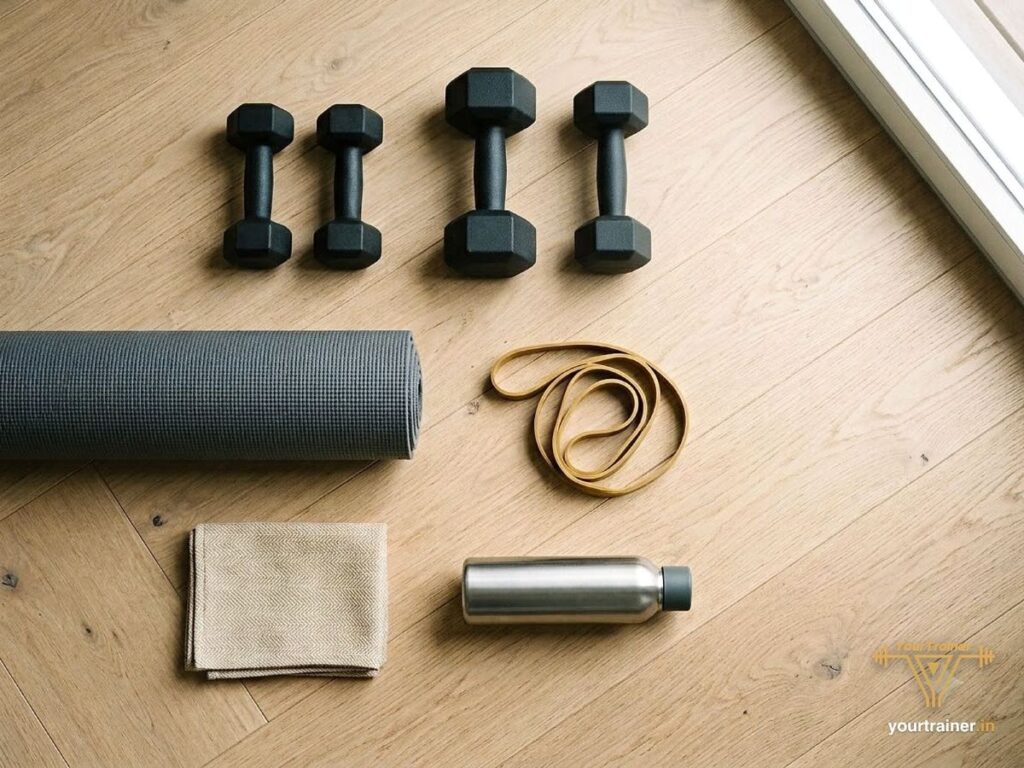
The CDC recommends that adults do muscle-strengthening activity on 2 days a week, working the legs, hips, back, abdomen, chest, shoulders and arms, alongside 150 minutes of moderate activity. The American Diabetes Association’s position statement on exercise lists body weight and resistance bands as valid forms of resistance exercise. No gym required.
A 20-minute home routine
Do this three times a week, for example Monday, Wednesday and Saturday. Two to three rounds:
Squats to a chair: 10 to 15 reps. Stand in front of a sturdy chair with your feet shoulder-width apart. Slowly lower yourself as though you’re going to sit down. Touch the seat, then stand up again. Hold a backpack full of books when it gets easy.
Push-ups: against a kitchen counter, then knees, then the floor. 8 to 12 reps. Stand facing a sturdy kitchen counter. Place your hands on its edge, slightly wider than your shoulders. Walk your feet back until your body forms a straight line. Bend your elbows to bring your chest toward the counter, then push yourself away.
Band or backpack rows: 10 to 15 reps. A band around a door handle works well. Put a few books in a backpack and hold it by its handle with both hands. Bend your knees slightly and lean forward from your hips, keeping your back straight. Pull the backpack toward your stomach, bringing your elbows back. Slowly lower it.
Glute bridges: 12 to 15 reps. Lie on your back on a mat with your knees bent and feet flat on the floor. Keep your arms beside you. Tighten your buttocks and slowly lift your hips until your shoulders, hips and knees form a straight line. Hold briefly, then lower your hips.
Split squats, holding a chair for balance: 8 to 10 reps each leg. Stand beside a sturdy chair and hold its back for balance. Step one foot forward and keep the other behind you. Bend both knees slightly, lowering your body straight down. Push through your front foot to stand back up. Keep your feet in the same position throughout.
Plank: 20 to 40 seconds. Lie face down on a mat. Raise yourself onto your forearms and toes, keeping your body in a straight line from head to heels. Tighten your stomach muscles and breathe normally. Avoid letting your hips sag.
Each week, add a rep or two, a heavier backpack or a stronger band. That steady increase is what builds muscle. If you have a heart condition, diabetes medication or joint pain, check the plan alongside your doctor first.
Fitting it into a US workweek
Schedules are hard. In a sample of our coaching questionnaires from outside India, 68% picked muscle building as a goal, as often as fat loss, and 42% said they had trained on and off over the years. Knowing what to do is rarely the problem. Keeping it going around work, family and travel is.
A few things that help:
- Book it like a meeting. Before the first call, or right after the kids’ bedtime.
- Use the gaps. In a trial in adults with type 2 diabetes, 3 minutes of half-squats, calf raises and knee raises every 30 minutes of sitting lowered blood sugar after meals. A few squats between Zoom calls is not nothing.
- Travel with a band. It weighs almost nothing and fits in a laptop bag.
- Eat protein at every meal. Dal plus curd, paneer, eggs, chicken or fish. Muscle needs building material.
Among clients training with us from abroad, travel or jet lag came up in 19% of coaching sessions and was the most common reason for a missed or late session. So plan a backup slot for the weeks you are on the road. More on how people abroad train is in our questionnaire study.
Start this week with two sessions. In a month, the chair squats will feel easy. That is the point to add load, and the point where the habit starts to stick.
Author bio:
*Anish Agarwal is a NASM-certified personal trainer and the founder of YourTrainer (yourtrainer.in), a Bengaluru coaching business that trains clients in India and Indian-origin people in the US, UK, Canada and the UAE over live video. He builds strength and nutrition plans around the Indian food his clients already eat.
