




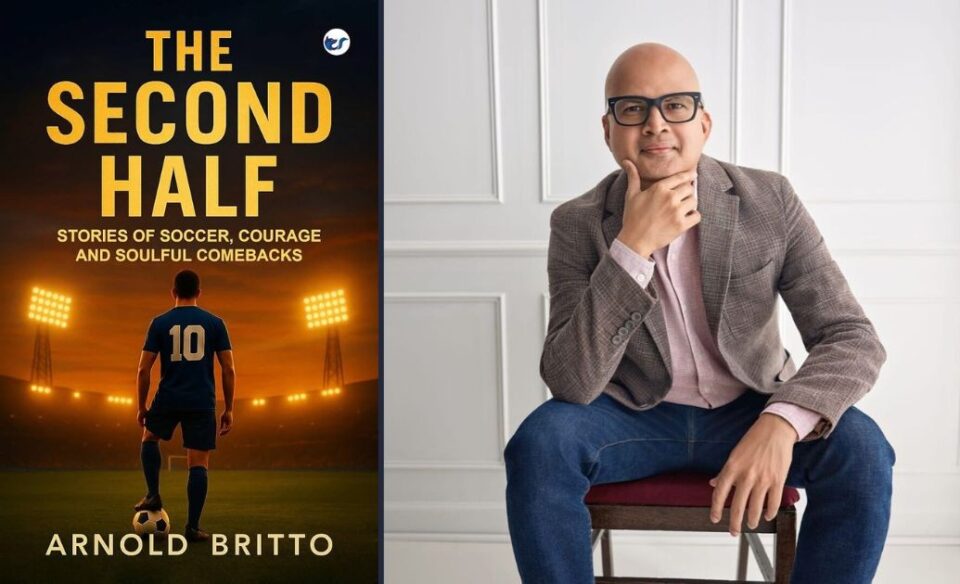
BY JYOTHSNA HEGDE
For many professionals, midlife does not arrive with a dramatic collapse. It comes more quietly, often in the middle of an otherwise successful life. The résumé is strong, the calendar is full and the milestones once imagined have largely been reached. Yet beneath the rhythm of meetings, promotions and responsibilities, another question begins to surface: I have built a successful career, but am I building a meaningful life?
That question lies at the heart of Arnold Britto’s The Second Half: Stories of Soccer, Courage, and Soulful Comebacks, a reflective book about reinvention, resilience and the search for purpose when familiar measures of success no longer feel complete. Through the language of soccer—opening whistles, red cards, missed passes, halftime pauses and unexpected comebacks—Britto explores what happens when achievement no longer offers the same sense of fulfillment it once did.
The book’s characters are not necessarily people whose lives have fallen apart. Many are accomplished professionals who have done nearly everything expected of them. They have worked, climbed, delivered and endured. Yet somewhere along the way, the joy beneath the movement has begun to fade. Their stories ask whether ambition can evolve without disappearing, whether success can make room for significance and whether a second half can be shaped not by regret, but by greater intention.
Arnold Britto is an Atlanta-based author, speaker and business leader with more than 27 years of experience in technology, partnerships and innovation. A former AWS Principal and the founder of Connected Growth, he writes about the intersection of professional achievement and personal transformation. His central belief is that individuals and organizations flourish through stronger connections—with themselves, with others and with a purpose larger than any title.
When the Scoreboard Is No Longer Enough
For decades, professional success was measured largely through titles, promotions, income, influence and financial milestones. Britto does not dismiss those accomplishments, but he believes many professionals are beginning to recognize their limits.
“Today, many accomplished professionals are pausing to ask a different question: ‘I’ve built a successful career, but am I building a meaningful life?’” he says.
The pandemic, layoffs, burnout and the rapid rise of artificial intelligence did not create that question, Britto believes. They simply made it more difficult to ignore. These disruptions exposed the fragility of titles, roles and carefully built career paths, while also prompting people to examine what remains when professional certainty disappears.
That may be why the idea of a “second half” is resonating so strongly, particularly with professionals in their 40s and 50s. After years spent building expertise, credibility and security, many are asking whether the life they created still reflects the person they have become.
Britto’s philosophy of Connected Growth is rooted in three relationships: connection with oneself, connection with others and connection with a purpose larger than a job title. When those relationships weaken, even visible success can feel strangely hollow. When they deepen, growth becomes more sustainable, human and fulfilling.
The second half, therefore, is not necessarily about leaving a career. It is about reconsidering the game one is playing and asking whether the old definition of winning still fits.
Career Uncertainty as Halftime
Career uncertainty can feel like the final whistle, especially when work has become closely tied to identity. A layoff, restructuring, health challenge or industry shift can leave even experienced professionals wondering whether their best years are behind them.
Britto offers a different interpretation.
“Career uncertainty can feel like the final whistle, but it’s often just halftime,” he says.
The instinctive response to disruption is often to ask, How do I get back to where I was? Britto believes a better question is, What am I being prepared for next?
He sees the first half of a career as a period of building capability and credibility. It is often defined by striving, proving and accumulating experience. The second half offers another task: converting that experience into purpose, impact and legacy.
Before chasing the next opportunity, Britto encourages professionals to reconnect with themselves, strengthen their relationships and consider the value they can create for others. Careers may pause or pivot, but purpose does not have to disappear with a title. When uncertainty is approached through connection rather than fear, it can become the beginning of reinvention rather than the end of success.
Reinvention Begins Within
Changing careers, Britto believes, is often easier than changing the story one carries about oneself.
“Many people change jobs but carry the same fears, habits, and definition of success into the next role,” he says. “That’s change, but it’s not reinvention.”
True reinvention is an inside-out journey. It requires people to redefine success, reconnect with what gives their lives meaning and use their experience in service of something larger than personal advancement.
A new position may represent movement, but transformation is measured differently. It is reflected in a deeper understanding of identity, in how one serves others and in the kind of legacy one begins to create.
This idea runs throughout The Second Half. Britto’s characters do not always change their lives through dramatic exits. Some rediscover creativity. Some repair neglected relationships. Some move from being star performers to becoming mentors. Others learn to slow down long enough to hear the questions that ambition had silenced.
Their lives change not because the outside world suddenly becomes easier, but because they begin to inhabit it differently.
A Second Conversation with the Self
Britto says he did not write The Second Half because he believes people simply need another chance.
“I wrote it because I believe people need a second conversation with themselves,” he says.
Over three decades in business, sports and life, he observed that the people who navigated change most successfully were not always the smartest or most talented. They were often those who remained connected to who they were, to the people around them and to a purpose greater than their immediate circumstances.
Modern culture tends to describe growth as acceleration—moving faster, climbing higher and accumulating more. Britto has come to believe that deeper growth may begin in the opposite direction: by slowing down enough to hear what constant motion has drowned out.
Connection, he says, gives people perspective, resilience and the courage to reinvent themselves. The book is therefore an invitation to rediscover those connections, not only because they can transform an individual life, but because they can also change the lives touched by that person’s leadership, choices and presence.
Why Soccer Became the Language of Life
Soccer provides Britto with a natural vocabulary for life’s uncertainty. A match is never shaped by talent alone. It turns on teamwork, trust, missed opportunities, resilience, leadership and the willingness to keep playing when the score is unfavorable.
What fascinates him most is halftime.
“Halftime doesn’t change the score, but it can change the story,” he says.
It creates a pause between what has happened and what remains possible. It allows players to breathe, reflect, reconnect and decide how they will return to the field.
Life offers similar halftimes after a setback, a promotion, a diagnosis, a loss or a career transition. These pauses can feel uncomfortable because they interrupt momentum, but they can also reveal what constant movement has concealed.
That is why soccer became the language of The Second Half. It is not ultimately a book about sport. It is about what sport teaches us about life: that no one plays alone, that missed chances do not end the match and that the meaning of the game lies not only in the score, but in the relationships, values and purpose that keep us showing up.
The Mistake of Trying to Recreate the Past
According to Britto, one of the greatest mistakes people make during midlife transitions is trying to recover their old lives.
They compare the future with who they once were and hold tightly to former identities, expectations and definitions of success. But midlife, he says, is not asking people to replay the first half. It is inviting them to play the second half differently.
Before people reinvent themselves, they must rediscover themselves. That begins with a deeper question: What is life trying to teach me?
Growth is not always about returning to what was familiar. It may involve reconnecting with values, relationships and purpose so that the future can be approached with greater wisdom.
“Sometimes the greatest comeback isn’t getting your old life back,” Britto says. “It’s discovering a better one you never imagined.”
From Competitive Advantage to Connected Advantage
Britto also connects the second-half conversation to a rapidly changing corporate world. For much of the past three decades, success was measured through revenue, promotions, market share and shareholder value. Those metrics still matter, he says, but they are no longer sufficient.
In an AI-driven world, technical knowledge is becoming increasingly accessible. What will distinguish leaders is their ability to build trust, inspire people, foster collaboration and create cultures where innovation and humanity can coexist.
Britto describes this as the shift from competitive advantage to connected advantage. Organizations that invest in relationships, purpose and human potential may ultimately outperform those that rely on technology alone.
The opportunity of the second half is therefore not only personal. It is organizational. It invites leaders to build not merely smarter workplaces, but more human ones—places where performance matters, but so do trust, dignity and belonging.
Resilience as Reconnection
Resilience is another central theme in Britto’s work, though he defines it differently from simple endurance.
“I see it as the ability to remain connected even amid chaos,” he says.
Setbacks can disconnect people from confidence. Loss can separate them from others. Uncertainty can obscure their sense of purpose. Those who thrive in their second half are not necessarily the people who never fall. They are the ones who find their way back to what matters most.
Resilience is not about returning unchanged to who one was before adversity. It is about allowing adversity to deepen wisdom, strengthen relationships and clarify purpose. The storm may alter the landscape, but it can also leave a person more compassionate, intentional and aware of how they want to play the rest of the game.
When the Player Changes
More than anything, Britto hopes readers finish the book believing their best chapters do not have to be behind them.
People often assume their stories are written by circumstances—the job that ended, the loss that arrived or the opportunity that did not. Britto believes the story is shaped just as powerfully by the choices made afterward.
If The Second Half helps readers pause long enough to reconnect with themselves, invest more deeply in the people they love and live with greater purpose, he believes it has fulfilled its role.
“Success isn’t measured by how impressive our first half was,” he says. “It’s measured by how intentionally we choose to play the second.”
For those standing at their own halftime, his advice is simple: reconnect before you reinvent. Reconnect with who you are, with the people who matter and with a purpose larger than fear.
“Halftime was never meant to change the score,” Britto says. “It was meant to change the player. And when the player changes, the rest of the game can change too.”
That may be the lasting message of The Second Half: reinvention is not an erasure of the life already lived. It is the art of carrying the lessons of the first half into a second one played with greater awareness—where achievement is joined by connection, resilience by compassion and success by significance.
