





BY NAMITA D. SUDAN
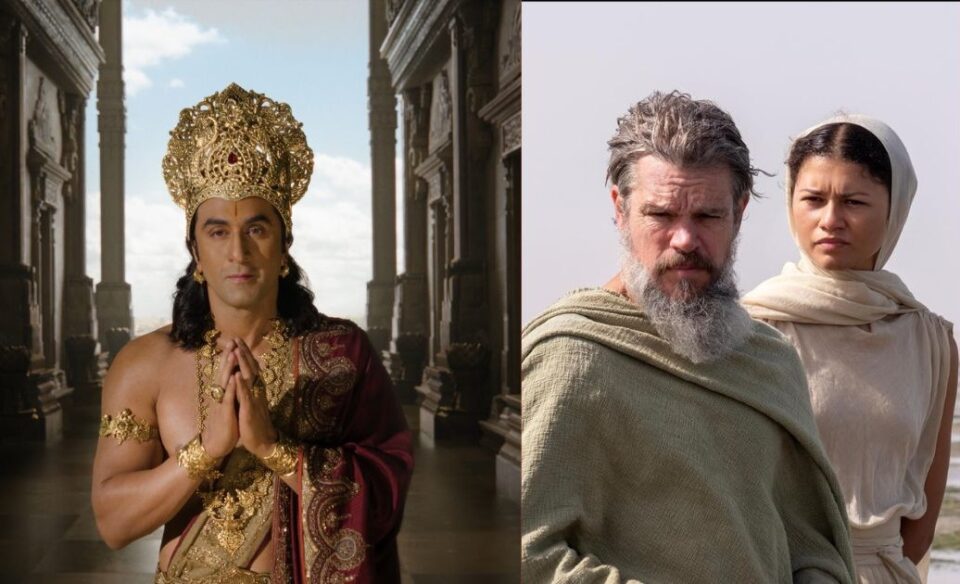
A comparative look at Christopher Nolan’s authentic Greek epic The Odyssey and Nitesh Tiwari’s high-budget Indian spectacle Ramayana reveals a deeper storytelling dilemma.
The global film industry is witnessing a fascinating clash between two approaches to bringing ancient epics to the screen. On one side, Christopher Nolan has set the internet abuzz with his adaptation of Homer’s The Odyssey, bringing a 3,000-year-old Greek epic to life. On the other hand, Indian cinema has unveiled the official trailer for Nitesh Tiwari’s magnum opus Ramayana, a multi-part saga reported to have a budget of around ₹4,000 crore.
The comparison between these two ambitious projects has reignited a familiar debate among critics and audiences: Why does Indian cinema, despite having thousands of years of rich mythology, vast natural landscapes, and enormous budgets, often struggle to match the emotional depth and visual authenticity of Hollywood’s biggest epics?
The Battle of Spectacle: Realism vs. Visual Effects
Christopher Nolan’s approach to The Odyssey reflects a deep commitment to physical scale and practical realism. The film was shot on location across six countries—Greece, Morocco, Italy, Iceland, Scotland, and the United States—using specially built 70mm IMAX cameras. Its physical film reel runs roughly 11 miles long and weighs around 630 pounds (about 286 kg), an astonishing feat of old-school filmmaking in the digital age. Nolan’s insistence on real seas, ancient Mediterranean landscapes, and practical effects earned him a personal note of appreciation from Greek Prime Minister Kyriakos Mitsotakis, who thanked the director for showcasing Greek culture and filming a significant portion of the movie on Greek soil.
In contrast, Indian cinema’s recent grand adaptations, including the newly released Ramayana trailer, lean heavily on visual effects (VFX) and green-screen environments. Tiwari’s production does bring serious firepower, including Oscar-winning VFX studio DNEG and a musical collaboration between A.R. Rahman and Hans Zimmer. Yet early audience reactions reflect persistent skepticism. Many viewers ask why a country blessed with breathtaking forests, rivers, and mountains so often defaults to digital backdrops that can strip a story of its organic warmth.
Film analysts argue that when a story lacks a strong narrative vision, filmmakers tend to overcompensate with digital spectacle. Hollywood, by contrast, often builds immersive worlds anchored in real psychological depth, while Indian mythological films can sometimes treat the material more as reverent spectacle than as human-driven drama.
The point is underlined closer to home by Bollywood’s own recent superhit, Dhurandhar. Part of why the film connected so strongly with audiences was its physical set: a six-acre recreation of Karachi’s Lyari constructed from scratch in Thailand rather than conjured on a green screen. Hollywood, too, uses VFX extensively, including in Marvel films, but the implementation is grounded in realism, built to serve the story rather than announce itself.
That raises an uncomfortable question for Indian filmmakers: DNEG, the same Oscar-winning VFX house that has delivered acclaimed work for Hollywood, has also worked on Ramayana, yet audiences still weren’t convinced. That’s a question the industry—and its makers—need to sit with.
India’s soft power deserves to be taken far more seriously than it currently is, and there’s a ready blueprint nearby: South Korea has turned K-dramas, K-pop, and Korean skincare into global cultural exports through sheer consistency and authenticity. Indian cinema has the raw material to do the same with its mythology; it just needs to trust the story over the spectacle.
Star Power vs. Character Immersion
Another point of friction lies in casting. Ramayana boasts a star-studded lineup: KGF’s Yash as Ravana, Ranbir Kapoor as Lord Ram, and Sai Pallavi as Sita. The film’s launch was strategically timed for 4:15 a.m. during the auspicious Brahma Muhurat on the first day of Sawan, honoring tradition.
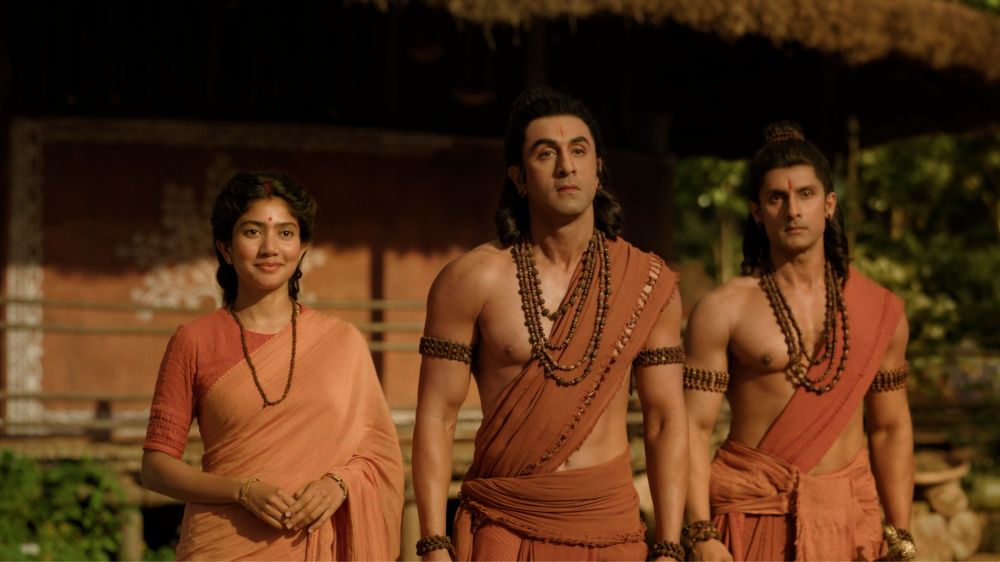
However, critics note that stardom can be a double-edged sword in mythological roles. While Yash’s fierce portrayal of Ravana has drawn early approval, Ranbir Kapoor’s casting faces closer scrutiny, as audiences struggle to separate his modern celebrity persona from the serene, divine quality expected of Lord Ram. Every visual detail, from hairstyling to facial expressions, is being dissected against decades of audience expectations shaped by Ramanand Sagar’s classic 1987 television series.
Hollywood, notably, faces the same challenge but handles it differently. The Odyssey is stacked with A-list stars—Matt Damon, Tom Holland, Anne Hathaway, Zendaya, Robert Pattinson, Charlize Theron, and Lupita Nyong’o, among others—yet Nolan largely manages to make audiences see the characters first and the celebrities second.
In India, the opposite tends to happen: star power is appeased rather than absorbed into the role. For example, South Indian stars whose established screen personas rarely dissolve into their characters are often presented the way fans expect to see them rather than the way the story demands. It’s understandable that a country as diverse as India faces real challenges in mounting a truly pan-India mythological epic, where every region’s expectations must be balanced. But that diversity is exactly why it’s high time Indian filmmakers trusted the shifting tastes of today’s audiences and took the leap toward character over persona.
Mythology as Psychology: The Storytelling Gap
The core distinction, as noted by film analysts, lies in how each industry frames its mythology. Hollywood tends to treat ancient stories and legends—from Thor to the tale of Achilles—as explorations of human psychology, moral conflict, and vulnerability. Odysseus isn’t simply a king; he’s a symbol of one man’s desperate longing to return home.
Indian epics carry equally rich, if not deeper, psychological material: Karna’s tragedy, Bhishma’s moral burden, and Krishna’s complex diplomacy in the Mahabharata. Yet modern Bollywood adaptations often reduce these layered character studies to black-and-white spectacle or surface-level grandeur, falling short of building the kind of connected, resonant cinematic universe that franchises like Marvel or The Lord of the Rings achieved.
Looking Ahead
As Ramayana prepares for its grand Diwali release in IMAX 2D and 3D, the film stands at a critical juncture. It has the technical backing, financial muscle, and legendary source material to redefine Indian world-building. Whether it can move beyond CGI-heavy spectacle to deliver genuine emotional depth remains the multi-million-dollar question for Indian cinema.
