



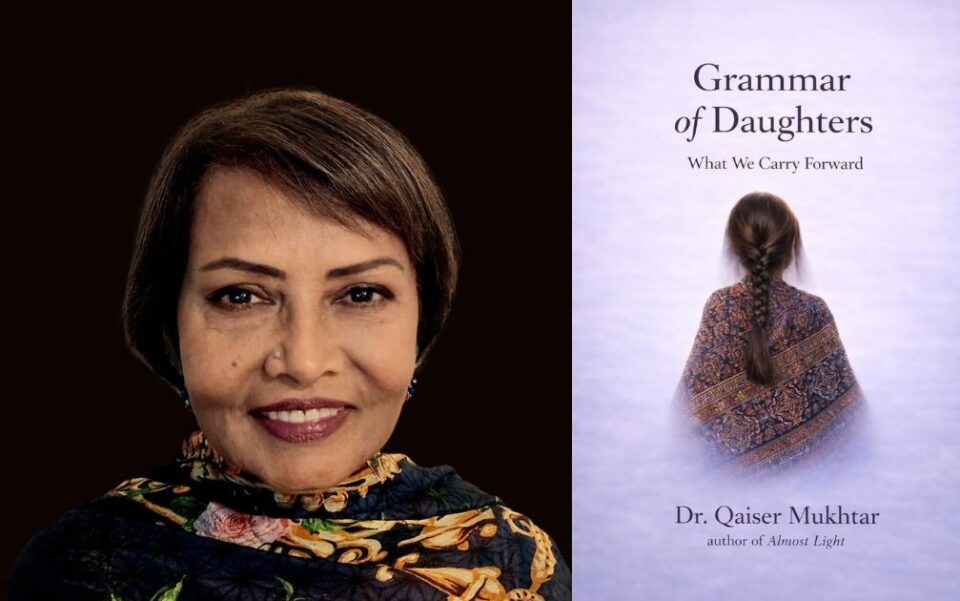
BY DR. QAISER MUKHTAR
(From the book Grammar of Daughters)
A mother’s love, shaped by what she lost, struggles to find its way through what she gives.
Every time I became pregnant, hope lifted again—not mine, everyone else’s.
No one said it outright, but it showed—in pauses, in careful smiles, in extra prayers.
This time, a son.
And each time it ended the same way. Another daughter. Wrapped. Placed beside me. Admired. Blessed.
I finally asked the dai, my midwife, for herbs to space the births.
They never worked.
No one blamed me aloud. My husband is devoted to his family. A good provider. He loves his daughters.
The word “Second wife” stays unspoken—not by him, not by his parents.
Still, I kept count.
Each time there was another daughter, I blamed myself.
Did I eat the wrong things?
Had I angered Allah without knowing?
Had I hurt someone who now prayed against me?
Or was I simply born unlucky?
I was born around the time of Partition in India, in a well-off family with business and social standing.
A decade later, we crossed into Pakistan empty-handed and found ourselves poor. Stability became urgent.
When I was a little girl, we lived in a large haveli where multiple generations kept their own household. It stretched across nearly an entire block, with streets running through it.
I used to watch my aunt in India. A car came for her every morning. Shiny. Clean. She stepped into it wearing a crisp uniform, books heavy in her lap. I stood at the gate and imagined that one day it would be me. One day the car would stop for me. It never did.
The first car that came for me was the one that took me as a bride.
I did not carry schoolbooks. I did not finish lessons. My parents moved me from my father’s house to my husband’s before I learned to belong to myself.
At fifteen, before I knew what it meant to be a woman, I became a mother.
Now my daughters carry schoolbags. They study English. They speak of college as if it were ordinary. They have access to the education I never touched.
Sometimes I watched them leave with their schoolbags and felt something rise in my throat—not pride, something sharper. I swallowed it.
I bring girls into the world one after another—warm, needy, alive. I feed them. Wash them. Sit through their fevers.
And yet, I braid their hair too tightly. I correct their posture, their tone, their timing.
I correct more than I comfort.
Love is there.
It comes out wrong.
Their father and grandparents love them easily. I see it. But something inside me stays tight.
Not against them.
Against the road that closed before I could walk it. I want their road open, even when mine had narrowed too soon.
When they laugh loudly, I hush them. When they dawdle, I hurry them. When they answer back, I cut them short.
It comes out faster than I intend.
Other mothers married young too—girls from the same lanes, the same age when we crossed thresholds. Some found a softness I could not.
They stroke hair without pulling it. They praise easily. They tell their daughters they are pretty.
Not me.
Some days I hear myself and do not like the voice. I learned duty early.
My hands learned correction before comfort.
I wanted time. A little more childhood. A life where I was asked what I wanted.
Eventually, I learned to accept my kismat. I softened with the younger ones. I let my words land lighter.
But I could not always reach the older daughters.
Even now, when I try tenderness, their bodies remember the first sharpness.
They pull back before they know they are moving.
I am still learning how to reach them.
Author Bio: Dr. Qaiser Mukhtar is the author of Almost Light and Grammar of Daughters. Born and raised in Karachi, she was shaped by courtyards, classrooms, and the quiet endurance of women whose lives taught more than words. She built a career as an epidemiologist at the Centers for Disease Control and Prevention before turning to writing. Her work explores memory, inheritance, and the inner lives that statistics cannot hold.
She lives in Atlanta with her husband. Her books are available on Amazon: https://www.amazon.com/stores/Qaiser-Mukhtar/author/B0GC3C47SP/
