





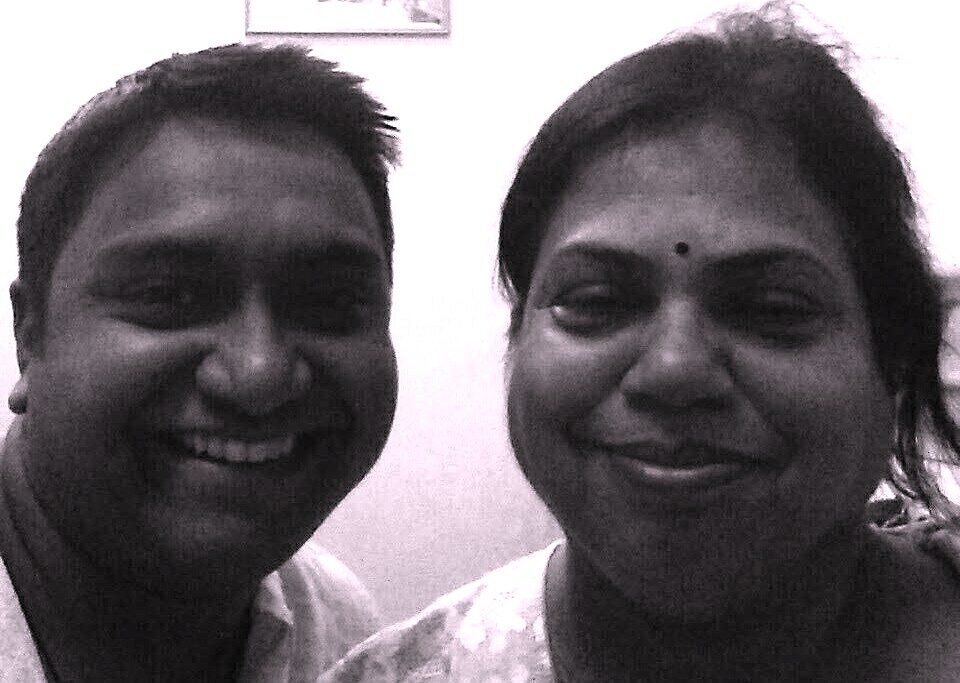
My mother called me almost every day. Now I understand what she was really asking.
This morning, I charged my mother’s phone.
She has been gone for almost two months — May 31 will make it two — and I don’t know what I expected to find. I charged it anyway, and waited, and watched it come back to life in my hand.
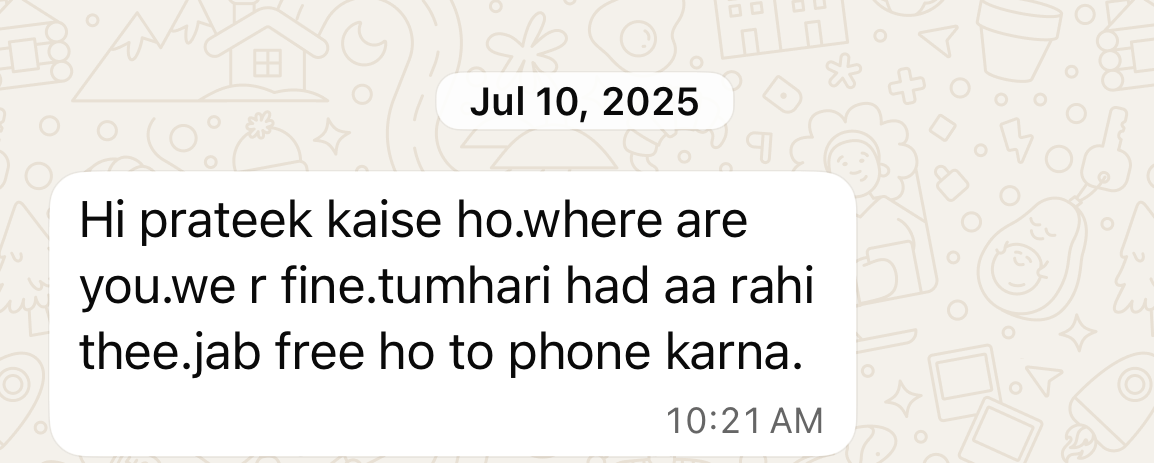
The first thing the screen showed me was a message from last July:
“Hi Prateek, kaise ho. Where are you. We r fine. Tumhari yaad aa rahi thee. Jab free ho to phone karna.”
I sat in my chair, here in Houston, and didn’t move for twenty minutes.
I kept scrolling. There were hundreds like it. Good morning beta. Hi beta, missing you badly — neend nahi aa rahi. A forwarded video about why curd is a superfood. A missed video call with nothing attached at all. Once, three messages in a single afternoon, an hour apart: Are you free. Or you have call. — as though she needed permission to want me.
She never did make peace with the time difference; she wrote to me whenever she wanted to hear from me, which was always, which was every single day.
I wasn’t looking for a pattern. I found one anyway — one line, surfacing over and over across an entire year:
Jab free ho to phone karna.
Call when you’re free.
My mother’s name was Kalpna. I only ever called her maa.
She was simple-hearted and startlingly funny, so innocent she was almost naïve, and the kindest person I have ever known. I know I’m biased. Ask anyone who knew her — they’ll tell you the same thing, and they won’t be.
She was, above everything, a scholar. A PhD in Economics — Dr. Kalpna, University of Allahabad — who set her own ambitions down to raise my brother and me, and taught math at an Egyptian school in Muscat after she married. She was not street-smart. But she was the most learned person in any room she walked into. She would recite the periodic table for fun. She’d run mental arithmetic before the rest of us could reach for a calculator. At fifty-five, just home from cancer, she sat the IELTS exam — and passed it well.
She was the connecting glue in a household of men.
And she poured herself into our lives without reservation — from homework that meant nothing to Math Olympiads and Board exams that meant everything. Whenever I doubted I could do a hard thing, she had one line, and I must have heard it two hundred and sixty times:
“Beta, remember — W = F × D.”
Work equals force times distance. Effort by itself, she’d say, isn’t work. Push as hard as you like; if nothing moves, you’ve done nothing. Real work is force with direction — force that actually carries you somewhere.
She used physics to teach me how to live. I nodded along to it for most of my life without truly understanding her. I think I finally do.
She called me almost every single day from the day I left India in 2015.
While I was a student, we spoke constantly. When I started working, when I got married, it eased to four times a week. Then three. This past year, twice — a quick video call mid-week, caught somewhere in transit, and a long, unhurried one every Saturday.
But she called every day. And every day I didn’t answer, the missed calls quietly stacked up.
One Tuesday, I was in Michigan, in a hotel conference room, building the last slides for a 10:30 client steering committee. At 10:09, my phone lit up. Maa. I turned it face-down. I’ll call her back after the meeting. The meeting ran two hours. By the time I was free, it was the middle of the night for her, and she was asleep. The next morning, the same thing. I finally reached her that Saturday — a full week later.
That Tuesday, I did not have the thirty seconds it would have taken to type back what I’d typed so many times before: Sorry. In office call.
When I did pick up, she’d tease me — “Arey, aaj meeting nahi hai kya?” (I told you she was funny.) She was a talker: bottom-up, unstructured, determined to walk me through every branch of a family update I was certain I didn’t care about. A recipe I had to try that weekend. A request to see Veda, my daughter, for just a minute. The calls had no agenda. She never wanted anything.
I’m ashamed to write this, but on a crowded Wednesday, I would sometimes meet her call the way I met a client’s — what’s the agenda here; what does this need from me?
There was no agenda.
The lack of agenda was the love.
Mothers don’t call to discuss something. They call to hear you breathe.
When the calls grew too many, I got efficient about it. I’d ask my brother to cover. Sometimes my wife. As though she were a task I could delegate.
She was not a task. She only wanted to stay relevant in the life of the son she had raised so hard — the son she had folded her own dreams away for. And he couldn’t find five minutes to call her back.
I always meant to call when I was free.
I was never free.
Now I have all the time in the world, and no one to call.
Now I wait for the call. I wait for the bulletins she used to deliver from Indian news channels — keeping watch over a country she had never lived in, only because I lived in it: “Prateek, be careful, there’s been a shooting in Austin.” I wait for “Beta, aaj Mittul ki birthday hai, wish him,” and “Navratre starts today — no non-veg.” I wait for the hardest bulletins too, the ones only she would think to send: “Binu mausi in hospital.” She didn’t only connect the three men under our roof. She was the wire that ran between me and an entire family I love and rarely call myself.
None of it comes anymore.
And I would give anything — anything — to see that number light up on WhatsApp one more time.
She came to see us four times over the years — three of them here, to Houston, the long way from Muscat. Each time, she folded herself into an economy seat for that brutal sixteen-hour journey, her knee aching the whole way after the surgery. And each time, I wanted to book her business class. And each time, she refused before I could even finish offering: “Beta, business class mat book karna — bahut mehenga hai. Zaroorat nahi. Paisa waste mat karo.” Five thousand dollars instead of one. And honestly? I let her talk me out of it. I could never quite justify the upgrade. There was always a next time to make it up to her.
I wanted, just once, to ignore her — to book the wide flatseat anyway, and watch her settle into it and pretend, for all sixteen hours, to be annoyed with me.
There is no next time now.
My achievements feel hollow; my loudest cheerleader has left the stands. I can’t tell her about the promotion. I can’t tell her the new word Veda learned this week. I can’t tell her I finally made her recipe, and that it came out exactly right.
I can’t tell her I finally made her biryani — the one we begged her for every time we landed in Muscat or Houston, the one she’d learned watching Sanjeev Kapoor on TV. I made it last night, her way, and it came out right (well, almost).
I just can’t anymore.
I have come to understand something since she left.
The people who love us rarely ask for our attention outright. They send a good morning, beta. They forward a video about the health benefits of curd. They ask, twice, an hour apart, whether you’re free. These are not small talk. They are bids for connection — the quiet, deniable ways love says I’m here; are you? And we answer them with will call later, with Sorry, in office call, with a phone turned face-down on a conference table — until one day the bids stop coming, and we would give the whole world to be interrupted by just one of them again.
So here is what I want to say to every son and daughter living an ocean away from home:
You left to become someone — to build the life your parents pointed you toward. But somewhere on your phone, right now, there is an unread voice note, or a missed call, from someone who only wanted to hear you breathe. They want to know you’re okay. They want to tell you they’re okay too. They want maybe five minutes of your day — just enough to make their whole day.
Don’t wait for the weekend. Don’t wait for the meeting to end. Don’t wait.
Call them back.
That is the whole of it. And I am sorry it took me this long to learn.
You may still have time. You can still hold the wrinkled hand. You can still carry the glass of water. You can still book the seat she’ll tell you not to book.
I have brought my father to Houston to live with me now. I am not going to miss another call.
For a year, she ended her messages the same way. One line I scrolled past a hundred times without ever really reading it.
Jab free ho to phone karna.
Call when you’re free.
I would give anything to return to that message from last July and answer it the way I always should have:
Haan, maa. Hamesha free hoon — aapke liye. Calling you now.
*Prateek Mathur is a Houston-based writer, son, and father. After losing his mother in March 2026, he started Eight Thousand Miles, a publication about the people who raise us, the distance between us, and what we owe them while we still can.
