





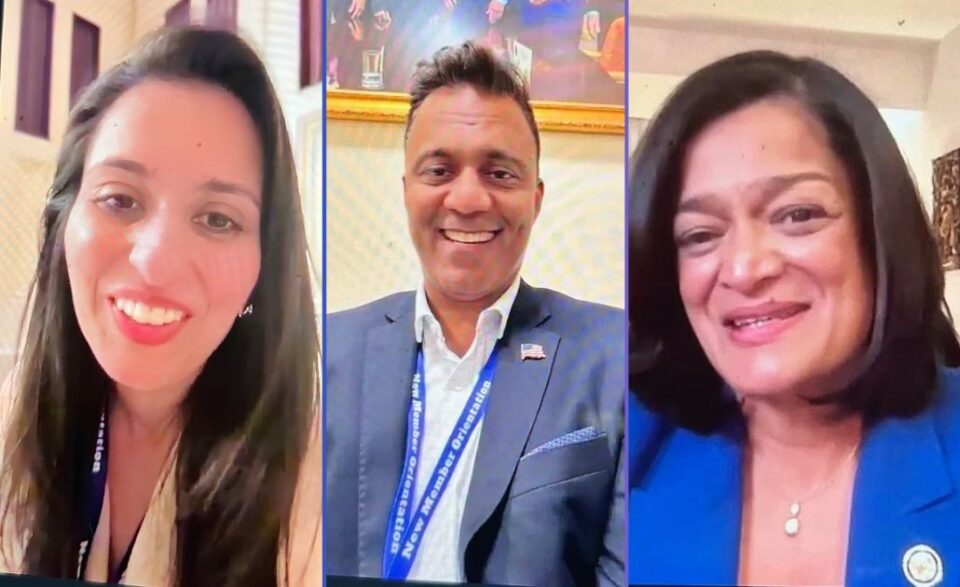
At Indian American Impact’s virtual Post-Election Power Hour, newly elected leaders outlined their priorities for Congress and state government.
BY VEENA RAO
Atlanta, GA, November 11, 2026: From overhauling immigration enforcement and addressing decades-long green card backlogs to lowering healthcare costs and finding common ground across party lines, prominent Indian American Democratic leaders laid out their priorities for the next Congress during a virtual post-election town hall on Tuesday evening.
U.S. Rep. Pramila Jayapal, who is set to chair the House immigration subcommittee, promised aggressive oversight of the Trump administration’s immigration policies and reforms to legal immigration pathways, including the H-1B visa system. Newly elected Florida Congresswoman Pia Dandiya emphasized the need for Democrats to deliver practical results on affordability, healthcare and Social Security while reaching across political divisions. Arizona Congressman-Elect Amish Shah, a practicing emergency physician, called for universal healthcare coverage, lower insurance premiums and renewed investment in medical research.
The November 10 “Post-Election Power Hour,” organized by Indian American Impact, also featured Michigan House Speaker-Elect Ranjeev Puri, who discussed his plans to advance gun violence prevention, reproductive rights and other legislative priorities following Democrats’ sweeping victories in the state.
The session brought together community members from across the country, who submitted questions through the Zoom chat window. Sarah Shah, Senior Director of Strategic Communications and Partnerships at Indian American Impact, moderated the question-and-answer session.
Opening the discussion, Indian American Impact Executive Director Chintan Patel said the organization had endorsed 57 candidates in the November elections, of whom 47 had won, one was headed to a runoff, and three were in races still too close to call as of Tuesday.
The speakers celebrated the growing political influence of Indian and South Asian Americans but emphasized that their electoral successes came with a responsibility to deliver meaningful policy changes.
“I think that voters did vote against Trump. There’s no question about that. They also gave Democrats a shot,” Jayapal said, summing up a recurring theme of the evening.
Jayapal, who is expected to become the first naturalized U.S. citizen to chair the House immigration subcommittee, said the Democratic victories had created an opportunity to fundamentally change immigration enforcement and address longstanding problems in the legal immigration system.
She outlined plans to require judicial warrants for certain Immigration and Customs Enforcement actions, restrict masked immigration agents, strengthen accountability mechanisms and restore protections for sensitive locations.
She also called for reducing funding for ICE and Customs and Border Protection and phasing out for-profit immigration detention centers.
“Immigration is a civil system, not a criminal system,” she said.
For Indian professionals caught in lengthy employment-based green card backlogs, Jayapal’s comments on legal immigration pathways were particularly significant.
“I think I’m the only member of Congress that’s been on an H-1B,” she said, emphasizing her personal understanding of the visa system.
Jayapal called for reforms that would prevent immigrants from waiting decades for work visas, permanent residency or family reunification. She also advocated expanding legal pathways for Dreamers, essential workers, spouses and parents of U.S. citizens.
She said she had been surprised during a visit to an immigration detention center in Tacoma, Washington, to learn that India ranked third among countries of origin of detainees at the facility, behind two Latin American countries.
Jayapal also condemned the recent disruption of a Diwali celebration in Seattle by far-right activists who shouted racist slurs. She said the incident illustrated the rising hostility faced by Indian and South Asian Americans.
Referring to the Democrats’ expanded congressional majority, Jayapal said the party would have greater power to conduct oversight hearings and challenge the Trump administration’s immigration policies.
She cautioned, however, that the election results did not necessarily amount to an unconditional endorsement of Democrats.
Voters had rejected Republicans and given Democrats an opportunity, she said, but the party now needed to demonstrate that it could lower costs, improve people’s lives and deliver on its promises.
“It’s not the end of the fight. It’s step one,” she said, urging community members to remain politically engaged.
Florida Congresswoman-Elect Pia Dandiya, joining the call from Capitol Hill during orientation for newly elected House members, echoed that emphasis on delivering results.
Dandiya, who flipped Florida’s 22nd Congressional District, described her constituency as politically competitive and said her campaign had succeeded by focusing on issues that resonated with voters across party lines.
Born and raised in Palm Beach County to parents from Jaipur, Dandiya began her career as a teacher and later served as principal of a high-poverty high school in Harlem, where she said every student went on to college. She subsequently worked at the White House and Apple before returning to Florida with her husband and son.
Dandiya said her campaign had swung the district 14 percentage points toward Democrats, despite changes to district boundaries.
“Our unofficial mantra has become ‘Make Common Sense Great Again,'” she said.
She identified lowering the cost of living, protecting healthcare and Social Security, and addressing corruption in Washington as priorities that could unite Democratic and Republican voters.
Asked whether a Democratic-controlled Congress could effectively check President Trump, Dandiya acknowledged the challenges but said the political dynamics in Washington had changed significantly after the election.
She argued that Republican lawmakers concerned about their political futures beyond 2028 might be more willing to work across party lines.
Dandiya said Democrats would need to be organized and strategic to move legislation through Congress and secure the president’s signature, but expressed optimism that the new majority would have greater bargaining power.
Dandiya also delivered one of the evening’s most memorable messages when asked what advice she would give young South Asian Americans considering careers in public service.
“Ask for permission from no one. Wait for no one to choose you and choose yourself,” she said.
She challenged media descriptions of her as a successful Democratic Party recruit.
“I am not a recruit. I recruited myself,” she said.
Dandiya encouraged young people to pursue their ambitions without waiting for political parties or established leaders to recognize their potential.
Arizona Congressman-Elect Amish Shah, who defeated Republican Jay Feely in a closely watched congressional race, joined the discussion from House Democratic leader Hakeem Jeffries’ office during congressional orientation.
Shah, an emergency physician who has practiced medicine for approximately 25 years and previously served in the Arizona legislature, said healthcare reform would be his central priority in Congress.
“Healthcare is kind of broken. Lots of people are not covered. The costs are too high,” he said.
Even Americans with health insurance, Shah noted, frequently face administrative hurdles, treatment delays and insurance denials.
Shah said he supports universal healthcare but believes the debate should focus on ensuring affordable coverage for everyone rather than becoming divided over competing healthcare models.
He identified a public health insurance option as a practical first step toward reducing premiums and expanding access.
“I believe in universal healthcare,” he said, adding that the goal should be a system in which everyone is covered and can afford the care they need.
Shah, who holds a master’s degree in public health from the University of California, Berkeley, said both single-payer and multipayer systems had advantages and disadvantages. Rather than allowing disagreements over the structure of healthcare reform to stall progress, he urged lawmakers to focus on measurable improvements for patients.
A significant reduction in insurance premiums, he said, would be a meaningful achievement for American families.
Shah also criticized Health and Human Services Secretary Robert F. Kennedy Jr.’s approach to scientific research, saying funding cuts and other policy decisions had damaged institutions that made the United States a global leader in medical innovation.
He specifically cited cancer and Alzheimer’s research as areas affected by the administration’s policies.
“It’s gonna take years to repair the damage that these guys have done,” he said.
He also shared the family story behind his decision to enter public service, recalling how an act of generosity in Mumbai decades ago helped his mother come to the United States for her education.
His mother raised him to believe in paying that kindness forward, he said.
Shah expressed hope that the Indian American congressional delegation, popularly known as the “Samosa Caucus,” would continue growing. He credited established Indian American lawmakers, including Suhas Subramanyam and Raja Krishnamoorthi, for mentoring him and said he wanted to offer similar support to future candidates.
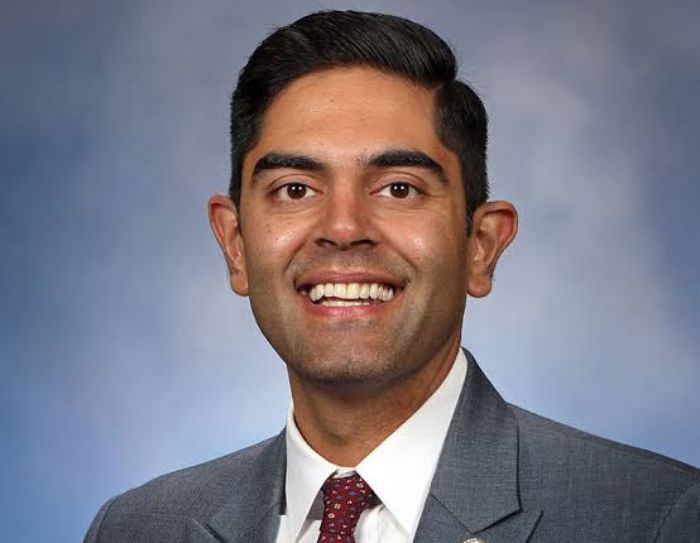
Michigan House Speaker-Elect Ranjeev Puri, who is set to become the state’s first Indian American and Sikh American House speaker, offered one of the evening’s most personal accounts of how discrimination and violence shaped his entry into politics.
The son of immigrants from Punjab, Puri said his parents arrived in the United States in the early 1970s and helped establish the first Sikh gurdwara in Wisconsin.
That same gurdwara in Oak Creek became the scene of a deadly white supremacist attack in August 2012, when six worshippers were killed.
Puri, who was working on President Barack Obama’s reelection campaign at the time, said the tragedy exposed the limited political influence and visibility of the Sikh American community.
“What stuck out to me was the fact that the story didn’t receive a lot of national attention,” he said, recalling his frustration that the attack quickly faded from national headlines.
Puri said a subsequent conversation with Obama, who encouraged him to run for office, helped set him on the path to public service.
He later completed his MBA and entered Michigan politics, winning election to the state House in 2020.
Now serving his third term, Puri said Michigan Democrats had flipped 11 Republican-held House seats in the November elections, their largest such gain since 1964, according to his account.
The victories, he said, would give Democrats a 63-member majority in the 110-seat chamber, compared with the narrow 56-54 majority they previously held.
With Democrats also controlling the governorship and state Senate, Puri said Michigan would have an opportunity to pursue more ambitious legislation on gun violence prevention, reproductive rights, clean energy and voting access.
“We’re gonna be able to be a lot more bold and aggressive,” he said.
Asked how he handled racism and attacks on his identity during campaigns, Puri said he had never tried to hide his Sikh background or conform to conventional expectations of what an American politician should look like.
“If someone’s not gonna vote for you because of your identity or the way you pray or the way your name sounds or where your parents are from, there’s really not much you could do,” he said.
Instead, Puri said he focused on demonstrating that his work benefited all Michigan residents, not just Indian or Sikh Americans.
Puri also shared a lighter moment from the election aftermath, recalling how critics alarmed by the election of Muslim and Sikh leaders in Michigan had begun warning about what they called “Samosa Law.”
“I think it was meant to be an insult, but I thought it was funny,” he said.
Puri said the South Asian American community was increasingly developing its own political identity, while recognizing that its members did not necessarily share the same political views.
“We don’t necessarily all need to agree or think the same on everything, but we do need to be a force for good,” he said.
Earlier in the session, Chintan Patel credited Impact’s volunteers, donors and partner organizations, including the AAPI Victory Fund, South Asians for America, They See Blue, Georgia’s Asian American Advocacy Fund and grassroots organizations in North Carolina and Texas, for helping mobilize voters.
He said Impact had concentrated its efforts in Georgia, Texas, North Carolina and Michigan, organizing canvassing drives, phone banks, text campaigns and community events.
The organization also held listening sessions in Norcross, Georgia, and Austin, Texas, in response to rising incidents of anti-Indian and anti-South Asian hate. Additional sessions are planned, including one in Virginia in December.
Patel cited a September survey commissioned by Impact that found 60% of South Asian voters planned to support Democratic congressional candidates, while 16% remained undecided. Notably, one-quarter of respondents who voted for Donald Trump in 2024 said they intended to support Democratic congressional candidates in 2026.
He also highlighted several historic victories, including Nithya Raman’s election as Los Angeles’ first Indian American mayor, Puri’s rise to the speakership in Michigan, and Jyot Singh’s election to the Georgia House of Representatives.
For the newly elected officials, the evening offered an opportunity to recognize the growing network of South Asian American political leaders who had helped pave the way for their campaigns.
Jayapal recalled becoming the first South Asian American woman elected to the U.S. House and said she had always hoped others would follow.
“I’ve always said that I was happy to be the first, but I definitely did not want to be the last,” she said.
With two new Indian American members joining Congress and South Asian Americans assuming leadership positions in state legislatures, the discussion reflected a community moving beyond the pursuit of political representation toward exercising greater influence over national and state policy.
But as the speakers repeatedly emphasized, the real test would be whether that growing political influence translated into results for the people who elected them.
