





NRI PULSE STAFF REPORT
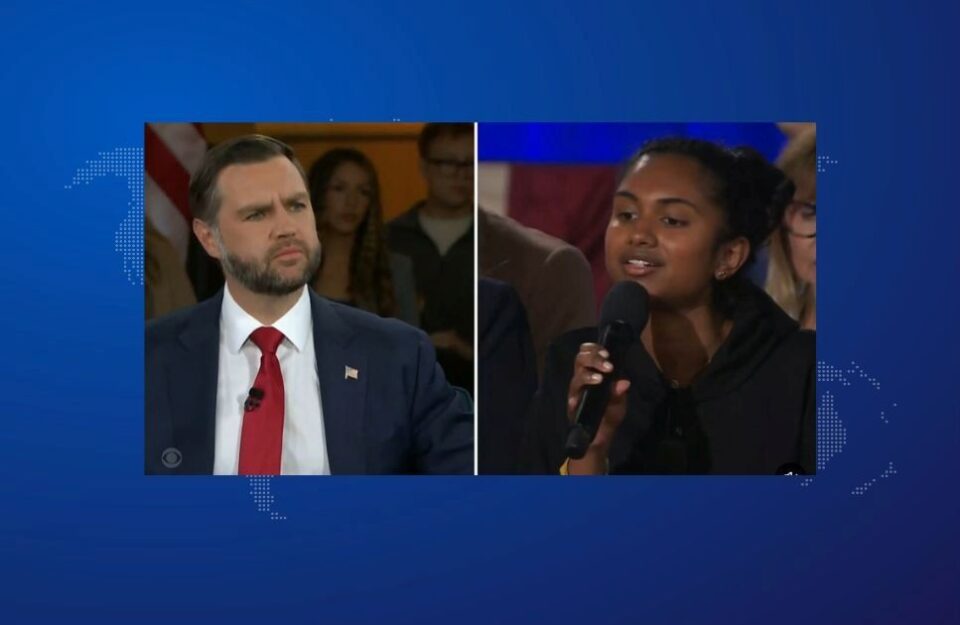
Michigan, October 18, 2026: Vice President JD Vance acknowledged that his rhetoric about H-1B visa holders may have been imperfect after an immigrant woman who voted for him in the 2024 presidential election confronted him over his description of foreign workers as “indentured servants” and accused the Trump administration of scapegoating immigrants.
The exchange took place during a CBS News town hall aired Saturday, October 17, in Michigan, where Vance faced questions from voters about immigration enforcement, the economy and other issues ahead of the November 3 midterm elections. The program, Things That Matter: A Town Hall With Vice President JD Vance, was moderated by CBS Evening News anchor Tony Dokoupil.
The woman, identified as Niv Agaram, told Vance that she had arrived in the United States approximately 20 years ago and become an American citizen five years earlier. She said Vance and President Donald Trump had received her first vote in a U.S. presidential election.
“One reason, because of the reasons you just mentioned, I was concerned about border safety, as in the trafficking and the drugs, not because I think immigrants actually take away jobs from Americans,” she said.
But Agaram told the vice president that her views had changed after witnessing the administration’s immigration enforcement tactics and hearing his recent comments about H-1B workers.
“After seeing ICE behave like military police, and you recently call H-1 visa workers foreign indentured servants, I think Americans are anything but safe,” she said.
“So I’m just curious, why are you scapegoating immigrants for the issues you’re supposed to be solving as a vice president?”
Vance thanked her for the question and acknowledged that his choice of words may have contributed to the criticism.
“To the extent that my rhetoric has been imperfect here, that’s on me,” he said.
He insisted that his criticism was directed not at H-1B visa holders themselves but at employers who use the program to replace American workers while exercising disproportionate control over foreign employees.
“When I say an indentured servant, that’s not a criticism of the H-1B visa holder,” Vance said. “That’s a criticism of a company” that brings in a foreign worker and knows the employee’s ability to remain in the United States is tied to the job.
Vance argued that such arrangements leave foreign workers vulnerable to exploitation because losing their jobs can also jeopardize their immigration status.
“I think that gives employers way too much power,” he said.
The vice president also invoked his own family’s immigrant background, referring to his wife, Usha Vance, and her parents, who immigrated from South India.
“I love my mother-in-law and father-in-law, who immigrated from South India, and obviously, their daughter, born in the United States of America, is now the second lady,” he said.
Vance maintained that the United States could welcome immigrants who contribute to the country while ensuring that employers do not displace American workers.
Dokoupil interrupted to point out that the audience’s concern went beyond immigration policy itself.
“They’re not talking about the system or the policy. They’re talking about the rhetoric, the language, what they see is dehumanization of immigrants,” the moderator said.
Vance responded that he did not intend to dehumanize immigrants.
“Nobody’s perfect, certainly not me,” he said. “But my goal here is not to dehumanize any immigrant.”
He went on to argue that immigration must be managed at a pace that preserves what he described as social cohesion and a shared sense of community.
“When too many people come to the United States too quickly, it changes the country in very profound ways,” Vance said.
He described Americans who no longer knew neighbors who spoke their language, arguing that citizens should be able to live in communities where they have things in common with those around them.
“I don’t think it’s unreasonable for an American citizen to want to share their community with people they have something in common with,” he said.
Vance said the immigration system should balance compassion for newcomers with the interests of existing citizens and avoid changing the country too rapidly.
The confrontation came just nine days after Vance announced a crackdown on alleged abuses of the H-1B visa and employment-based green card systems.
At an October 8 news conference, Vance accused Microsoft of laying off approximately 6,000 American workers while benefiting from thousands of H-1B petitions and green card applications. He described foreign employees caught in such arrangements as “foreign indentured servants.”
The administration subsequently suspended Microsoft, Adobe and six major IT services companies, including Indian technology firms Infosys, Tata Consultancy Services, Wipro and HCL, from the federal Permanent Labor Certification Program, commonly known as PERM. The program is an important step in obtaining employment-based green cards. The suspension does not itself revoke existing H-1B visas.
Microsoft disputed Vance’s characterization of its hiring practices. In an October 8 statement, the company said approximately 80% of its 6,000 H-1B filings during the previous fiscal year involved extensions or status changes for existing employees, rather than new hires.
The company also said it paid H-1B employees the same as other workers performing comparable jobs.
Microsoft President Brad Smith subsequently criticized the administration’s restrictions, warning that limiting access to skilled foreign workers could weaken America’s technological competitiveness and encourage international talent to seek opportunities elsewhere.
The H-1B program allows American employers to hire foreign professionals in specialized occupations, particularly in technology, engineering and other skilled fields. Indian nationals account for the largest share of H-1B beneficiaries, making changes to the program especially significant for Indian professionals and their families.
For many Indian workers, the stakes extend beyond employment. H-1B status is generally tied to a sponsoring employer, and workers who lose their jobs typically have a limited period to secure another qualifying position or make alternative immigration arrangements. Long employment-based green card backlogs can further complicate their ability to change jobs or plan their futures in the United States.
Agaram’s question highlighted a different dimension of the debate: the impact of political language on immigrants, including those who entered the country legally, became American citizens and supported the current administration.
Her exchange with Vance was among several contentious moments during the town hall. Sister Nancy Sylvester, a Catholic nun whose religious community works with immigrants, also questioned the vice president about the fear and trauma experienced by families affected by Immigration and Customs Enforcement operations.
The town hall came as immigration enforcement and the administration’s approach to legal immigration remain prominent issues ahead of the midterm elections.
For Agaram, the question was personal. Having supported Vance at the ballot box, she challenged him directly over whether the administration’s language and enforcement policies were making immigrants and American citizens feel less safe.
Vance acknowledged shortcomings in his rhetoric but defended the administration’s broader position that immigration must be balanced against American workers’ interests and the country’s social cohesion.
Niv Agaram immigrated to the U.S. with her family about 20 years ago. After becoming a U.S. citizen, she first voted for President Trump and Vice President JD Vance. She asked Vance about the administration’s immigration policies and his rhetoric surrounding immigrants. “I don’t think it’s unreasonable for an American citizen to want to share their community with people they have something in common with,” Vance said. “And I think our immigration system has to build that.
— CBS News (@CBSNews) October 18, 2026
