





BY RAMYA RAJU AND PRIYA SRINIVASAN*
During Men’s Health Month, we often talk about physical health. We talk about fitness, diet, medical check-ups, blood pressure, diabetes, and heart health. All of these matter deeply. But there is another part of men’s health that often sits quietly in the background: emotional health.
Many boys grow up hearing messages like, “Don’t cry,” “Be strong,” “Control yourself,” “Don’t be sensitive,” or “Man up.” At first, these may sound like advice. But over time, many boys learn a deeper message: hide your pain, don’t show fear, don’t express sadness, and don’t ask for help unless things become unbearable.
Let us imagine a simple life scenario.
Rohan is a 38-year-old professional living away from his family. On the outside, he looks responsible and calm. He works hard, supports his family, pays bills, attends social gatherings, and says, “I’m fine” almost automatically. But inside, things are different. He feels tired. He gets irritated easily. He has trouble sleeping. Small comments affect him deeply, but he brushes them off. He misses home but does not say it. He feels pressure at work, but tells himself, “Others have it worse.” When his partner asks, “Are you okay?” he says, “Nothing, I’m just tired.”
One day, after a small disagreement at home, he reacts strongly. Everyone around him wonders, “Why did he overreact?” But maybe he was not overreacting. Maybe he was carrying emotions he was never taught to understand.
This is something we need to talk about more openly. Suppressing emotions does not erase them. It often teaches the mind and body to carry them silently. Over time, unprocessed emotions may return in other forms — anger, anxiety, numbness, emotional exhaustion, irritability, relationship strain, shutdown, or self-blame. Sometimes what looks like anger may actually be hurt. Sometimes silence may be sadness. Sometimes “I don’t care” may actually mean, “I don’t know how to say this without feeling weak.”
This is why emotional health is not a soft topic. It is a life topic. For many men, the problem is not that they do not feel. The problem is that they were not always given the language, permission, or safety to express what they feel. When emotions have been pushed down for years, even a small moment can feel too heavy.
Not all emotions need a lecture. Some just need a chair, a glass of water, and someone saying, “Okay… tell me what happened.” That one sentence can create more safety than a long speech.
Emotional validation does not mean agreeing with every behavior. It does not mean that staying angry, shouting, avoiding communication, or using hurtful words is acceptable. Validation simply means acknowledging the emotion behind the behavior. It can sound like:
- “I can see this affected you.”
- “That must have been difficult.”
- “You don’t have to handle this alone.”
- “What you feel makes sense.”
For someone who has spent years believing their emotions are “too much” or “not allowed,” such words can be deeply healing.
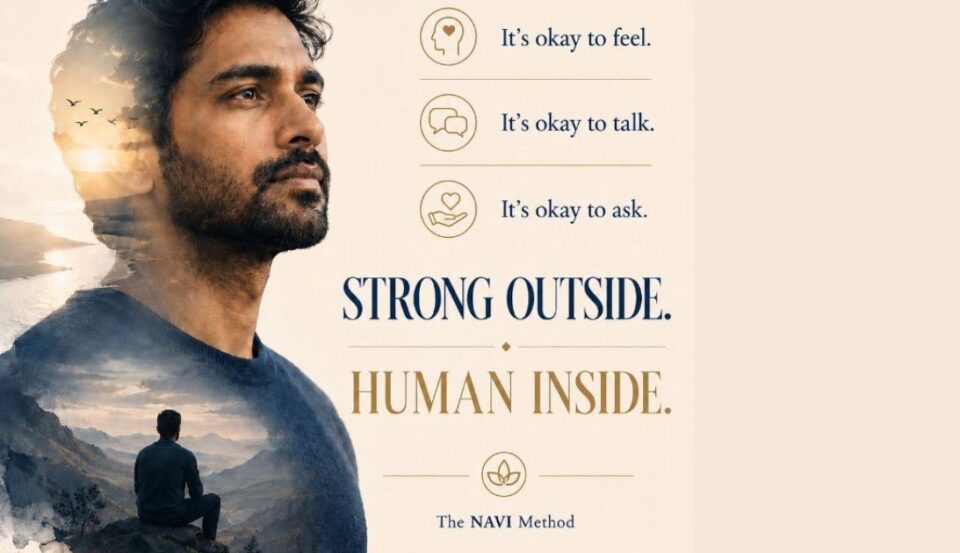
A simple way to remember emotional care is the NAVI Method. NAVI means learning to navigate emotions instead of ignoring them.

N — Notice
Notice what is happening inside you. Is it anger, sadness, fear, shame, stress, or hurt? Is your body tense? Is your sleep affected? Are you reacting more than usual?
A — Acknowledge
Acknowledge the emotion honestly. Naming an emotion is not a weakness. Saying “I feel hurt” or “I feel overwhelmed” gives the mind a clearer map.
V — Validate
Validate the feeling. This does not mean every reaction is right. It means the feeling deserves attention. You can say, “It makes sense that I feel this way.”
I — Intentionally Respond
Choose the next healthy step. Pause. Breathe. Talk to someone. Write it down. Set a boundary. Apologize if needed. Ask for support. Seek professional help when the distress feels too heavy.
The NAVI Method is simple, but it can be powerful because it helps a person move from suppression to awareness, and from reaction to response.
Many men are taught to solve problems quickly. But emotions are not always problems to be fixed immediately. Sometimes emotions are signals to be understood. A headache tells us something may need attention. A fever tells us the body is fighting something. In the same way, irritability, emotional numbness, sleep disturbance, sudden anger, or withdrawal may be emotional signals asking for care.
Men’s emotional health also affects families. When a father, husband, brother, son, or friend learns to express emotions in a healthier way, it changes the emotional environment around him. Children learn that crying is not shameful. Partners feel safer. Friendships become deeper. Families stop treating silence as strength and start understanding that healthy expression is strength too.
Asking for help does not make a man weak. A boy crying is not weak. A man saying “I am not okay” is not weak. Sometimes “I’m not okay” is not a breakdown. It is the beginning of healing. Therapy is not only for people who are “abnormal” or “unable to cope.” It can be a space to understand patterns, regulate emotions, process pain, improve relationships, and build healthier ways of responding to life.
During Men’s Health Month, let us expand the conversation. Let us talk about heart health, but also emotional heart health. Let us talk about strength, but not the kind that forces people to suffer silently.
Strong outside is good. Human inside is necessary.
*Author Bios
Priya Srinivasan is a public health consultant, researcher, Master Certified Life Coach, Certified QPR Suicide Prevention Gatekeeper Instructor, Doctor of Public Health candidate, and founder of Mindful Achievement of Goals for Individuals and Communities, LLC.
Ramya Raju is a counseling psychologist and child development specialist based in India, as well as a Certified Life Coach, Certified QPR Suicide Prevention Gatekeeper Instructor, and advisor and collaborator with the organization.
