





BY NAMITA DOGRA SUDAN*
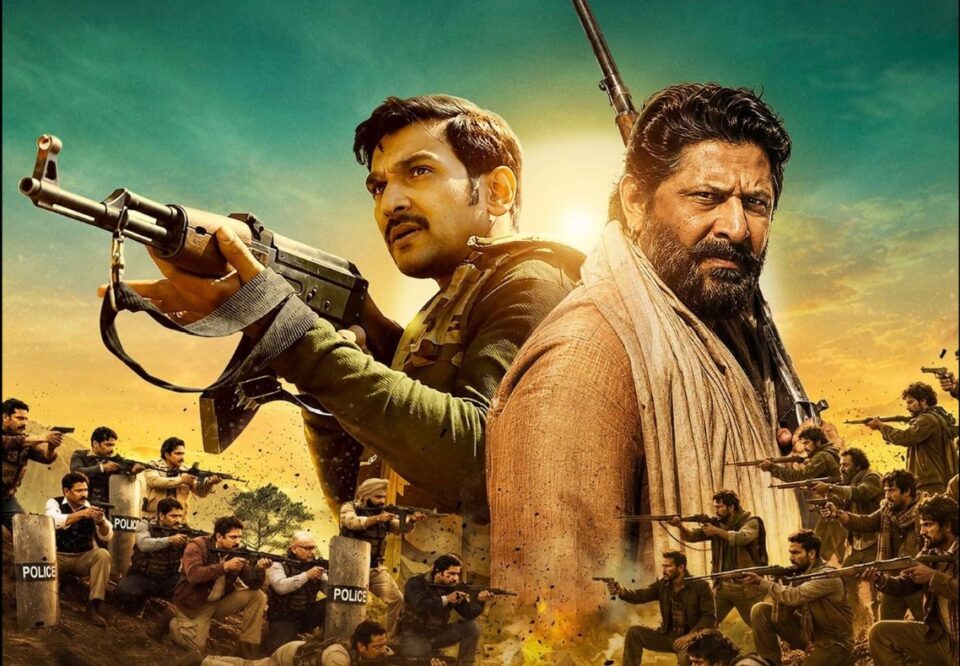
Tigmanshu Dhulia returns to the world of dacoits, crime and the Indian heartland with Ghamasaan, a gritty crime thriller starring Arshad Warsi and Pratik Gandhi. Streaming on ZEE5, the film takes viewers into the rugged world of Bundelkhand, where a feared dacoit has ruled through fear and influence for decades.
The film has all the ingredients of a classic Dhulia crime drama: strong performances, realistic locations, a local flavour and a morally complex world. But while Ghamasaan succeeds in creating the right atmosphere and delivers a satisfying climax, its editing and screenplay keep it from becoming one of the director’s strongest films.
The Story: A Cop vs. a Dacoit
The story revolves around Maharaj (Arshad Warsi), a feared dacoit who has built a powerful network across the region. His influence goes beyond the villages and reaches the political and police system. For years, the police have struggled to even get a clear picture of him.
The situation changes when IPS officer Aditya Singh (Pratik Gandhi) arrives in the region with a Special Task Force. He is initially sent to maintain law and order during the elections, but as he learns more about Maharaj and his hold over the area, the mission becomes much bigger.
What follows is a cat-and-mouse game between the officer and the dacoit, involving betrayal, politics, violence, power and survival.
The film is reportedly inspired by real events and a real dacoit, with some reports linking Maharaj to the notorious Bundelkhand dacoit Dadua. However, Ghamasaan is not presented as a direct biopic, and the story takes considerable cinematic liberties.
Arshad Warsi and Pratik Gandhi Lead the Show
The biggest strength of Ghamasaan is its casting.
Arshad Warsi steps far away from the comic roles audiences usually associate with him. As Maharaj, he is intimidating, unpredictable and brutal. His performance does not try to make the dacoit heroic or glamorous. Instead, Warsi makes him a frightening man who has survived by creating an atmosphere of fear around him.
Pratik Gandhi is equally effective as Aditya Singh. He does not play the typical larger-than-life police officer who solves everything with physical strength. His character is quieter and more intelligent, and Gandhi keeps the performance controlled and believable.
The supporting cast features reliable performances from Jatin Goswami, Deepraj Rana and Ishita Dutta, but it is Rajpal Yadav who steals the third act. Playing an expelled gang member, Yadav beautifully balances comedy and deep pathos, offering a vital breakthrough to the narrative.
The Real Locations Make a Difference
One of the most refreshing aspects of Ghamasaan is its visual treatment. The film’s biggest strength is its cinematography by Dev Agarwal. He captures the Bundelkhand landscape beautifully and gives the film a raw, almost Western-like visual identity.
The film was originally planned as a theatrical release and was shot using anamorphic lenses to give it a widescreen, Western-style look. Dhulia has also spoken about shooting on real locations rather than recreating the world inside studios. The film was shot in rugged locations including Dholpur and the Bundelkhand/Chitrakoot region, helping give the story its dusty, raw and lived-in atmosphere.
At a time when many films depend heavily on VFX and CGI, there is something refreshing about watching actors actually inhabit these landscapes. The forests, ravines, villages and open terrain become an important part of the film.
Where the Film Works
The biggest positive is its authenticity.
The film does not make the dacoit world look glamorous. It shows a harsh environment where fear, politics and survival are closely connected.
The performances are another major plus. Warsi’s transformation is impressive, while Gandhi gives the film a grounded protagonist. The chemistry between the hunter and the hunted keeps the central conflict interesting.
And when the film finally reaches its climax, it delivers a good payoff. The final stretch is one of the film’s strongest portions and manages to create the tension and unease that the story promises.
Ghamasaan also succeeds in haunting the viewer at the right moments. Some scenes stay with you because of their rawness rather than because they are particularly dramatic.
Where the Film Falls Short
The biggest problem is the screenplay and editing.
At around two-and-a-half hours, the film sometimes feels longer than it needs to be. The first half takes time to establish the world, but several portions feel repetitive. Some subplots are introduced without getting enough development, which makes the narrative feel uneven.
The editing could have been tighter as well. Some transitions feel abrupt, while certain scenes could have been shortened without losing anything from the story.
There is also a clear attempt to create an emotional connection with the characters and their circumstances. But the film does not always go deep enough emotionally. We understand the violence, fear and circumstances surrounding these characters, but we do not always feel their emotional trauma as strongly as the film seems to want us to.
This is perhaps where Ghamasaan falls short of Dhulia’s best work. Films such as Paan Singh Tomar managed to combine the setting, characters and larger social reality with a much stronger emotional impact.
The Verdict
Ghamasaan may not be Tigmanshu Dhulia’s next Paan Singh Tomar, but it is still a solid crime thriller with two strong lead performances.
Arshad Warsi’s menacing turn as Maharaj and Pratik Gandhi’s restrained performance as Aditya are the film’s biggest strengths. The real locations and raw visual treatment also make it stand apart from the heavily polished and VFX-driven look of many contemporary films.
The screenplay, editing and lack of emotional depth hold Ghamasaan back, but the film still manages to create tension, unsettle the viewer at the right moments and deliver a satisfying climax. At nearly two-and-a-half hours, the film does test your patience with its uneven pacing, repetitive first half, cluttered screenplay and some unexplained subplots. But if you can bear with the first half, the second half picks up pace and keeps your heart racing as the cat-and-mouse game between the cop and the dacoit moves toward its payoff.
Final Verdict: ★★½☆☆ (2.5/5)

*Namita Dogra Sudan is the entertainment news editor and video news producer of NRIPulse.
