





From early Indian railroad workers and farmers to the technology leaders of Silicon Valley, a new SAAPRI report traces centuries of South Asian contributions to America and the recurring history of racial exclusion.
BY VEENA RAO
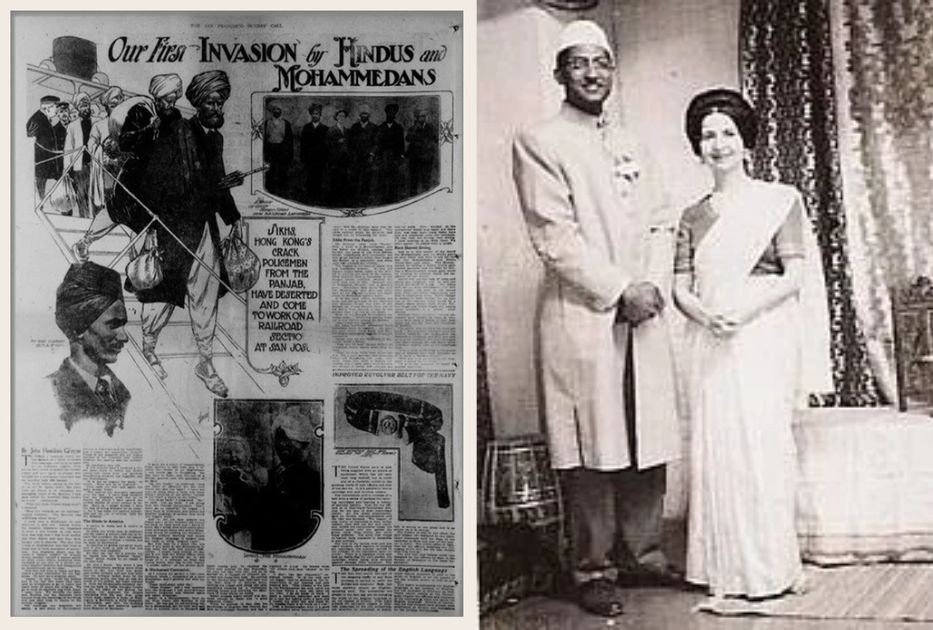
In November 1906, the San Francisco Call ran an article with the headline “Our First Invasion of Hindus and Mohammedans,” portraying the arrival of immigrants from the Indian subcontinent as a threat. Less than a year later, a mob of 500 white men descended upon Sikh mill workers in Bellingham, Washington, breaking windows, beating the workers and holding them hostage in the basement of City Hall. Within ten days, the city’s entire Sikh community had fled.
More than a century later, as Indian immigrants once again find themselves at the center of a heated debate over American jobs, immigration and national identity, a new report examines the historical roots of a familiar racist refrain: “Go back to where you came from.”
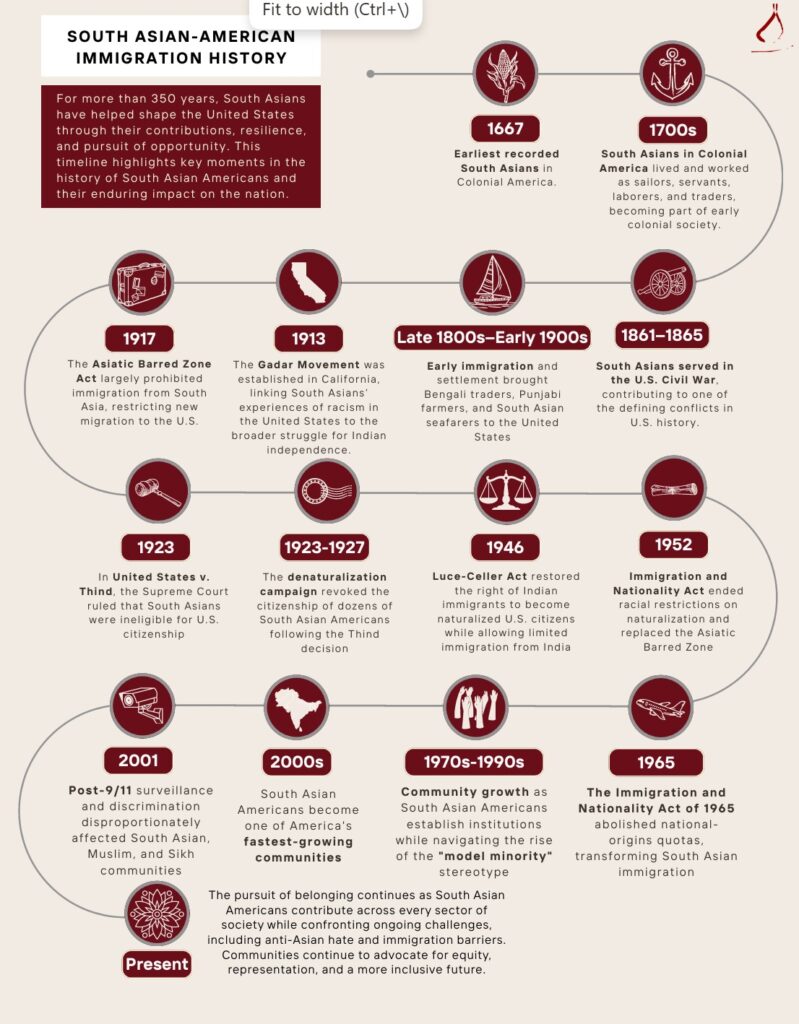
Titled Defining American: Decoding “Go Back to Where You Came From,” the report by the South Asian American Policy & Research Institute (SAAPRI) traces more than 350 years of South Asian presence in America, documenting the community’s contributions to the nation alongside a long history of racial violence, discriminatory legislation and exclusion.
Authored by Pooja Kansal and Priyanka Nair, the report comes amid a disturbing resurgence of anti-South Asian hostility. Citing research by Stop AAPI Hate, it notes that the use of anti-South Asian slurs online increased by 109 percent between January 2023 and December 2025. South Asians were the targets of 71 percent of recorded anti-Asian threats of violence between August 2024 and December 2025.
For Indian Americans, the report offers a particularly compelling historical perspective on the current backlash. Long before Indian immigrants became associated with Silicon Valley, medicine and corporate leadership, they were helping build America’s railroads, working in its lumber mills, cultivating its farmland and establishing businesses across the country.
And long before the H-1B visa became a political flashpoint, Indian workers were facing hostility over their presence in the American labor market.
Historical records place South Asians in colonial America as early as 1667, more than a century before the United States declared its independence. Larger waves of migration began in the late 19th century, when Bengali Muslim traders traveled along commercial and tourist routes from New Jersey to New Orleans, selling textiles and other goods from the Indian subcontinent.
Around the turn of the 20th century, Punjabi immigrants, predominantly Sikhs but also Muslims and Hindus, arrived on the Pacific Coast, drawn by employment opportunities in agriculture, lumber and railroad construction. Many brought extensive farming experience from Punjab but found themselves confined to low-paying and seasonal jobs because of racial barriers.
The report includes a photograph from around 1906 showing Indian immigrants working on the construction of the Pacific and Eastern Railroad in Oregon. Another shows an Indian immigrant harvesting sugar beets in California in the early 20th century.
These largely forgotten images offer a striking contrast to the contemporary portrayal of Indian immigration as a relatively recent phenomenon driven by the technology industry.
The racial hostility these early immigrants encountered also helped shape a politically engaged Indian diaspora. In 1913, Indian immigrants established the Gadar Party in California, connecting their experiences of racism in North America with the struggle against British colonial rule in India. The movement brought together Sikhs, Hindus and Muslims in a common campaign for Indian independence.
But perhaps one of the most unsettling chapters in the report concerns an Indian immigrant who served in the U.S. Army and subsequently found himself fighting for the right to be an American citizen.
Bhagat Singh Thind, a Sikh immigrant from Punjab, had been granted citizenship twice by district courts, only to have the Bureau of Naturalization challenge his eligibility. His case eventually reached the U.S. Supreme Court.
In 1923, the court ruled that although Thind could be classified as Caucasian under prevailing anthropological definitions, he was not white in the commonly understood sense of the word and was therefore ineligible for naturalization under the racial restrictions of the time.
The court’s reasoning explicitly questioned the ability of people of Indian ancestry to assimilate into American society.
“The children of English, French, German, Italian, Scandinavian, and other European parentage quickly merge into the mass of our population and lose the distinctive hallmarks of their European origin,” Justice George Sutherland wrote. “On the other hand, it cannot be doubted that the children born in this country of Hindu parents would retain indefinitely the clear evidence of their ancestry.”
The consequences extended far beyond Thind himself. According to the SAAPRI report, 65 South Asian Americans had their citizenship revoked between 1923 and 1927.
Meanwhile, the Immigration Act of 1917 and the Johnson-Reed Act of 1924 effectively closed the door to most immigration from the Indian subcontinent.
The idea that people of Indian origin could remain outsiders regardless of how long they had lived in America, or even whether they had been born there, was thus embedded in the country’s legal history.
It would take decades for those barriers to come down.
The Luce-Celler Act of 1946 restored the right of Indian immigrants to become naturalized U.S. citizens. Further reforms followed in 1952, and in 1957, Dalip Singh Saund, an immigrant from Punjab, became the first Asian American to serve in the U.S. Congress.
The most consequential transformation, however, came with the Immigration and Nationality Act of 1965, which abolished national-origin quotas and established preferences for skilled professionals and family reunification.
The report makes an important point about this watershed moment in Indian American history: America was actively seeking the talent that Indian immigrants brought.
The United States was concerned about falling behind the Soviet Union in scientific advancement and needed healthcare professionals following the establishment of Medicare and Medicaid. Indian doctors, engineers and scientists were among those who helped meet these needs.
Between 1966 and 1977 alone, approximately 25,000 physicians, 40,000 engineers and 20,000 scientists with PhDs immigrated to the United States from India, according to research cited in the report.
Subsequent generations of Indian immigrants would help drive another major transformation in the American economy.
The expansion of Silicon Valley and the computer revolution of the 1990s created an enormous demand for technical expertise. Through the H-1B visa program and American universities, Indian professionals entered the workforce in engineering, information technology and the sciences. Many went on to establish companies, develop new technologies and assume leadership positions in major corporations.
By 2019, Indian nationals accounted for 74.5 percent of H-1B petitions for initial or continuing employment.
The report situates this concentration within the broader history of American immigration policy, the country’s demand for highly skilled workers and the strong science and engineering educational pipelines in India.
It is a perspective often missing from contemporary debates over Indian professionals and the H-1B program: the demographic transformation of the American technology workforce was shaped, in significant part, by immigration policies designed to serve American economic interests.
The arrival of highly educated Indian immigrants after 1965 also helped reinforce the perception of Asian Americans as a “model minority,” a community whose educational attainment, professional success and economic prosperity were held up as evidence of successful assimilation.
But the SAAPRI report challenges that characterization on several fronts.
The stereotype, the authors argue, obscures the role of selective immigration policies in shaping the community’s socioeconomic profile. It also masks substantial economic disparities within the broader South Asian population, along with experiences of discrimination, mental health struggles and structural inequities.
Perhaps most importantly, professional success has not insulated Indian Americans from racial hostility.
The aftermath of the September 11, 2001, terrorist attacks exposed the fragility of that acceptance. Sikh Americans, many of whom were targeted because of their turbans and beards, experienced a wave of violence and discrimination. Among the victims was Balbir Singh Sodhi, a Sikh gas station owner murdered in Arizona.
In 2012, a white supremacist opened fire at a Sikh gurdwara in Oak Creek, Wisconsin, in one of the most devastating attacks on the Indian American community.
The report also documents the disproportionate impact of post-9/11 surveillance and immigration enforcement on Pakistani and Bangladeshi immigrants, illustrating how different segments of the South Asian American population have experienced exclusion in different ways.
Today, the challenges confronting Indian immigrants include prolonged employment-based green card backlogs, uncertainty surrounding work visas and an increasingly hostile online environment.
SAAPRI’s own earlier research found that nearly one in four South Asian respondents reported experiencing or witnessing a hate crime. The survey, conducted between July 2021 and June 2023, involved 416 participants, primarily in Illinois.
The more recent online hate figures cited in the report suggest that the hostility has intensified. Between November 2024 and January 2025, South Asians accounted for 73 percent of anti-Asian slurs and 75 percent of anti-Asian threats recorded in extremist online spaces.
While these figures encompass the broader South Asian population rather than Indian Americans alone, they provide important context for the racial hostility confronting the community.
The report is the first in SAAPRI’s “Defining American” series, which will examine the evolution of U.S. immigration policies across political administrations and their impact on South Asian communities. It seeks to bring South Asian experiences into broader policy discussions from which they have often been absent.
What emerges from its historical review is a recurring contradiction in America’s relationship with immigrants from the Indian subcontinent.
Their labor was needed in the fields, mills and railroads of the early 20th century. Their medical and scientific expertise was sought during the Cold War. Their technological skills helped power the digital revolution. Yet their acceptance as Americans has repeatedly been challenged by racial prejudice, economic anxieties and exclusionary policies.
From the Punjabi laborer laying railroad tracks in Oregon in 1906 to the Indian engineer developing technology in Silicon Valley more than a century later, the occupations, circumstances and aspirations of Indian immigrants have changed enormously.
The question of belonging, however, has endured.
And the words “go back to where you came from,” directed at people whose communities have helped shape America since before its founding, reveal how much of that history remains unacknowledged.
Cover photo credit:
Left: An article in the San Francisco Call, November 20, 1906. California Digital Newspaper Collection, Center for Bibliographic Studies and Research, University of California, Riverside.
Right: Giriraj Rao, one of the earliest Indian immigrants to settle in Atlanta, with his Italian American wife, Carolina, in 1956. Rao arrived in the United States in 1946 to pursue training in food technology at the University of California, Berkeley. The couple married in 1948, overcoming racial, religious and legal barriers, and went on to share 48 years of married life (File photo).
