





BY JYOTHSNA HEGDE
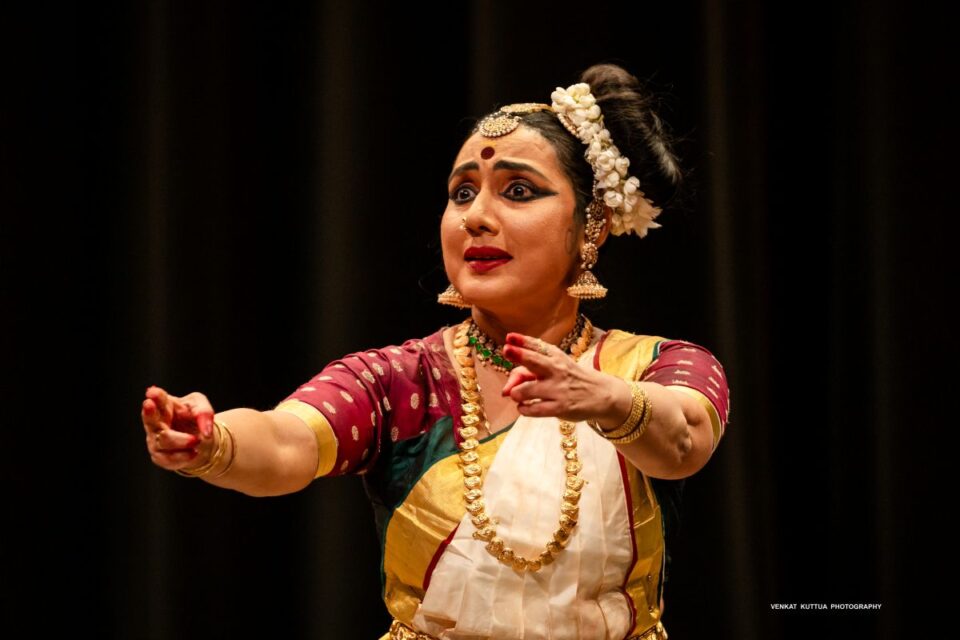
Atlanta, GA, October 23, 2026: A hand curved, a gaze lingered, and a world took shape. A temple procession moved through an imagined courtyard. Radha asked the night to stay. Arjuna searched the darkness for a friend whose absence had emptied him of strength.
At Sylvia Beard Theatre in Buford on October 18, Dr. Neena Prasad’s Lasya Lahari: The Timeless Grace of Mohiniyattam unfolded like poetry in motion, weaving devotion, love, and longing into every gesture.
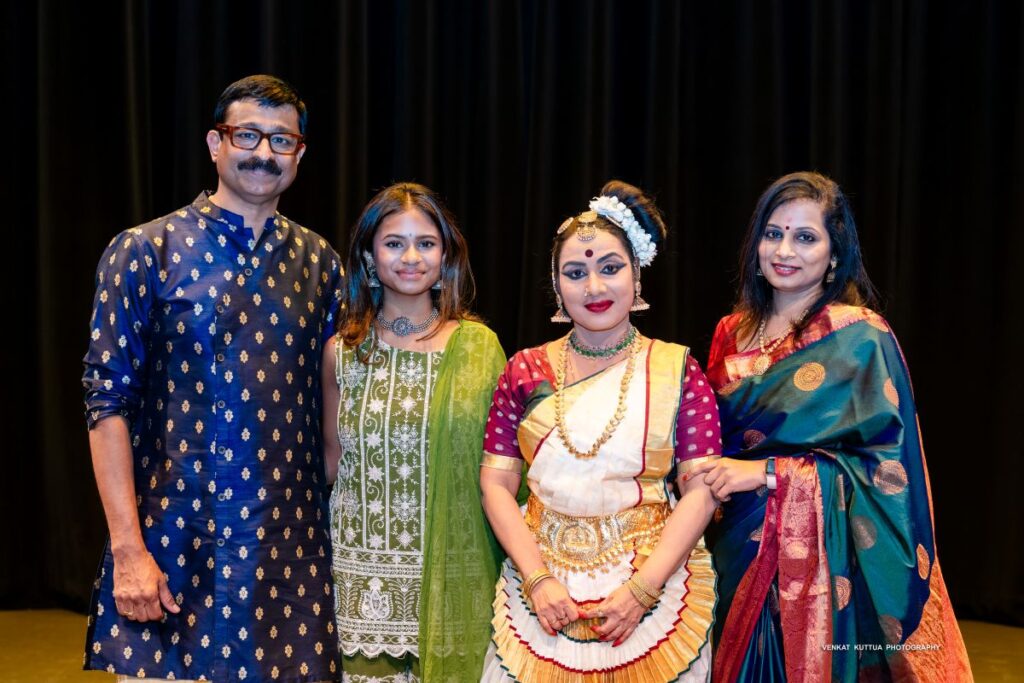
Presented by the Foundation of Arts, Culture & Tradition (FACT), a nonprofit dedicated to preserving, promoting, and celebrating India’s artistic and cultural heritage, the recital brought that mission to life through dance and live music. Organized by Sanjana, Rakhi, and Rajeev Menon, the evening was introduced by emcee Taniya Panda, who acquainted the audience with the accomplished artists behind the performance.
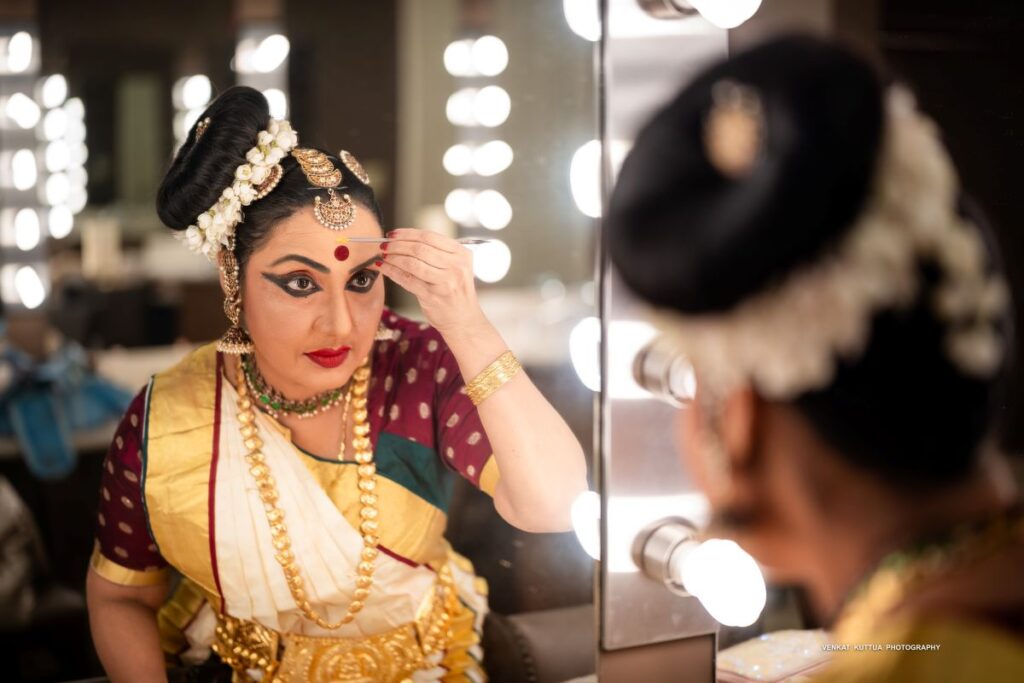
A scholar, teacher, and choreographer, Prasad brings academic depth to an expansive artistic practice. Trained in Mohiniyattam, Bharatanatyam, Kuchipudi, and Kathakali under distinguished gurus, she holds a doctorate and has pursued postdoctoral research in dance. Through her Sougandhika Centre for Mohiniyattam, she has nurtured younger dancers while developing productions that extend the form’s expressive range. Her honors include the Sangeet Natak Akademi Award and the Madras Music Academy’s Nritya Kalanidhi in 2024.
That depth of experience found expression in a performance where every movement seemed to emerge from thought and feeling. A turn of the head could redirect a conversation; a change in the eyes could alter the emotional weather of the stage. In her interpretation, Mohiniyattam’s softness became a language capable of holding tenderness, doubt, and devastation.
A landscape remembered in movement
Kerala seemed present in the very architecture of the dance. Introducing the recital, Prasad connected Mohiniyattam’s spirals and gently oscillating movements to the geography of its birthplace. Her explanation offered an illuminating way to watch: the body could suggest water moving along a bank, a breeze passing through foliage, a landscape breathing.
One of Kerala’s classical dance traditions, Mohiniyattam is distinguished by its lasya, or lyrical grace, and expressive storytelling. Its history draws on older South Indian performance traditions, including those of temple dancers. The form received significant patronage under nineteenth-century Travancore ruler Maharaja Swathi Thirunal. Following a period of decline, its twentieth-century revival was advanced by poet Vallathol Narayana Menon, Kerala Kalamandalam, and influential teachers including Kalamandalam Kalyanikutty Amma.
That inheritance felt alive throughout the evening. Speaking of a journey with Mohiniyattam spanning more than three decades, Prasad described her continuing interest in exploring its dramatic possibilities. The recital revealed how much emotional territory could open within its flowing vocabulary.
An offering, then a god upon a swing
The opening Cholkettu established a mood of concentration and devotion. Rhythmic syllables flowered into movement before giving way to a salutation to the goddess. Chosen for the Navaratri season, the piece honored Gnanaprasunambika, consort of Kalahastishwara.
An original composition by vocalist Changanacherry Madhavan Nampoothiri, the invocation brought rhythmic intricacy into conversation with the dance’s flowing contours. There was pleasure in that meeting: precision at the feet, spaciousness through the body, devotion gathering in the face.
The next presentation evoked the festival world of Thiruvananthapuram’s Sree Padmanabhaswamy Temple. Drawing on a composition of Swathi Thirunal, Prasad conjured the deity’s procession upon a swinging vehicle.
The image acquired different meanings through the eyes of those who beheld it. To admiring women, the lord embodied irresistible beauty; to sages, he represented the essence of sacred knowledge. For the devoted, he was their own Padmanabha.
Through subtle shifts of expression, Prasad allowed these perspectives to emerge. A deity might belong to an entire city, yet each worshipper encountered an intimate presence.
Radha asks the night to linger
With Jayadeva’s Gita Govinda, the recital entered a more private chamber.
Introducing the twelfth-century poet’s celebration of Radha and Krishna, Prasad emphasized their recognizable emotional lives: playfulness, jealousy, disagreement, longing, and reconciliation. The divine lovers came close enough to reveal the human pulse within the poetry.
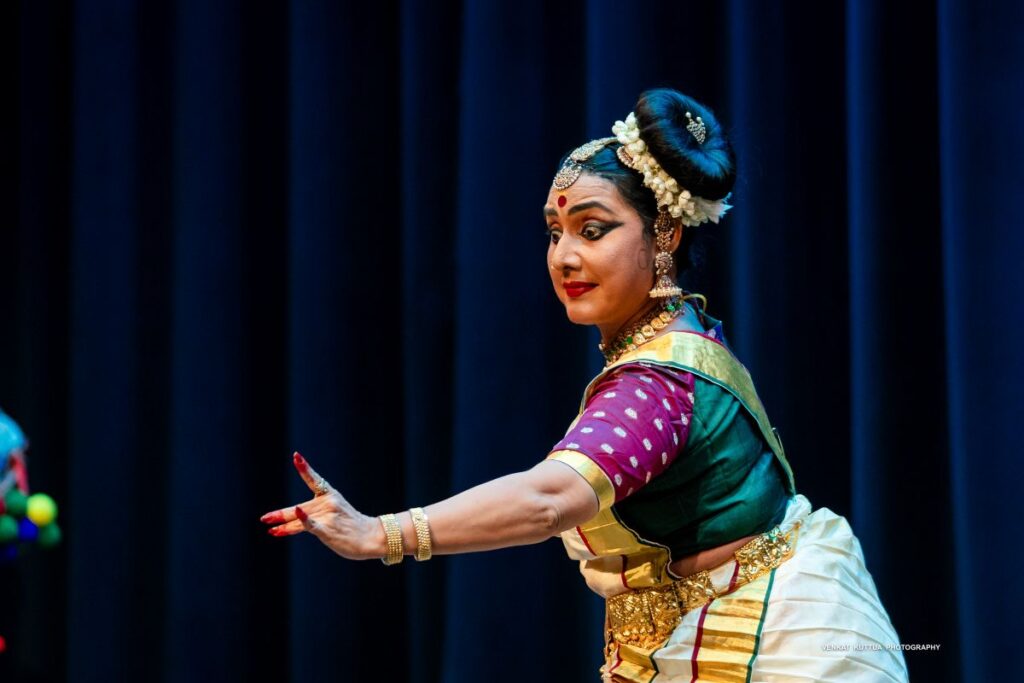
In the chosen passage, Radha asks Krishna to restore the adornments disturbed by their intimacy. Her hair must be arranged again, her eyes attended to, her ornaments renewed. Beneath these affectionate requests lies another plea: remain with me a little longer.
Prasad gave the passage a delicate emotional texture. Radha’s gestures carried confidence, pleasure, and the vulnerability of someone unwilling to let a cherished moment end. Each request prolonged togetherness. Time seemed to gather around the lovers, reluctant to move.
Sakhyam: When the warrior loses his light
The evening’s emotional center was Sakhyam, an exploration of the bond between Krishna and Arjuna.
Prasad introduced friendship as one of the paths of devotion, a relationship that permits argument and questioning while resting upon profound trust. Her presentation began in the desolation following Krishna’s departure from the mortal world.
Here was Arjuna, the great warrior, confronting his own helplessness. His bow remained; the confidence that once animated it had deserted him. His grief carried a terrible question: who was he without the companion who had guided his life?
Prasad traced that question through memory. Episodes of rescue, counsel, and companionship returned as Arjuna searched for the meaning of his loss. Kurukshetra emerged as a place of moral bewilderment, where victory itself became difficult to desire when those standing opposite were teachers, relatives, and friends.
The movement between past and present gave the work its dramatic force. Recollection briefly restored Krishna’s presence, then made his absence more acute. The warrior’s stature seemed to contract beneath the burden of grief.
For anyone who has lost a person who helped make the world intelligible, the episode carried a recognizable ache. One mourns a presence, and also the self that existed beside it.
Eventually, the work moved toward an inward awakening. Arjuna had to accept that a chapter of his life had ended and find the strength to continue. The friendship remained within him as guidance, even as he relinquished its familiar earthly form.
Grace became the means through which a broken spirit learned to walk again.
Four musicians, one shared imagination
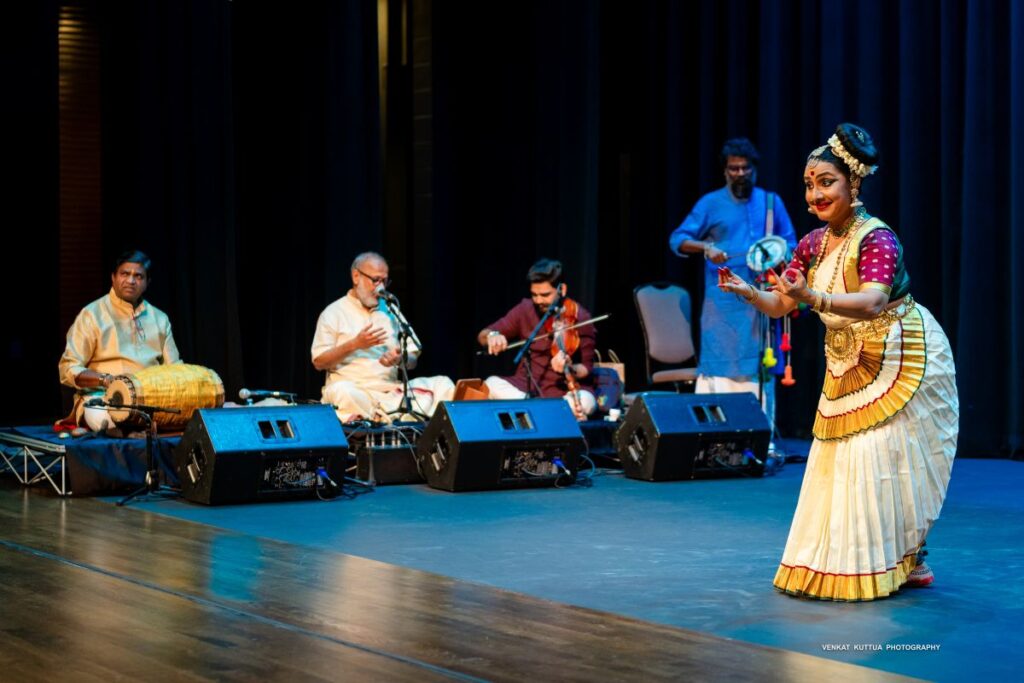
The live ensemble was essential to the recital’s emotional life. Voice, strings, and percussion helped establish the worlds through which Prasad moved, giving each transition its atmosphere and momentum.
On vocals, Changanacherry Madhavan Nampoothiri provided the melodic and literary foundation. A senior disciple of T. V. Sankaranarayanan, with additional training under P. R. Kumarakerala Varma and Kalanjoor Chandrasekharan, he has presented more than 500 solo performances and performed internationally. A retired music lecturer at R. L. V. College of Music and Fine Arts, Thripunithura, and an A-Grade All India Radio artist, he is also an accomplished composer for dance. His creative contribution framed the evening through both the opening Cholkettu and concluding Tillana. His singing carried poetry toward the dancer, where it acquired gesture, character, and visible feeling.
On mridangam, K. P. Ramesh Babu brought rhythmic assurance and sensitivity to the unfolding drama. The Chennai percussionist trained under his father, K. P. Bhaskar Das, and gurus Puthukode S. Krishnan and Karaikudi R. Mani. An internationally experienced accompanist with a longstanding association with Bharatha Kalanjali, he brought an understanding of the relationship between rhythm and movement. Prasad’s closing acknowledgment highlighted that essential responsiveness: the ability to follow the dancer’s intention and give it room to breathe.
Shyam Kalyan M, on violin, added melodic continuity and emotional shading. The grandson of Kalamandalam N. K. Vasudeva Panicker and son of N. K. Madhusoodanan, he is a longtime disciple of T. H. Subramanniam and a B-High Graded All India Radio artist. His career spans major festivals and institutions, including Khajuraho, Konark, NCPA Mumbai, and the Madras Music Academy, alongside compositions for classical dance and work in Malayalam, Tamil, and Hindi cinema. His violin sustained the emotional space around the dancer, extending a phrase or deepening a feeling left suspended by a gesture.
On edakka, Kalamandalam Arundas brought a sound intimately connected to Kerala’s artistic landscape. Trained at Kerala Kalamandalam, the percussionist, composer, and music director is accomplished in edakka and chenda, with additional skills in tabla and guitar. He has accompanied artists including Ustad Zakir Hussain, Sivamani, Kalamandalam Kshemavathy, and Methil Devika. He also runs Sruthilaya Music Production House in Cheruthuruthy and received the Bharath P. J. Antony Memorial National Award for Best Music Director in 2022. The edakka’s bending tones found a natural companion in Mohiniyattam’s oscillating movements, giving sound to the dance’s breathing contours.
Together, the musicians created a shared field of attention. Prasad’s acknowledgment of their artistry revealed the knowledge and trust beneath the evening’s apparent ease.
A tradition carried forward
A Tillana in Kapi, composed by Madhavan Nampoothiri, brought renewed rhythmic brightness before the concluding Mangalam offered a benediction.
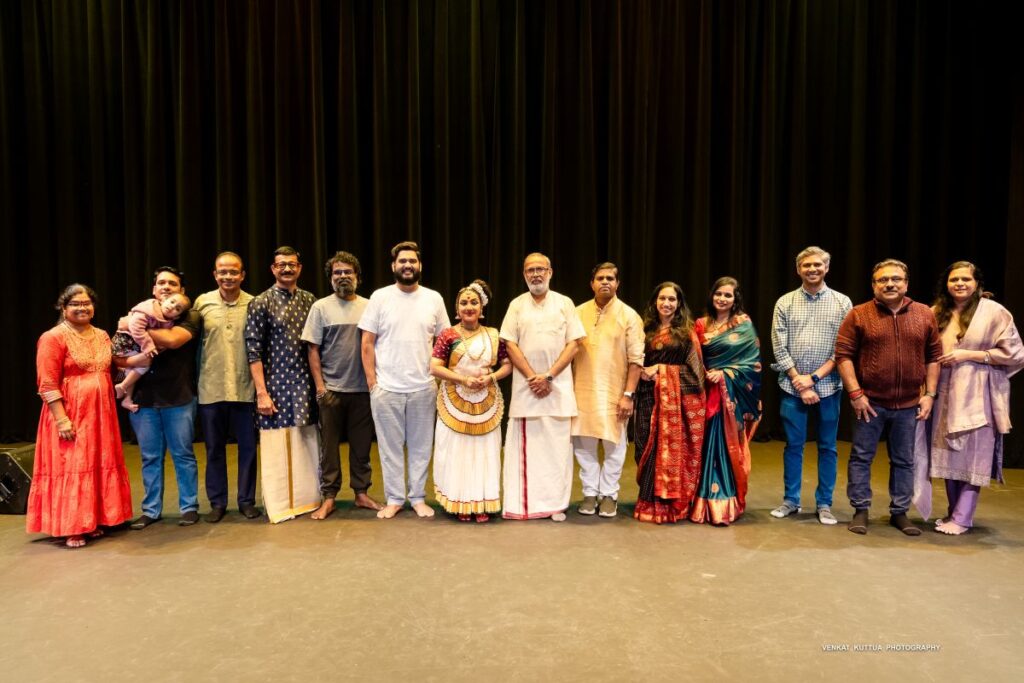
In their closing remarks, the organizers thanked the artists, audience, and volunteers, noting that the program had been brought together in three weeks. Their commitment to presenting classical arts in Atlanta made space for an encounter with a tradition in all its complexity and emotional depth.
What lingered after Lasya Lahari was the image of Arjuna learning to carry an absence. Around it remained other impressions: the swing of a temple deity, Radha’s wish for an unending night, the curve of an offering hand.
A body swayed, a face changed, and the distance between an ancient story and a life in the audience quietly disappeared.
