



BY VEENA RAO*
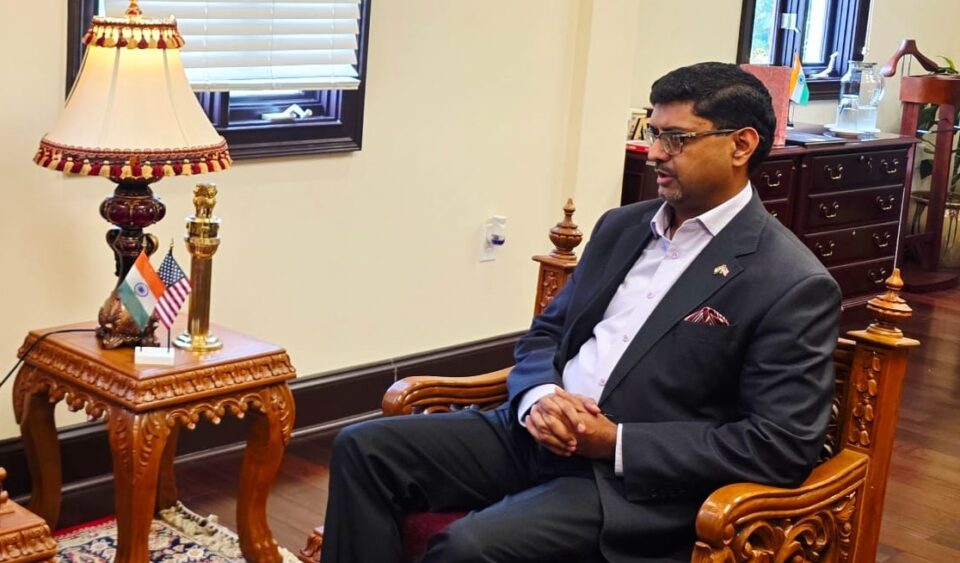
Atlanta, GA, September 14, 2026: Two weeks into his new assignment as Consul General of India in Atlanta, Dr. Sumit Seth has already set out his priorities for the Southeast, with plans to take consular services closer to communities outside Atlanta, expand trade and technology ties, build university partnerships and deepen engagement with the Indian diaspora across the region.
A trained forensic pathologist who later joined the Indian Foreign Service, Dr. Seth brings some of his medical instincts to diplomacy. He believes in listening carefully, understanding the landscape and, as he puts it, “checking the pulse” before deciding where intervention can make the greatest difference.
That approach is paired with a framework he brings from his previous posting as India’s Ambassador to Panama, Costa Rica and Nicaragua: five Ts: Traditions, Trade, Technology, Tourism and Talent. He adds a sixth: “Touching lives.”
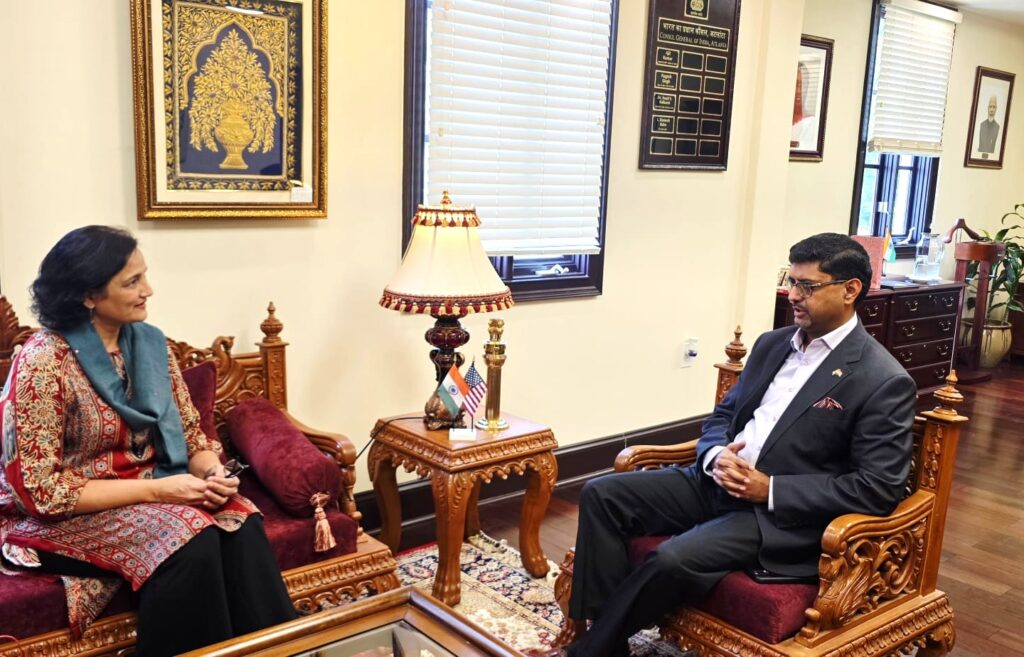
“Diplomacy should not become something abstract,” Dr. Seth told NRI Pulse in an interview at the Consulate. “It should directly or indirectly affect people’s lives in a positive manner.”
In a wide-ranging conversation with NRI Pulse, Dr. Seth spoke about his first impressions of Atlanta, his priorities for the Consulate, concerns over immigration and anti-Indian rhetoric, his journey from forensic medicine to diplomacy, and another passion that has followed him from posting to posting: writing.
You’ve been here since August 26. How have the past two weeks been?
The kind of intense engagement I have had since day one makes it feel as though I’ve been here for many, many years. I feel at home.
The Indian community has received me with such warmth and a welcoming attitude. That is an encouraging sign of what we can do in the Southeast, which is one of the fastest-growing regions of the country.
I can already see that the ideas and plans I have brought with me are possible to implement, with the help not only of the Indian community, but also of the Americans I have begun to meet.
You’ve described your approach as “diagnose before you prescribe.” What does that mean in your new role?
It’s a mental model I have been using throughout my career as a diplomat.
A doctor has a particular way of approaching a problem: you diagnose before you prescribe, and to diagnose you must run tests. Here, those tests mean meeting people and listening to them.
What are the issues Indian passport holders are facing? What are the issues facing a person of Indian origin who is now an American? How do these people see India? How do they see the new policies being brought in? How can they contribute back to their motherland?
Many have left India, and their karambhoomi, the land where one’s life’s work is done, is now the U.S. They have been very successful. At the same time, after reaching a certain stage of success and prosperity, many are trying to find ways to contribute back to India.
My job as Consul General and representative of my government is to create that bridge, that conduit, through which they can support and strengthen the India-U.S. relationship.
You came to Atlanta with a plan built around what you call the five Ts. What are they?
The first is Traditions. It is very important for a Consulate to celebrate India’s traditions, culture, cuisine and dance forms in their authentic form.
But I also want us to celebrate American traditions. If I celebrate only my own festivals and do not involve them, that is not enough. I would like them to join our festivals, just as we join theirs. By doing so, we create better mutual understanding.
The second T is Trade — commerce and business.
There is an old saying in diplomacy: “Flags follow the ships.” Ships are a symbol of commerce, trade, companies and investment. The more business ties and investment we have, the more jobs we create here and the more we open India’s large market to U.S. companies. Political relations automatically follow.
The third T is Technology. We have added a new dictum from “Flags follow the ships” to a new idiom of diplomacy: “Flags follow the chips.”
When I say chips, I mean the digital economy as a whole: data, artificial intelligence and machine learning, high technology, space industries and advanced manufacturing.
Then there is Tourism, in both directions. There are many myths about India. You cannot capture the essence of India from Netflix or YouTube videos alone; sometimes they only reinforce the stereotypes. The best way to break a stereotype is to take people to India.
And the fifth T is Talent. There is enormous potential for universities in the U.S. and India to work together, including opportunities for American universities to establish campuses in India.
All these five Ts lead to the sixth T: Touching lives.
Diplomacy should not become something abstract. It should directly or indirectly affect people’s lives in a positive manner.
And there is one more T that runs through all of them: Trust, which is the bedrock of diplomacy.
You’ve made better consular services your first priority. What would you like to improve?
Consular work may not be perceived as the most glamorous part of diplomacy. There is a traditional image of the diplomat who attends receptions, gives speeches, speaks at seminars and signs documents.
But the real day-to-day work is done by our consular team.
There is always a better way to run our systems by adding efficiencies, bringing in technology, putting out updated information in real time and troubleshooting quickly.
I may deliver a well-crafted speech at a seminar, or give an interview. But what really matters is the experience a person has when interacting with our consular staff.
Every application comes with a story. There is a family involved. Somebody may want to go to India on short notice. Somebody needs documents attested. Somebody wants to sell property in India.
These situations create a lot of stress for families and individuals. We want to minimize that stress.
When people think of visiting the Consulate, they should not feel nervous or agitated. They should feel, “If I go to the Consulate, my application will be positively received, and I will get the service I expect.”
You’ve said the Consulate needs to “leave its own ZIP code.” Can you talk a little bit about what you mean by that?
Our Consulate is in Atlanta, but our jurisdiction runs across Alabama, Florida, Georgia beyond Atlanta, Mississippi, South Carolina and Tennessee. We also provide consular services in Puerto Rico and the U.S. Virgin Islands.
If the Consulate remains only within the ZIP code of Atlanta, then we are not doing enough.
We need to leave the ZIP code. We need to go out. We have to go to your doorstep.
We want our consular staff to travel and reach the people who need our services, rather than expecting them to come to us.
That includes a predictable calendar of consular camps, so that people know well in advance when we are coming and can keep their documents ready.
We will not be tied to the four walls of the Consulate. We will go out. We will reach out.
Where do you see the biggest opportunities for trade and investment between India and the Southeast?
From my current understanding, the Southeast is strong in logistics, advanced manufacturing, payment gateways and transactions. These are areas where a lot of work can be done.
Education is another area. The Southeast has some of the most renowned educational institutions, and many students come here from India.
India’s new education policy also allows foreign universities to establish campuses in India. I am going to reach out to universities here to understand their plans and to identify where theirs and ours converge.
A few weeks ago, our Ambassador was in Atlanta for an education roundtable, where a great deal was discussed. My job now is to convert those words and ideas into action, into reality, and into concrete outcomes.
Speaking of students, there is considerable anxiety among Indian students coming to the U.S. today. What role can the Consulate play?
I have not yet had a chance to meet them, but it is high on my agenda to meet student groups at various universities and listen to them.
What makes them anxious?
My own son is studying abroad. As a parent, I know how much every parent worries when a child goes abroad to study.
Every family wants predictability.
I need to reach out to these students, listen to their concerns and convey them through the proper channels, without making public noise about it.
Most serious diplomacy happens behind closed doors, in an atmosphere of confidence where you can speak your mind and communicate concerns in a manner that our interlocutors can understand and act upon.
There are mental health and loneliness issues among international students as well.
Yes, very much.
Many students come here and, as a doctor, I can tell you that being away from home brings a great deal of isolation.
They are within a student community, but each individual can still feel a certain sense of loneliness because their roots are somewhere else. They are in a new system and have to adjust to a cross-cultural environment.
Here, I think the Consulate can play the role of a counselor, to guide them and give them the feeling that, come what may, in any crisis, the Consulate will always be there.
I can put that on social media, but it won’t have the same impact until I meet them, look them in the eye and convey it not just through my words, but through our actions.
There is also a lot of anxiety over H-1B visas, green-card backlogs and changing immigration rules. What can the Indian government realistically do?
We are already doing it. Not every action taken by diplomats needs to be put on social media.
Diplomacy is a slow process. There is a cumulative effect. One meeting may not yield a result, but the second carries the weight of the first. That effect accumulates, and then suddenly you see positive results.
We are aware of the concerns. When I talk to our Indian diaspora, they mention these issues.
There are diplomatic channels available through which we are raising these concerns. It is a continuous process. Sometimes the results are not immediately visible.
But I can assure you that we will leave no stone unturned to ensure that the interests of the Indian diaspora are preserved and promoted.
We’re also seeing more anti-Indian rhetoric and incidents targeting Indians. How concerned are you?
We are aware of some instances.
But there are also many instances where Americans have warmly embraced Indians. There are good stories too.
Such incidents do catch attention, because there is a human tendency to focus on them. But they should not be generalized.
There are cases, and as you said, the numbers are increasing in some areas. We are trying to understand why this is happening, what the causes are, how they can be mitigated and what precautions can be taken.
It is a complex problem, and there is no simple solution to it. But the Consulate is definitely aware of it.
Sometimes by the time information reaches us through social media, it is already distorted and filtered. Media organizations like yours can be a conduit, bringing us a more direct and authentic account of what has actually happened.
The channel is open. When you come across such incidents, you can bring them to our attention. If there is a serious issue, we will definitely take it up at higher levels through the diplomatic channels available to us.
You were one of the early officers involved in the Ministry’s digital diplomacy efforts. How do you plan to use that experience here?
This is something close to my heart.
Many years ago, when I was posted at headquarters, I was fortunate to be the first Foreign Service officer appointed as Deputy Secretary for Digital Diplomacy.
We recently revamped our Instagram page @Indiain_Atlanta. More and more young people are on Instagram. How do we tailor our content so that it speaks their language, so that they understand it and identify with it? That is our focus.
It’s all about telling stories. Stories that appeal to the emotions of people.
There are so many success stories of people from India who came here, studied here and made the U.S. their home. How did they reach that level of success? How are they giving back to society in both the U.S. and India, and bringing the two countries together?
There are thousands of stories like this.
Finally, you write short stories and poetry. What does writing give you that diplomacy doesn’t?
Diplomacy is about writing. Writing is an instrument of thinking. Very often it is only once you begin to write that the new ideas arrive.
The day’s experiences find their way into what you write. There are some facts, some fiction, some creativity. They come together and create something new.
My mother tongue is Hindi, so I think in Hindi; I write in English.
And I have another software running in my mind: Spanish. I’ve read a lot of Spanish literature.
I see similarities between Indian literature, American literature and Spanish literature. There are common emotions — fear, greed, love, heartbreaks, revenge and redemption. Someone has been written off by everyone, has been knocked down, and then rebounds. These are universal stories.
*Veena Rao is the founder and editor-in-chief of NRI Pulse.
