



BY VEENA RAO*
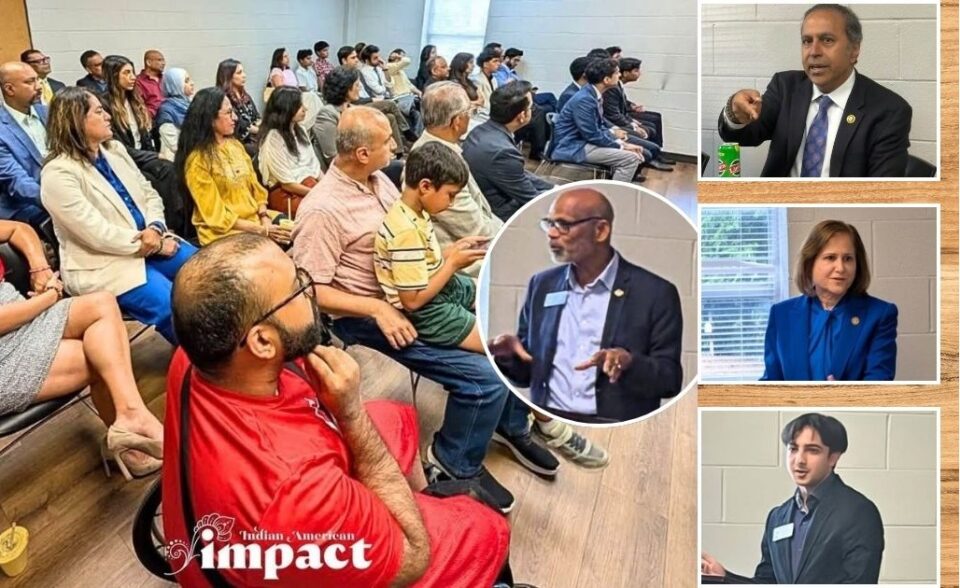
Norcross, GA, September 9, 2026: Rising anti-South Asian hate, reflected in political rhetoric, social media, and everyday encounters, brought national and Georgia political leaders together in Norcross on September 3 for a candid conversation about what is fueling the hostility and how the community should respond.
The Community Listening Session, organized by Indian American Impact, brought together U.S. Rep. Raja Krishnamoorthi of Illinois, Virginia Lt. Gov. Ghazala Hashmi, Georgia State Rep. Akbar Ali, and Georgia State Sens. Sheikh Rahman and Josh McLaurin. Community members also shared their own experiences and challenged the panel on questions ranging from reporting hate incidents to political representation and divisions within the South Asian diaspora.
“This issue of rising anti-Asian hate, anti-South Asian hate is not abstract. It’s personal,” Krishnamoorthi told the gathering.
He recounted a recent clash with a Florida elected official who had called for the mass deportation of Indians and then targeted Krishnamoorthi after the congressman criticized his remarks.
“He called me a foreign occupier, and he said my name was unpronounceable,” Krishnamoorthi said.
The Congressman’s response: “Councilman Langevin, just call me Raja. I’ll call you racist.”
But the discussion quickly moved beyond individual incidents to a broader question: What can be done about the rise in hostility toward South Asians?
Over the course of the evening, speakers called for better tracking of hate incidents, greater accountability for social media platforms, stronger political participation and more visible representation. They also repeatedly returned to a challenge within the community itself — the need for South Asians to stand together across religious, national and political divisions.
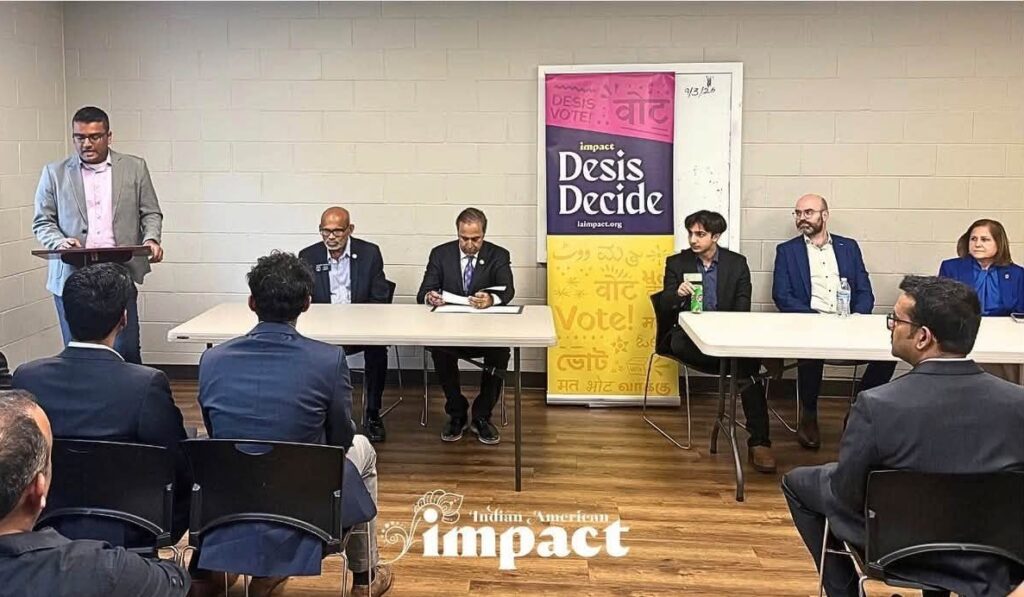
Indian American Impact Executive Director Chintan Patel opened the discussion by placing Georgia at the intersection of two very different stories: a state that has witnessed some of the most painful episodes of anti-Asian hate in recent years, but also one where South Asian and Asian-American political power has grown substantially.
Patel referenced the 2021 Atlanta-area spa shootings, which left eight people dead, as well as other incidents affecting the community. But he said Georgia was also “proof of concept of what’s possible when we organize as a community,” pointing to elected officials, candidates and advocacy organizations that have emerged across the state.
“Tonight is a continuation of that work,” Patel said.
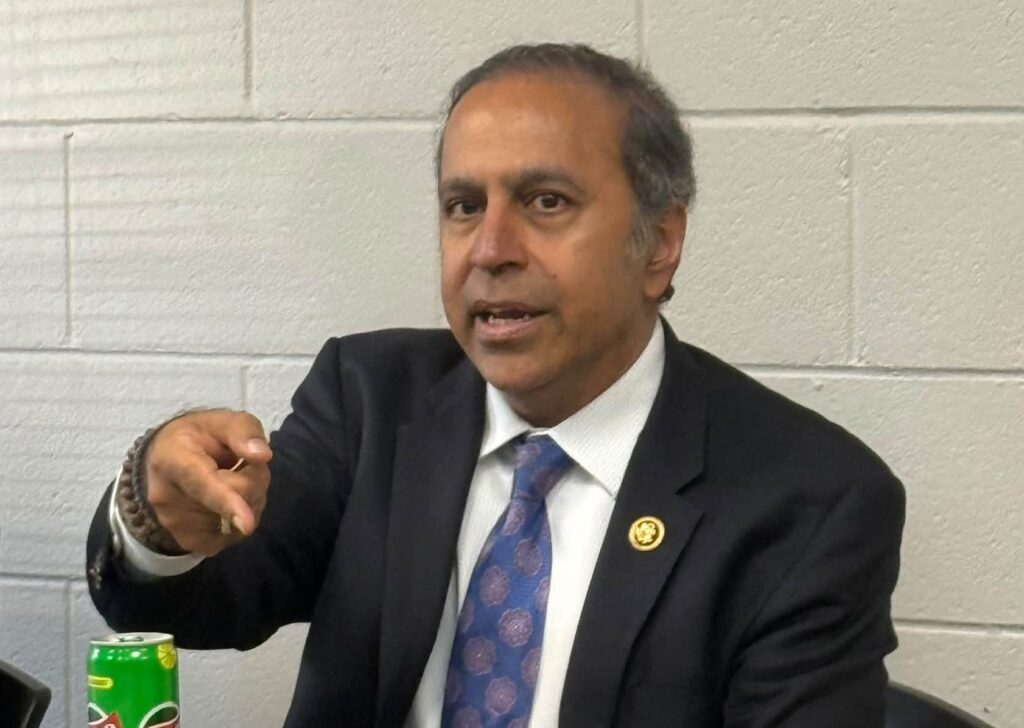
We cannot fix what we can’t measure: Raja Krishnamoorthi
Krishnamoorthi laid out several areas where he believes action is needed, beginning with more precise hate-crime data.
“We cannot fix what we can’t measure,” he said, arguing that existing statistics do not adequately disaggregate incidents affecting different Asian and South Asian communities.
He pointed to his proposed bipartisan Hate Crimes Commission Act, which he said would examine the broader rise in hate, produce findings and identify possible solutions.
In a brief interview with NRI Pulse after his remarks, Krishnamoorthi said the proposed commission would fill a gap in the federal response.
“There’s no commission to look at the rise of hate,” he said. “Ever since 2017, we’ve seen such a rise that it has to attract attention and some focus and investigation.”
He said a bipartisan approach was important “so that nobody can claim that it was just a political exercise.”
Krishnamoorthi also took aim at social media platforms, accusing them of propagating hateful content and profiting from engagement it generates. He called for changes to Section 230 protections and, in the meantime, pressure on technology companies to change their algorithms and reduce the reach of hateful posts.
His third prescription was directed not at government or technology companies, but at South Asians themselves.
“I don’t care if you’re Hindu. I don’t care if you’re Muslim. I don’t care if you’re Sikh. I don’t care if you’re Jain. I don’t care if you’re Christian,” he said. “I don’t care if you’re a man or a woman or a Republican or a Democrat. We’ve got to stand together.”
“Hate should have no home in America,” he added.
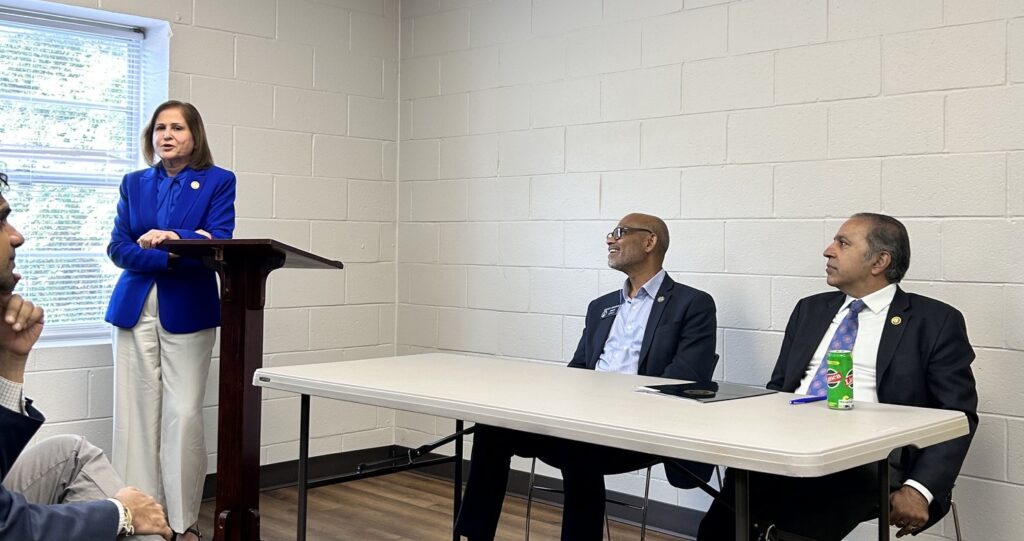
Our names are just as American: Ghazala Hashmi
For Hashmi, who grew up in Statesboro, Georgia, before moving to Virginia, the discussion was also deeply personal.
The former college professor recalled deciding to enter politics after Donald Trump’s first election in 2016, saying she felt compelled to become more visible “as an immigrant, as a Muslim woman in particular.”
When she launched her political career, Hashmi said she adopted a pointed campaign message: “Ghazala Hashmi is an American name.”
“My name, our names, are just as American,” she said.
Hashmi said political representation must translate into tangible changes for communities. She pointed to efforts in Virginia involving inclusive school calendars, recognition of holidays such as Diwali, language access, immigrant services and security assistance for houses of worship.
She also argued that combating hate cannot be left solely to Washington.
“A lot of the work in responding to these concerns has to start at a local level,” Hashmi said during the discussion, pointing to local governments, school boards and state legislatures.
Elected officials, she said, also have a particular obligation when discriminatory rhetoric surfaces.
“If we’re in elected office, we have a responsibility to speak out,” she said. “We have a responsibility to push back on hate in any form that is showing up.”
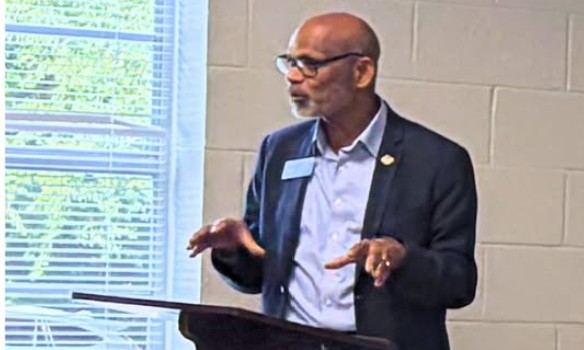
From ‘go home’ to the Georgia Senate: Sheikh Rahman
Georgia State Sen. Sheikh Rahman offered a reminder of how long such hostility has existed — and how dramatically Georgia itself has changed.
Rahman recalled being a student in North Carolina more than four decades ago when someone in a passing pickup truck threw a beer can at him and yelled, “Raghead, go home.”
“I can’t forget that,” he said.
Rahman later spent more than a decade living and doing business in rural Georgia and stressed that his experiences should not be used to stereotype Georgians.
“Not everybody’s racist,” he said, describing many of his experiences in rural Georgia positively.
But he argued that the most effective response for immigrant communities is participation — particularly at the ballot box.
“We just can’t stay on the sidelines,” Rahman said.
He recalled a time when Gwinnett County’s political leadership looked vastly different from today and spoke of his own long fight for minority representation. Now, South Asians and other minorities serve in legislatures, on city councils and in other elected positions across metro Atlanta.
“Things have changed,” he said. “All of us have a duty to participate.”
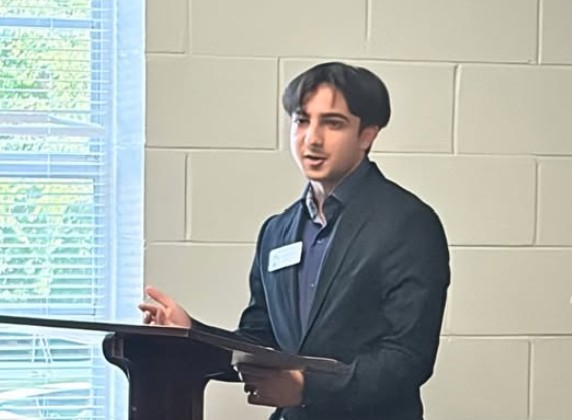
You should change your name: Akbar Ali
State Rep. Akbar Ali, one of the youngest members of the Georgia legislature, brought a younger generation’s version of the same struggle.
While canvassing during his special election campaign, Ali said a longtime Democratic voter told him she intended to vote for him — but suggested that he change his name to something that sounded more conventionally American.
Ali responded by asking whether she wanted one of his yard signs, which displayed his name prominently.
The next time he passed her house, he said, the sign was in her yard.
Ali said he deliberately used his full name, Muhammad Akbar Ali, on the ballot and repeatedly introduced himself by that name at campaign events.
“We are also American,” he said. “We have just as much right to be here as anyone else.”
Ali said his experience in office also demonstrated why representation needs to produce results people can actually feel. Despite entering the legislature at 21 as a freshman Democrat in a Republican-controlled state, he pointed to several legislative priorities that advanced during his first year.
His message to the audience boiled down to three things: “Tangibility, presence and being proud of who you are.”
“We should just never shy away from that,” he said.
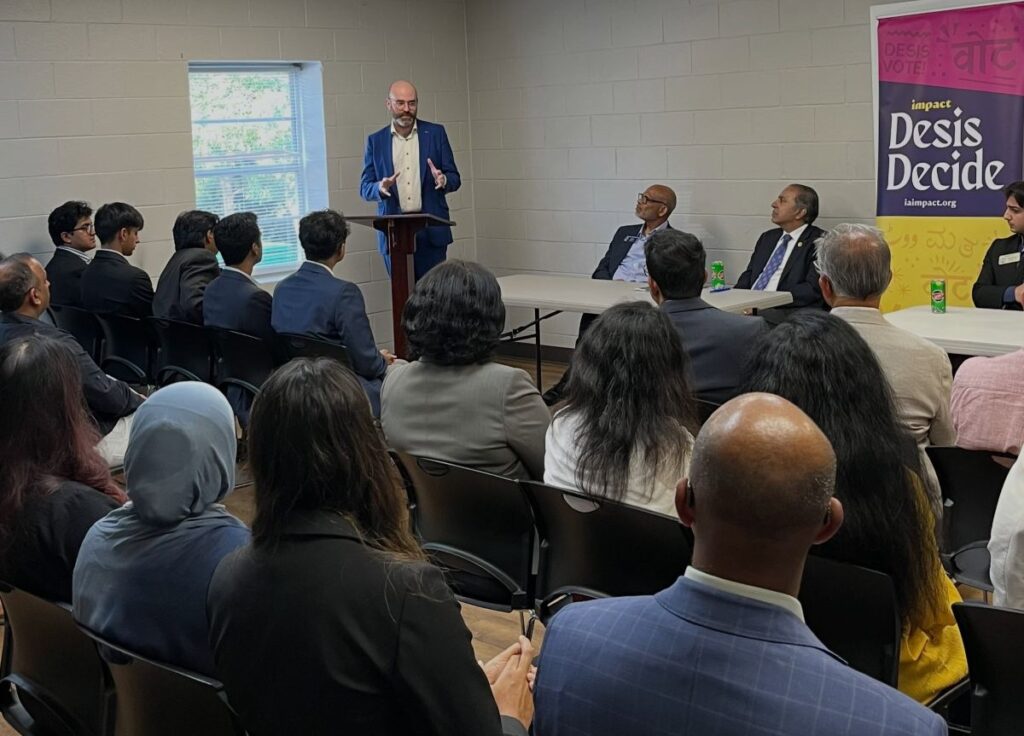
Peace-loving people don’t seek out culture war: Josh McLaurin
State Sen. Josh McLaurin, who is running for lieutenant governor, approached the issue as an ally and warned about politicians using racial and religious division as a substitute for policy.
“Peace-loving people don’t seek out culture war,” McLaurin said. “Peace-loving people don’t seek out division for clicks on the internet to try to shore up their own politics.”
McLaurin said periods of economic and political uncertainty can make people more receptive to scapegoating and simplistic explanations.
“When people are looking for easy answers, and nuanced answers are more difficult, they will turn to an oversimplified, reductive, racist, warped view of reality,” he said.
McLaurin cautioned that legislation alone cannot solve deeply rooted social prejudice, arguing that the everyday visibility of minority communities — including their presence in elected office — can be just as important in changing attitudes.
Audience interaction
Some of the evening’s most candid exchanges came when audience members turned the conversation inward.
How, one participant asked, can South Asians effectively combat outside hatred when divisions persist within the diaspora — between Hindus and Muslims, Indians and Pakistanis, and among regional, religious and political groups?
“Do you have an easy question?” Krishnamoorthi responded, drawing laughter. But he acknowledged the seriousness of the problem.
As the South Asian population has grown, he said, communities have become large enough to retreat into increasingly narrow social circles.
“We’ve gotten so numerous in this country,” he said, that people can congregate “in a more tribal way than ever before.” Those divisions, he warned, weaken the community’s ability to respond collectively when it is targeted.
“When someone sees you, and they see the color of your skin, and they don’t like brown, they’re not going to ask you, ‘Are you from India or Pakistan?’” he said.
Krishnamoorthi recalled once being confronted simply with the words: “Get out.”
“I knew exactly what he was talking about,” he said.
Hashmi said younger South Asians give her reason for optimism, saying she sees a generation increasingly willing to move beyond divisions inherited from the subcontinent.
Rahman echoed that sentiment, describing his own son’s friendships with young people from India, Pakistan, Africa and other backgrounds.
“You will have to change that,” he told the younger people in the room. “You are the leaders.”
‘Don’t do it’
Perhaps the evening’s most direct question came from a young attendee who asked what advice the leaders had for South Asians who feel pressure to diminish their identity — to be “less South Asian” — because of fear or the belief that assimilation could open doors.
Krishnamoorthi’s answer was immediate.
“Don’t do it.”
“You have to be yourself,” he said. “And you have to make sure that not only you be yourself, but you make other people feel comfortable being who they are.”
He compared identity and heritage to the roots of a tree.
“We all need to be those trees that grow deep roots, and we cultivate those roots and our heritage,” he said, “because in becoming those strong, sturdy trees, we then provide shade for others.”
Ali offered his own warning about opportunities that require people to minimize who they are.
He recalled a saying that had stayed with him: “Tokens get spent.”
Those opportunities, Ali said, “are not worth it.”
For Krishnamoorthi, the broader answer to the hostility confronting South Asians ultimately came back to the same message with which he began the evening.
“In politics and in life, you win through addition and multiplication, not subtraction and division,” he said. “We only multiply our numbers by standing together.”
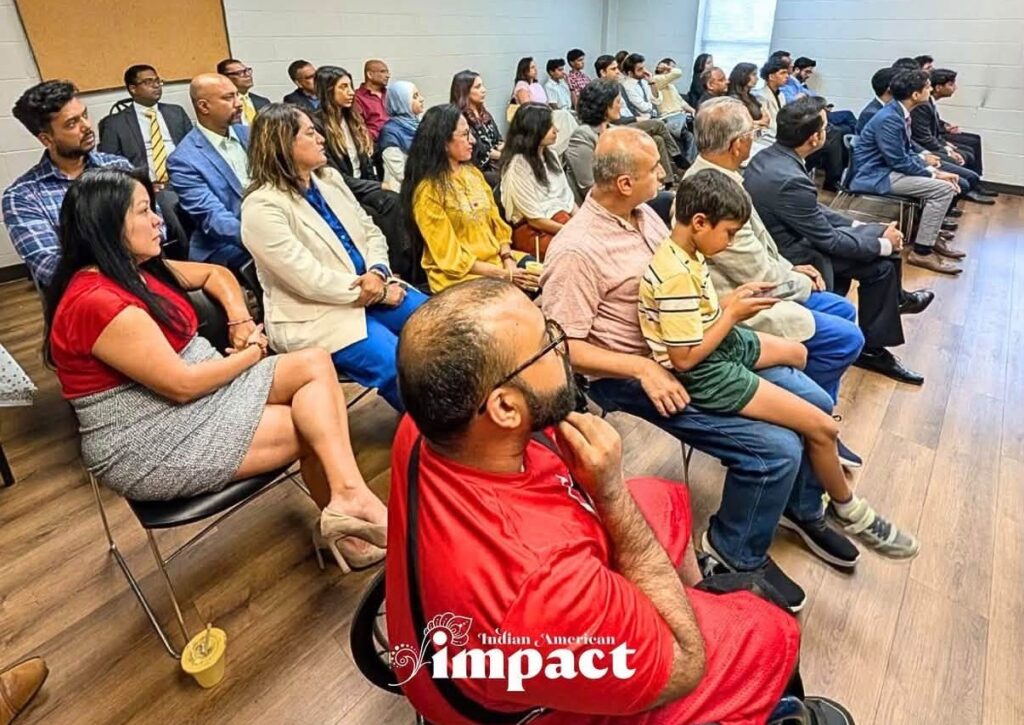
NRI Pulse raises questions on reporting hate, H-1B and federal action
In a brief interview with Congressman Krishnamoorthi, NRI Pulse asked him about three issues arising from the discussion: what victims should do when hate incidents are not adequately addressed by local police, whether the H-1B program needs reform amid rhetoric increasingly directed at Indian workers, and what his proposed Hate Crimes Commission would accomplish.
NRI Pulse City News Editor Jyothsna Hegde cited the recent case of an Indian-American woman who said she was chased on the road by a white man who told her to “go back to India.” Hegde pointed to the difficulties the woman encountered when she tried to report the incident to local authorities and asked where victims should turn when local police fail to adequately document such cases.
Krishnamoorthi suggested taking the matter to higher state authorities.
“I think it’s important that you go to the state Attorney General,” he said. “Usually, the state Attorney General will be a responsible officer for this type of issue.”
He also offered to have his office help determine where such cases could be directed.
NRI Pulse also asked about the H-1B visa program, noting that some of the rising anti-India rhetoric has become intertwined with the debate over H-1B workers, even as legitimate concerns remain about loopholes in the system. Does the program itself need reform?
“I think it does need reforms,” Krishnamoorthi said. “But, you know, fundamentally, it’s an important program.”
He pointed to H-1B workers who eventually obtained green cards, started businesses, and created hundreds of jobs in the United States.
“We have to kind of keep in mind that we should not throw the baby out with the bathwater.”
Elaborating on his proposed Hate Crimes Commission Act, Krishnamoorthi said there’s no commission to look at the rise of hate, arguing that the increase over the past decade warrants dedicated attention, investigation, and recommendations.
The Congressman said he wants the effort to be bipartisan “so that nobody can claim that it was just a political exercise.”
“Whether you are a Muslim, Hindu, Jew, whether you’re gay, straight, a minority or woman, there’s so many groups that have seen just the rise of hate,” he said, adding that it has manifested in “some very ugly incidents” over the past decade.
The goal, he said, is to develop findings that can lead to action — including better measurement of hate incidents and possible reforms addressing the role of social media in amplifying hateful content.
Photos by: Indian American Impact and NRI Pulse.
*Veena Rao is the founder and editor-in-chief of NRI Pulse.
