





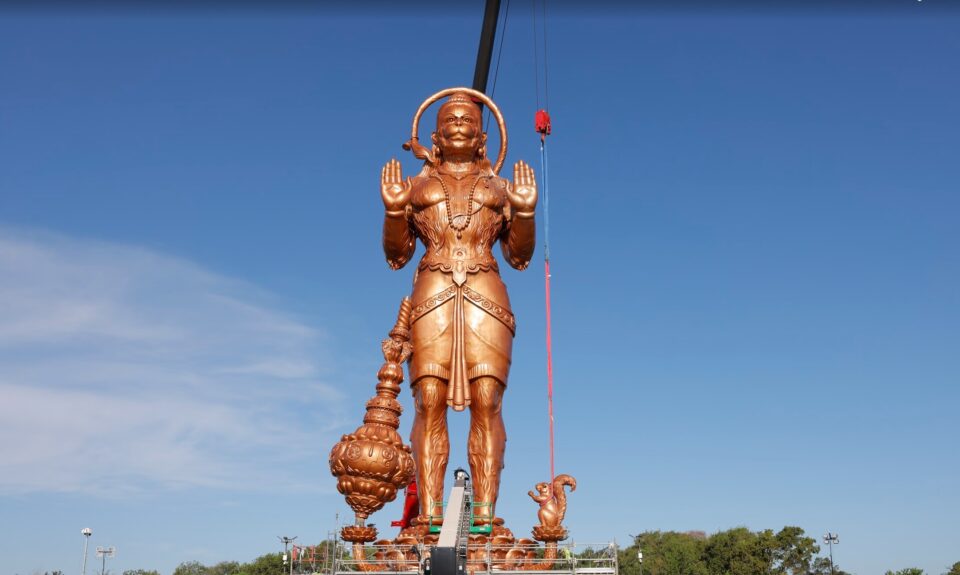
Sugar Land, TX, September 22, 2026: A 90-foot statue of Lord Hanuman at a Hindu temple in Texas has again become the center of controversy after conservative YouTuber Jesse Hughes said the monument would be torn down “when we win,” prompting strong reactions from Hindu Americans and a U.S. Army combat veteran.
Hughes posted a photograph of the towering statue on X with the message: “Btw, when we win, we are tearing this down.” He did not specify what he meant by “when we win” or explain how he believed the privately located religious monument could be removed. Multiple news organizations reported the post this week.
The statue, known as the Statue of Union, stands at the Sri Ashtalakshmi Temple in Sugar Land, in the Houston metropolitan area. According to the temple, the 90-foot monument is the tallest statue of Lord Hanuman in North America. It was envisioned by Sri Chinna Jeeyar Swamiji and named the Statue of Union in reference to Hanuman’s role in reuniting Rama and Sita in the Ramayana.
Hughes’ comment drew a particularly forceful response from Ruchir Bakshi, a Hindu American and U.S. Army combat veteran who served in Afghanistan and Iraq.
“I’m a U.S. Army combat veteran and a Hindu American,” Bakshi wrote on X, before arguing that his military service was not undertaken so that Americans could threaten another community’s religion. Bakshi said he had served alongside Christians, Jews, Muslims, atheists and other Hindus and described the suggestion of tearing down the statue as incompatible with religious liberty.
“When we win, we are tearing this down” is “not patriotism,” Bakshi wrote, calling the statement “a threat against Hinduism itself.” He added that religious freedom should apply equally to Hindu Americans.
The Coalition of Hindus of North America also responded to Bakshi’s comments, saying it shared his concern about what it described as “open religious bigotry” being mainstreamed on social media.
The latest dispute is not the first time the Hanuman statue has attracted opposition.
Soon after the statue was consecrated in August 2024, about 25 members of the Humble-based Awakening Generation Church gathered at the temple grounds. According to contemporaneous reporting by the Houston Chronicle, members prayed and walked around the statue, while some approached temple visitors to preach Christianity. Some participants could be heard saying that “false gods” should burn, the newspaper reported.
The church’s pastor, Rev. Greg Gervais, disputed the characterization of the gathering as a protest, telling the Chronicle that the group had come to pray peacefully for people in Sugar Land. He acknowledged that his church regarded the statue as representing a “false idol” but said the group intended to remain peaceful.
Following that incident, temple leaders hired security guards and announced plans to install security cameras. Temple founder Dr. Ravi Tamerisa told the Chronicle at the time that temple officials had never expected they would need security.
The statue resurfaced in political debate in September 2025 when Alexander Duncan, then a Republican candidate for the U.S. Senate from Texas, posted a video of it and questioned why a statue of what he called a “false Hindu God” was being allowed in Texas, while declaring the United States a Christian nation. His remarks drew criticism from Hindu organizations and others who pointed to constitutional protections for religious freedom.
The current controversy comes amid a broader debate in Texas over immigration, religious identity and the state’s growing Indian-American population. Recent reporting by the Houston Chronicle has documented increasing anti-Indian and anti-Hindu rhetoric in the state, including disputes involving immigration, H-1B visas and Hindu religious expression.
The Statue of Union itself is located on temple property. Contemporary reporting on its construction said the temple began securing permits in 2023 and that engineers designed the structure to withstand winds exceeding 180 miles per hour because of Houston’s hurricane risk. The statue survived Hurricane Beryl while still surrounded by scaffolding in 2024.
For the Sri Ashtalakshmi Temple community, the monument is intended to symbolize strength, devotion and selfless service. The temple describes it as a spiritual center and says its name reflects Hanuman’s role as a unifying figure.
The latest call to tear it down has once again placed the monument at the intersection of two constitutionally protected forms of expression in the United States: the right to voice religious or political criticism and the right of religious communities to worship and maintain religious symbols on their property.
