





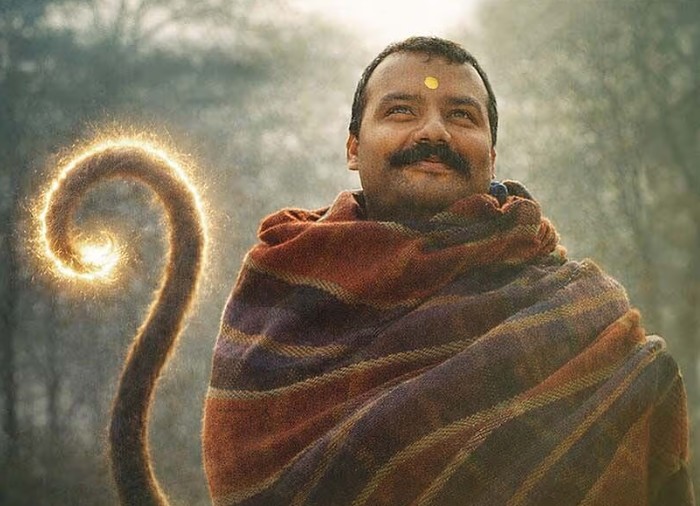
Cover photo: A full house at AMC Avenue Forsyth 12 for a late night screening of Hanuman Ansh. Inset: A scene from the movie.
BY NAMITA DOGRA SUDAN*
It is not often that a film releases in India and arrives in overseas theatres nearly a month later, only to find packed houses in the United States. Movie Hanuman Ansh, which is based on the life of Neem Karoli Baba, is one such unusual success story.
Released in India on August 7 and arriving in overseas markets on September 11, a ₹2 crore film has generated considerable curiosity among Indian audiences in the US. At the time of this review, Hanuman Ansh has reportedly crossed the ₹268 crore mark worldwide, including around ₹15 crore from its opening overseas weekend.
The film’s overseas distribution has been handled by Hombale Films, the production house behind major blockbusters such as Kantara and KGF. Their decision to take this relatively small-budget film to international audiences has helped introduce Hanuman Ansh to viewers beyond India.
From an Early Setback to a Word-of-Mouth Success
When Hanuman Ansh initially opened in India, it was reportedly written off by some as a flop. However, the film gradually gained momentum through word of mouth. Its performance eventually saw it competing successfully with much bigger titles, including Mirzapur and Toxic, at the box office. Its overseas response suggests that there is a sizable audience for films that offer something different from the increasingly common formula of high-octane action and violence.
During a Saturday night screening in the US, the theatre was packed from top to bottom. Families had turned up with young children as well as elderly parents. The strong turnout for a late-night show was particularly striking and reflected the film’s appeal as a family viewing experience. Whether the audience’s interest comes from a growing curiosity about Neem Karoli Baba, a desire for clean family entertainment, or simply the spiritual appeal of the subject is difficult to say. For many viewers, however, the film appears to have arrived at a time when they were looking for something more inspirational and emotionally grounded.
Who Is Neem Karoli Baba and Why Is He So Popular Today?
For audiences who may not be familiar with Neem Karoli Baba, the film’s subject has an interesting connection to contemporary pop culture. Neem Karoli Baba, born Lakshman Narayan Sharma, was an Indian spiritual teacher who died in 1973. Despite his death more than five decades ago, his influence has continued to grow, including among a younger generation that has discovered his teachings through some of the world’s most recognizable names in technology, entertainment and sports. Apple co-founder Steve Jobs visited India in search of spiritual guidance and was influenced by Neem Karoli Baba’s teachings. Facebook co-founder Mark Zuckerberg has also spoken about the role Baba’s ashram played in his life, while actress Julia Roberts has publicly discussed her connection with Hindu spirituality and Neem Karoli Baba.
In India, Neem Karoli Baba has received another wave of attention in recent years, particularly after cricketer Virat Kohli and actress Anushka Sharma visited his ashram at Kainchi Dham. Their visit brought renewed attention to the ashram and Baba’s legacy among millions of younger Indians and social-media users. As a result, Neem Karoli Baba has moved beyond being known primarily within spiritual circles and has become a recognizable figure in contemporary pop culture. That growing curiosity may also help explain why a film about his early life has managed to connect with audiences well beyond its expected market.
The Story of Hanuman Ansh
Hanuman Ansh tells the story of Neem Karoli Baba, beginning with his childhood as Lakshman Narayan Sharma. The film traces his decision to leave home at the age of 13 and his journey of devotion and spiritual search through Lord Rama and Lord Hanuman. Among the episodes depicted is the famous train incident associated with Neem Karoli Baba, in which a train is said to have stopped after he was made to get off. Rather than focusing on a single episode, the film brings together significant events and spiritual experiences from roughly the first 42 years of his life. The storytelling remains largely calm and devotional, allowing the character and his journey to remain at the centre of the narrative.
Authentic Period Setting Stands Out
One of the film’s strongest aspects is its visual treatment. Director Vishal Chaturvedi and cinematographer Vishal Bawa have recreated the pre-Independence setting with considerable attention to detail. The villages, temples, surroundings and period atmosphere give the film an authentic look and help transport the audience into the era in which the story unfolds. The film does not depend on a large roster of established stars. Instead, it features several familiar faces alongside relatively lesser-known performers. Lead actor Shobhinaw Satyaa, who played Neem Karoli Baba, stole the show. Purnima Tiwari makes a strong impression as Rambeti Sharma, bringing sincerity and emotional depth to her role. The performances across the cast are generally effective, with the actors fitting naturally into the film’s period setting. The filmmakers have also incorporated a few subtle comic moments, which provide some lighter touches without disrupting the devotional tone.
The film’s technical strengths extend beyond its cinematography. The editing is crisp, while the background score works effectively in supporting the emotional and spiritual tone of the story. One of the most memorable moments comes towards the climax, when the complete Hanuman Chalisa is sung. Rather than feeling forced or inserted simply for devotional effect, the sequence arrives at a natural point in the narrative and creates a genuinely moving, goosebump-inducing moment.
Where the Film Could Have Been Tighter
Hanuman Ansh is not without its shortcomings. At approximately two hours and 30 minutes, the film could have benefited from some trimming. Certain portions could have been shortened or omitted altogether, bringing the runtime closer to two hours and making the overall experience more streamlined. The film also does not follow the conventional pattern of dramatic highs, sudden twists and cinematic action peaks. Its pace remains calm and steady for most of the runtime.
For viewers expecting a conventional commercial entertainer, this measured storytelling may feel slow at times. But for audiences approaching the film as a devotional and inspirational family drama, the steady pace is likely to work better.
The Unusual Story Behind the Lead Actor
Perhaps one of the most intriguing stories associated with Hanuman Ansh concerns its lead actor, Shobhinaw Satyaa, who plays Neem Karoli Baba. Satyaa was reportedly not originally supposed to play the lead. He was working as the film’s assistant director. According to the story shared by director Vishal Chaturvedi, the actor originally cast as Baba fell ill just one day before shooting was scheduled to begin. With the film being made on a reported budget of only around ₹2 crore, there was little time or money available to bring in another actor. The director noticed that Satyaa was a devoted follower of Neem Karoli Baba and that his appearance bore a resemblance to the spiritual figure. After an audition, he was given the lead role.
It is a remarkable turn of events—and whether one sees it as coincidence, circumstance or something more spiritual will depend on one’s personal beliefs. For a film centred on faith, however, the story adds another fascinating layer to its journey.
Even the Monkeys Became Part of the Story
There is another unusual detail that adds to the film’s behind-the-scenes story. The opening credits include a special thanks to monkeys and langurs. Director Vishal Chaturvedi has reportedly spoken about how monkeys and langurs would unexpectedly appear during the shoot. One langur apparently came into the frame and sat quietly without any instruction from the crew. In another instance, a dog reportedly appeared on its own during a scene involving Baba. Rather than removing these unexpected appearances, the filmmakers chose to retain some of these real moments in the final film. For a movie built around spirituality and faith, these little coincidences have inevitably become part of its larger story.
Verdict
Hanuman Ansh may not have the scale, star power or conventional commercial formula of a major Bollywood release, but that is precisely what makes its journey interesting. It is a simple, devotional and inspirational family film that appears to have found an audience through word of mouth rather than hype. Its strongest elements are its authentic period setting, sincere performances, cinematography, editing, and emotionally effective music. The film could have been shorter, and its calm pace may not appeal to everyone. But if you are looking for a clean film that you can watch with children, parents and grandparents, Hanuman Ansh is worth considering.
And for those who miss its theatrical run, the film is worth keeping an eye out for on OTT. The makers have also indicated that more stories from Neem Karoli Baba’s life are planned in two future instalments, with the subsequent films expected to explore the rest of his life and his international recognition.
For a film whose journey feels almost as surprising as the story it tells, Hanuman Ansh has certainly found an unexpected place in audiences’ hearts.
Rating – 3.75/5

*Namita Dogra Sudan is the entertainment news editor and video news producer of NRIPulse.
