





NRI PULSE STAFF REPORT
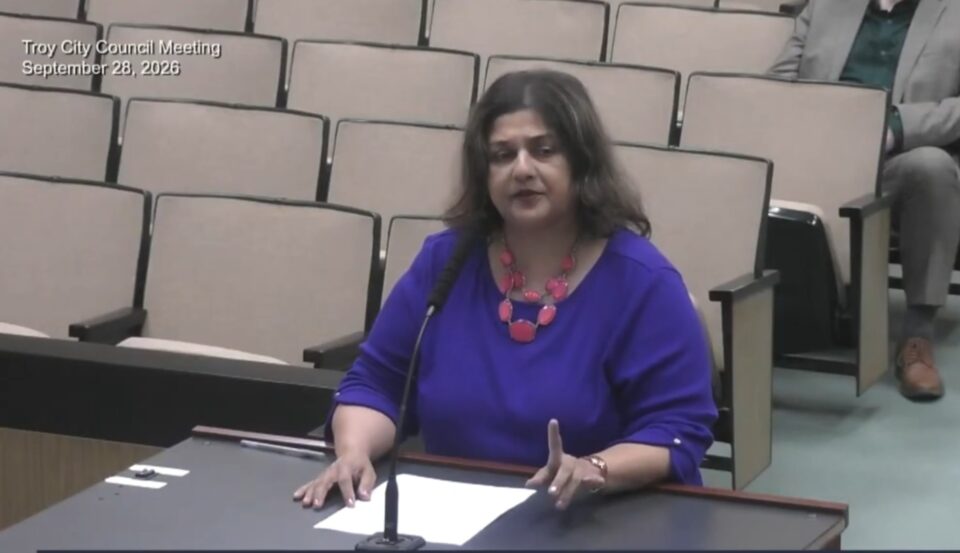
Troy, MI, October 13, 2026: Hindu American community advocate Padmaja Rao addressed the Troy City Council in Michigan, calling for greater understanding of Hindu beliefs and traditions amid concerns about rising anti-Hindu prejudice and misinformation in the United States.
Rao, a resident of Berkley, Michigan, urged city leaders and residents to look beyond stereotypes and engage with Hindu Americans as neighbors, colleagues and fellow members of the community.
“Sadly, many people are learning about Hinduism from stereotypes, social media, or limited exposure, rather than meaningful interactions with Hindu families,” Rao told the council.
She began by acknowledging the city’s commitment to welcoming diverse communities and said her remarks were intended to deepen understanding and strengthen mutual respect.
Rao explained that Hindu beliefs and practices are sometimes misunderstood because they require cultural and philosophical context that may be unfamiliar to those outside the tradition.
At the heart of her address was the Hindu concept of dharma, which she described through values that Americans across religious and cultural backgrounds would recognize.
“These values include honesty, integrity, responsibility for others, respect for parents and elders, service to the community, self-discipline, gratitude, reverence for life, accountability for one’s actions, and respect for diverse paths to spiritual truths,” she said.
Rao emphasized that Hindu Americans contribute to society in numerous ways, working as teachers, engineers, researchers, physicians, business owners, public servants and community volunteers.
Yet, she said, these everyday contributions are often overshadowed by misconceptions about Hindu worship, symbolism and religious practices.
Addressing one such misconception, Rao explained that Hindus understand the divine as infinite and beyond any single form or image. Sacred representations in temples, she said, help devotees focus on prayer, contemplation and spiritual connection.
She also addressed the subject of caste, arguing that discussions of caste and social hierarchy often overlook historical complexity.
Rao noted that the English word “caste” originated from an Iberian term in the 16th century and that colonial classifications later helped formalize social categories. She urged listeners to consider that historical context rather than make broad assumptions about Hindu families today.
“Understanding begins when we look beyond inherited assumptions and meet one another as neighbors,” she said.
Throughout her remarks, Rao stressed that her goal was not to persuade others to adopt Hindu religious beliefs but to encourage the same respect and openness that every community deserves.
“My hope is not that we all agree on theology or philosophy,” she said. “It’s simply that Hindu Americans be understood through genuine human interactions, sincere curiosity, and the same respect that we seek for every community in Troy.”
She concluded by thanking council members for helping build a city where every resident feels seen, understood and welcomed.
Rao holds a master’s degree in Community Agency Counseling and post-master’s certificates in Peace and International Security Studies and Diversity, Equity, and Inclusion in the Workplace. She is also a certified Global Career Development Facilitator.
An advocate for greater awareness of Hindu traditions, Rao has delivered presentations to Rotary Club members, university audiences and interfaith forums. She has been involved with the Hindu American Foundation and recently received its Dharma Ambassador certificate.
Her advocacy has also included challenging misinformation about Hinduism in local publications and businesses, participating in Michigan’s K-12 textbook standards review process, and pursuing further studies through Hindu University of America.
A second-generation Hindu American woman, Rao has also spoken publicly about her experiences with Hindudvesha, or anti-Hindu prejudice.
Her remarks before the Troy City Council reflected a broader appeal for understanding across religious and cultural differences, beginning with conversations among neighbors.
Padmaja Rao speaks at the City Council in Troy #Michigan about rising anti-Hindu bigotry in the country. Explains the concept of ‘Dharma’ and how it defines values that Americans would consider ideal. https://t.co/2oF8NOV1Xf
— HinduACTion (@HinduACT) October 12, 2026
Cover screenshot courtesy: Hindu Action/X.
