





NRI PULSE STAFF REPORT
The death of a nine-year-old boy riding an electric scooter in Northern Virginia is putting a spotlight on the safety risks children face as increasingly powerful e-scooters become a common sight in neighborhoods across the country.
Badrinarayan Hungund died after a July 23 collision involving his electric scooter and a minivan in the Sully Square area of Fairfax County, near Herndon.
According to the Fairfax County Police Department, officers responded at approximately 5:30 p.m. to the 3000 block of Madden Court following a collision between an electric scooter and a vehicle. Badrinarayan was taken to a hospital in critical condition and later died.
Police said preliminary evidence showed that a woman driving a 2012 Honda Odyssey was making a left turn from Highland Mews Court onto Madden Court when the collision occurred in a parking area.
At a news conference the following day, Fairfax County Police Capt. Harold Morris said the nine-year-old, who was operating the scooter, struck the rear passenger side of the minivan.
Investigators said Badrinarayan was not wearing a helmet.
Police said speed and alcohol were not factors for the driver. Investigators also said they had found no preliminary evidence that she was operating the minivan in an unsafe or reckless manner. The crash remained under investigation.
The tragedy has also brought attention to a larger question confronting parents and communities: Are electric scooters appropriate for young children, particularly in residential areas where they must share space with moving vehicles?
Following the crash, Fairfax County police urged parents to take scooter safety seriously.
“Please have your kids wear helmets. Teach them the basic safety rules. Keep an eye on them,” Capt. Chris Cosgriff said after the collision.
Pediatric E-Scooter Injuries Are Rising
Badrinarayan’s death comes amid growing concern among physicians and safety experts about injuries involving children and motorized micromobility devices.
The U.S. Consumer Product Safety Commission has previously found that children 14 and younger accounted for approximately 36 percent of all micromobility-related injuries between 2017 and 2022, despite representing about 18 percent of the U.S. population.
More recent medical research suggests the problem is continuing to grow.
A 2026 study examining pediatric e-scooter injuries found that injuries rose steadily between 2020 and 2024, with younger teenagers experiencing particularly high injury rates. The researchers said the findings support consideration of age restrictions as an injury-prevention measure.
Another 2026 study comparing electric and traditional bicycles and scooters found a 267.6 percent increase in e-bike and e-scooter injuries among pediatric patients at one children’s hospital between 2021 and 2024.
Researchers found that injuries involving electric scooters were more severe than those involving traditional scooters and were more likely to include head and chest trauma. Helmet use was also lower among children injured on motorized devices.
Not the Scooter Many Parents Grew Up With
For parents, one challenge may be recognizing how different today’s electric scooters are from the kick scooters familiar to earlier generations.
A motorized scooter can travel considerably faster than a traditional child-powered scooter. Virginia law, for example, allows motorized scooters to operate at speeds of up to 20 mph.
That speed can become especially consequential in parking lots, driveways and residential streets, where cars may be backing out, turning corners or entering parking areas and where both drivers and young riders can have limited time to react.
The concern is not simply about scooters themselves. It is also about the environment in which children use them — and whether young riders have the judgment, experience and ability to anticipate vehicle movements.
For parents, however, the broader safety message is already clear: age restrictions, adult supervision, helmets, appropriate speeds and keeping inexperienced young riders away from moving traffic can matter enormously.
As electric scooters become faster, cheaper and increasingly common among children, the rules surrounding what once seemed like a simple neighborhood activity may deserve a second look.
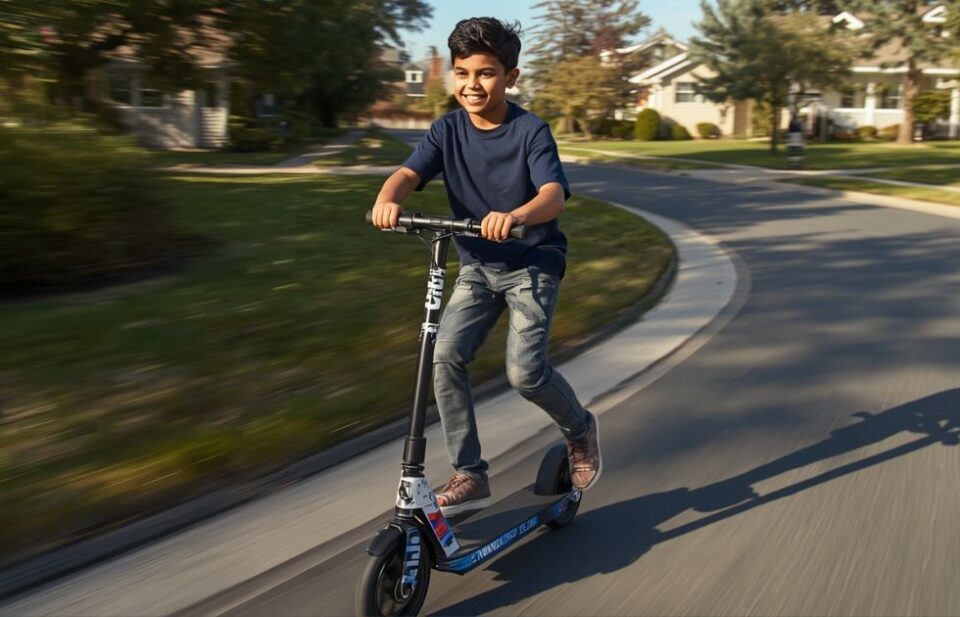
Cover photo generated using Canva for illustrative purposes only.
