




BY VEENA RAO
Washington, DC, July 27, 2026 — As the United States marks its 250th anniversary, a new analysis from the U.S. Census Bureau traces the remarkable evolution of the nation’s immigrant population—from one overwhelmingly European in the 19th century to one shaped increasingly by immigrants from Latin America and Asia, with India now emerging as the second-largest country of birth among foreign-born U.S. residents.
The report, released as part of the Census Bureau’s semiquincentennial series commemorating 250 years since the Declaration of Independence, places today’s immigration patterns in historical context. It notes that the United States was home to a record 50.2 million foreign-born residents in 2024, accounting for 14.8% of the nation’s population—the highest share since 1890.
While the 50.2 million figure was first reported with the release of the 2024 American Community Survey, the new analysis examines how the countries of origin of America’s immigrants have changed over the past two centuries.
In 1850, nearly all—92.2%—of the foreign-born population was born in Europe. That remained largely unchanged through the 1930s, reflecting U.S. immigration policies that relied on national-origin quotas favoring European countries.
A major turning point came with the Immigration and Nationality Act of 1965, which abolished the quota system and introduced a framework that prioritized family reunification, employment-based immigration, and refugee resettlement. The law reshaped the nation’s immigration landscape, opening new pathways for immigrants from Asia, Latin America, Africa, and other regions.
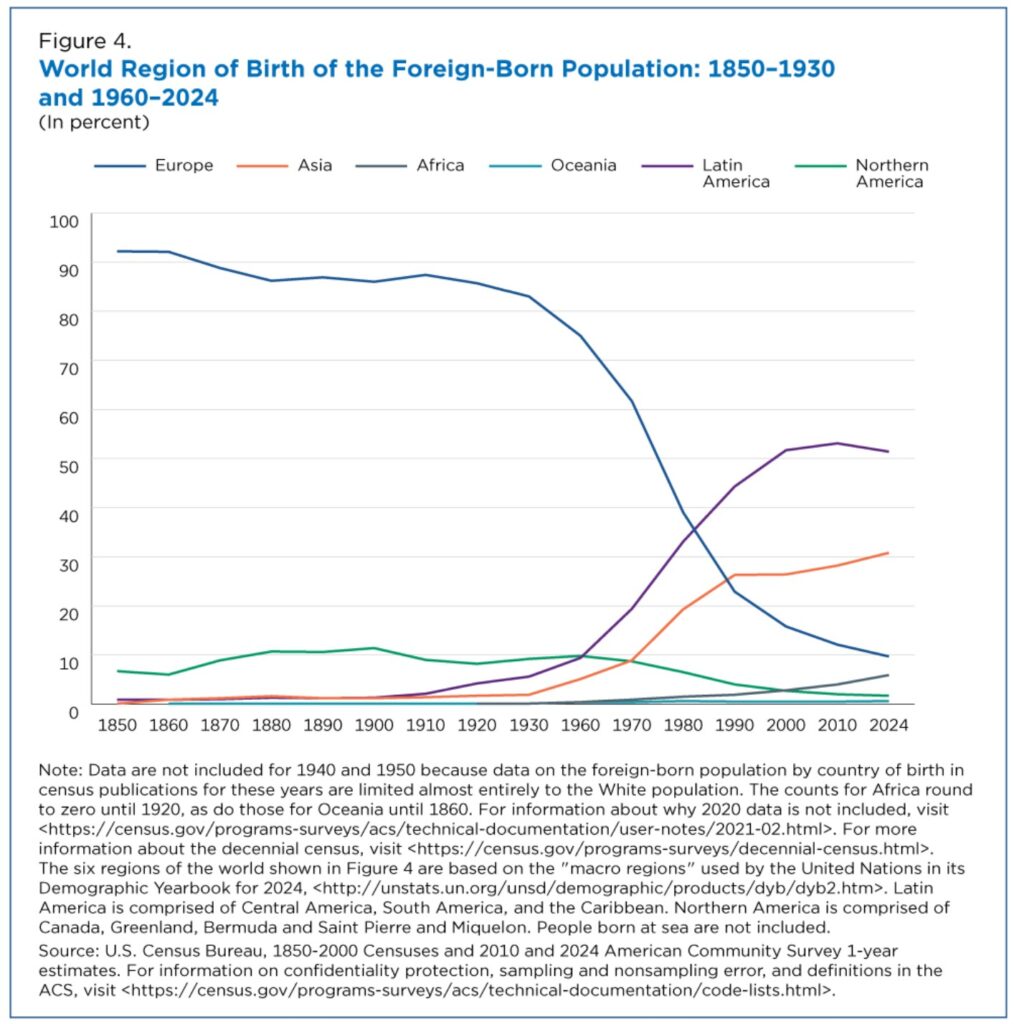
Immigration from Latin America grew rapidly in the decades that followed, surpassing Europe as the largest source region after 1980. At the same time, refugee resettlement following the Vietnam War and increasing demand for highly skilled workers fueled a sharp rise in immigration from Asia. By 1990, the United States was home to more immigrants from Asia than from Europe.
Today, immigrants from Latin America account for 51.4% of the foreign-born population, followed by Asia at 30.8%. Europe now represents 9.7%, while Africa accounts for 5.9%, illustrating how dramatically America’s immigrant population has diversified over the past century.
Within that broader transformation, India has become the second-largest country of birth among foreign-born U.S. residents, behind only Mexico and ahead of China, the Philippines, and El Salvador, according to the 2024 American Community Survey.
The rise reflects decades of immigration driven by family reunification, higher education, and employment-based visas. Indian immigrants have become an integral part of the American workforce, with large numbers working as physicians, engineers, scientists, researchers, educators, entrepreneurs, and technology professionals. Indian Americans are also among the nation’s most highly educated immigrant communities and have played an increasingly prominent role in business, innovation, healthcare and academia.
The Census Bureau’s historical analysis shows that while the origins of America’s immigrants have changed dramatically since the country’s founding, immigration has remained a defining feature of the nation’s growth and development.
Cover photo credit: Census.gov.
