



BY SHIKHA DAS SHANKAR*
The first Sunday morning, Pradeepa wasn’t sure she would go. She had signed up, yes — but the morning came with the pressure of a long to-do list. Her children would wake soon. Her husband needed to know the plan. And then there was the driving: Georgia’s highways that rise and dip without warning. Every reason to stay home made complete sense.
But there was something else underneath the reasons. Wanting something just for herself, on a Sunday morning, when there were children and a household and a family that needed her — was not something she had seen growing up. Nobody had modeled this. The familiar feeling of guilt settled in, like it often does when a South Asian woman tries to do something just for herself.
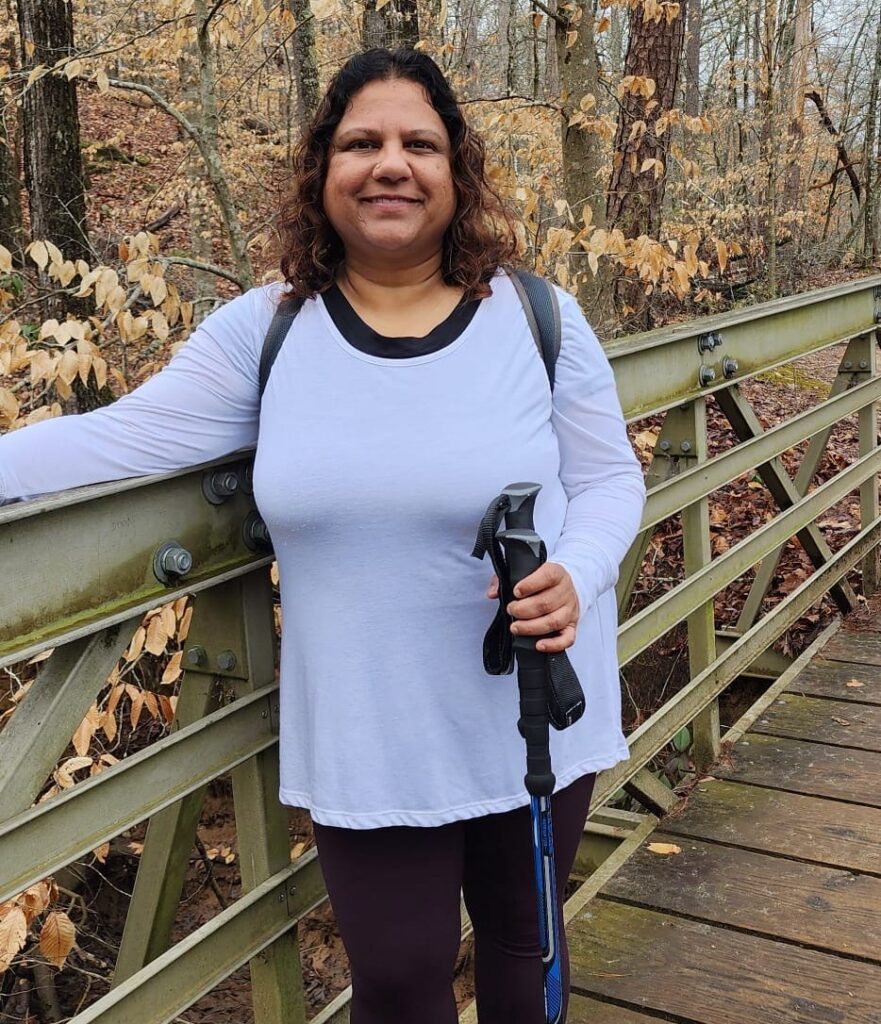
A friend came to pick her up. Pradeepa got in the car. She made it to the trailhead, made it through the hike, and made it home. And she has not doubted the decision ever since. Her family coordinates around her now. The children grew to expect her Sunday mornings away. Her daughter tells her friends: my mom is a hiker, she goes every week. She signed up for half marathon training. She started doing things she had told herself were for braver people.
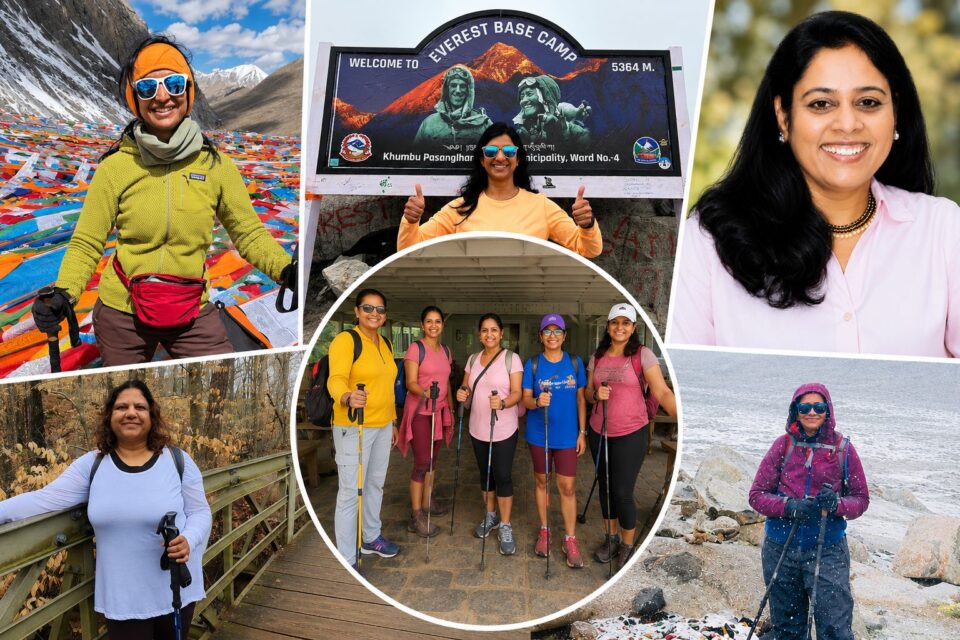
What she found on those trails was not what she expected. Not just the walking, or the fresh air, or the beauty of the outdoors. It was the women. Women raising kids, holding careers, and training for half marathons, doing strength training, practicing yoga — showing up for themselves in ways Pradeepa had not thought to model for herself. She watched them and felt something loosen. “I got inspired from them,” she says simply.
She said something during our conversation that has stayed with me. Said plainly as an observation and not as a complaint, Pradeepa says, “We don’t see our moms taking out time for themselves unless some medical problem happened — if the doctor said you need physio because your knees are hurting. That was the only time our moms took out time for themselves.”
It’s an offhand line, but it’s the whole article in one sentence. For a generation of South Asian women, rest was prescribed like medication. Self-care was taken into consideration only when doctors intervened, not as a choice made on its own terms.
For a long time, the outdoor life of most South Asian women fit inside a very small radius. A jaunt around the neighborhood, a walk to the school bus stop, the grocery store if it was close enough. The idea of driving forty minutes to a trailhead, lacing up proper boots, doing something purely for the body and the mind — that belonged to a different season of life. One that started when the kids got older and when the house needed less attention.
That a woman like Pradeepa could get in her car on a Sunday morning, drive herself to a trailhead, and come home different did not happen by accident. It happened because a few women decided to build something without waiting for anyone to say it was time. They didn’t start a trend. They started a reckoning conducted entirely on trails and WhatsApp groups.
No awards will come for this work and yet they are doing something that is subtly changing lives — anchoring women to grow, to thrive, to take risks, to try something new, to be adventurous, or simply to live a dream they have carried since they were girls looking up at mountains and wondering.
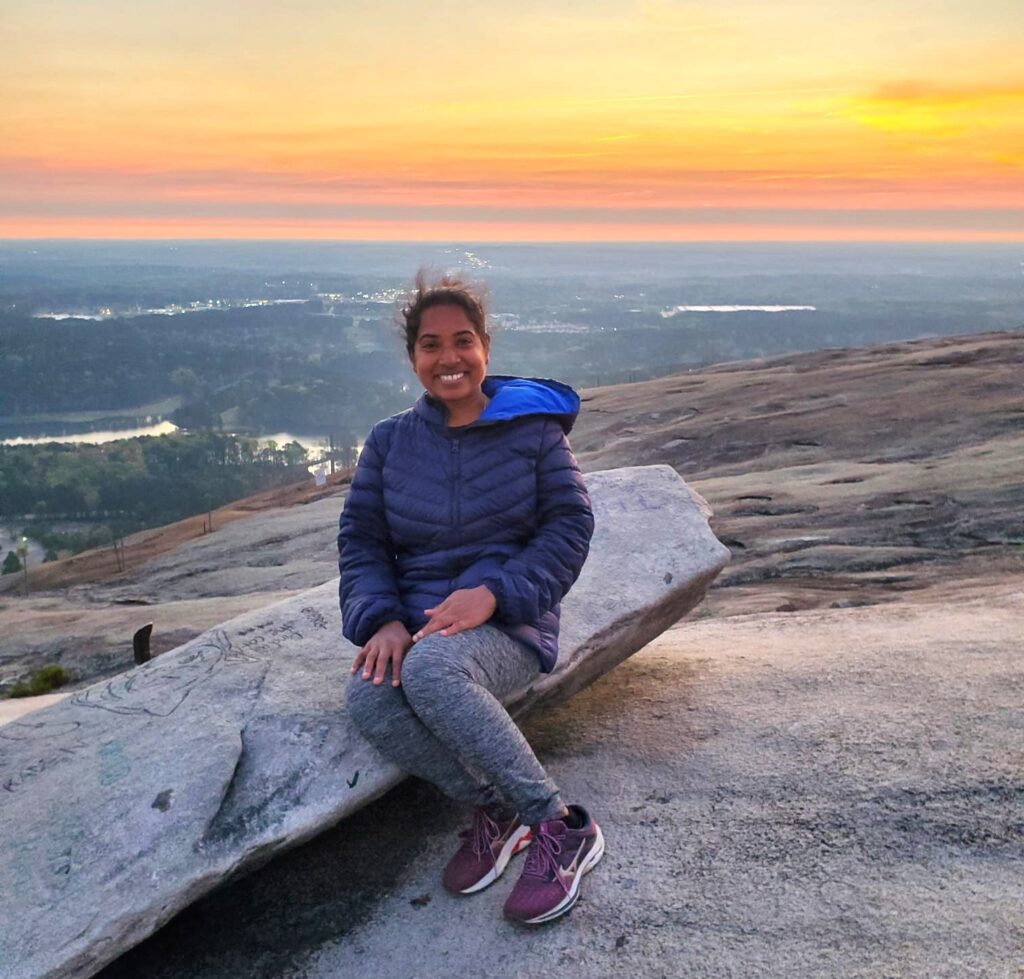
Anu Ganesh: Trail to Sisterhood
Anu Ganesh, regional marketing director of Mylapore Express, mother of three, and someone who grew up between two countries before planting roots in Metro Atlanta, was not looking to build a movement.
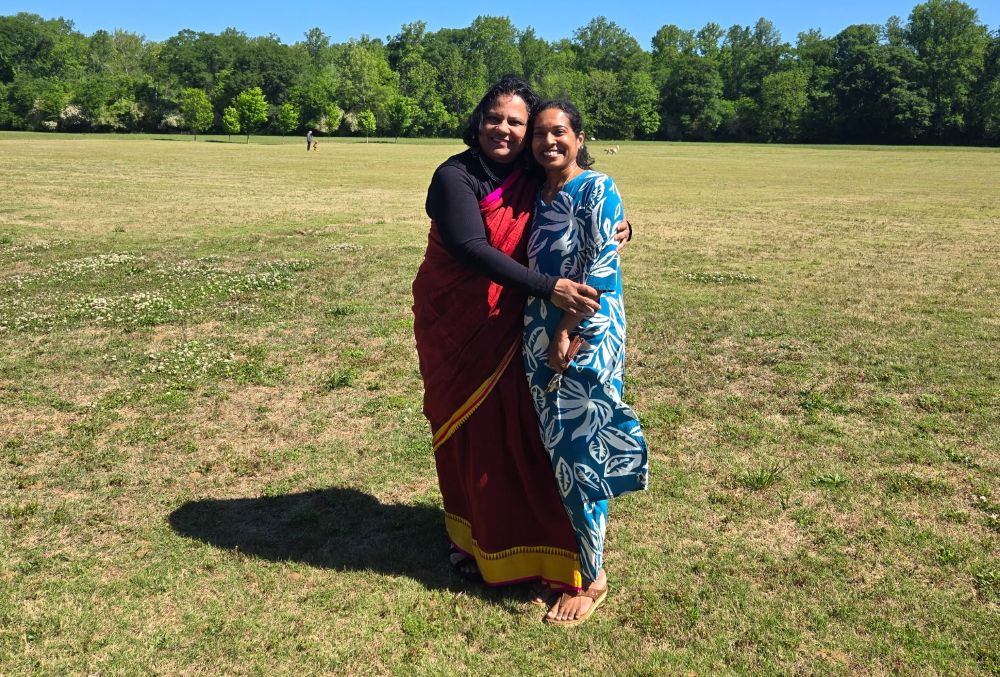
What she built, Sunday after Sunday, was a hiking group that grew with each week until it became something closer to a circle of sisters. The conviction that women needed this had taken root in her initial years of hiking. Not only did more women need to step out into the outdoors, but they each other on the trail, forgetting about the long list of things that waited for them at home.
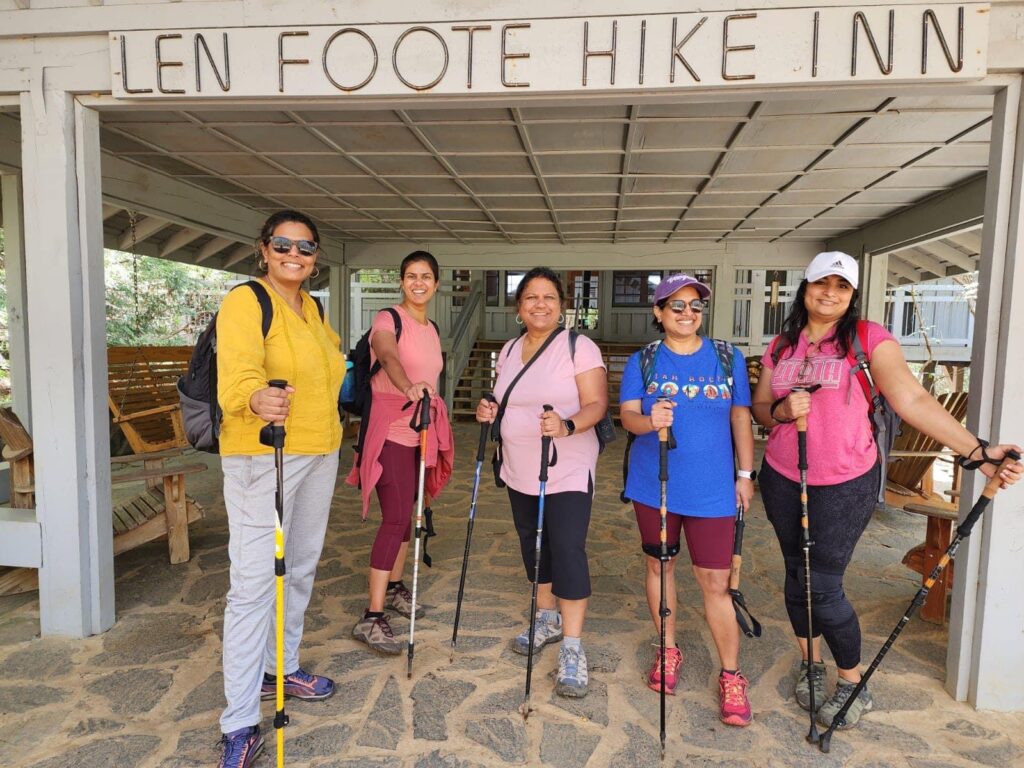
She started small, just a few close friends who enjoyed hiking. Women showing up week after week to walk through Georgia woods together. That was 2022. Today, Anu and Her Warriors has grown into one of Metro Atlanta’s most prominent South Asian women’s hiking communities with nearly 500 members, and Anu Ganesh has become something of a pioneer.
What she built is not, strictly speaking, just a hiking group. You understand this quickly when you talk to her. The hiking is the frame, and inside it lives something much older and essential — a sisterhood that forms when women are given enough space and enough trust to stop performing. Like the trails they walk on, conversation meanders from weather conditions to hiking gear, from new motherhood to the exhaustion of building a life across two cultures. Women share not because they have to but because nature and company have a way of loosening what the heart holds tightly.
Her icebreaker question before the start of a hike is deceptively simple: “Tell me something you did for yourself this past year.” The silence that follows, she says, used to surprise her. Blank faces. Women reaching for an answer and finding nothing, or finding something so small they were embarrassed to say it out loud. She is no longer surprised. She has come to understand that for many South Asian women, the question itself is radical.
The group is women-only, and that is not incidental. Anu has thought carefully about what that boundary makes possible. She has watched women arrive guarded and leave loose-limbed and laughing. She created a space where nobody has to perform, and nobody has to explain why they needed to get out of the house. “I wanted this to be a place where you could just be. Without any strings attached.”
Anu recalls a woman who called before her first hike, asking how to get permission from her husband to come. Anu told her to reframe it. “Don’t ask, can I go? Say instead — I would like to go, how can we make this work?”
The guilt women carry, Anu says, does not care what kind of woman you are. “Those who are stay-at-home moms are guilty they didn’t go to work. Those who are working are guilty they didn’t spend the time. It’s like we’re born with guilt.” Her group does not promise to fix that. It just gives women somewhere to put it down for a few hours.
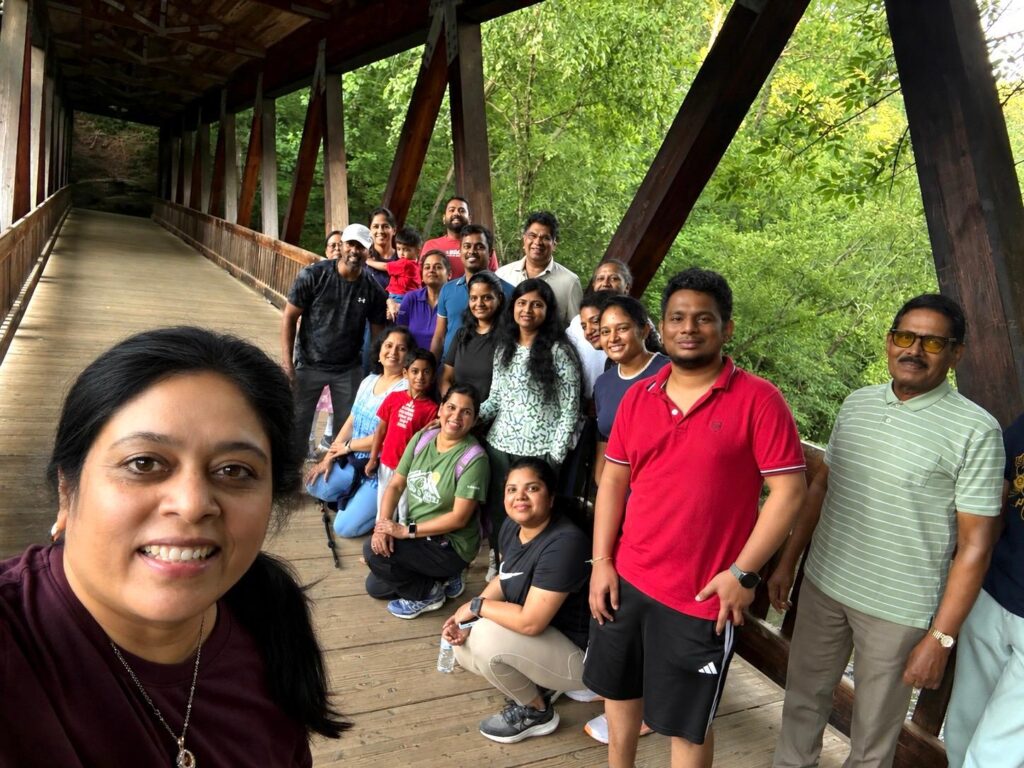
Something beautiful started happening alongside the growing numbers. Women met on her trails and formed their own groups — other hiking communities, hobby circles, groups for women navigating menopause, spaces for every specific need a general hiking group couldn’t fully hold. From her group came others — a kayaking circle, a running group, women learning to swim for the first time, a gathering called Bhajan and Bhojan for empty nesters finding their footing in a quieter house. Two members once ran into each other in Iceland, strangers to that country, not to each other. Anu heard about it and laughed. “If I could provide a platform for women to find each other and build something of their own — that is more than enough. That is the whole point.”
The most heartfelt moment came towards the end of our conversation, delivered in true Anu style — without fanfare: “Leave everything a little better than you find it.”
She means the trail and she means the women on it.
Dr. Snehalatha Talika: No Rules, No Roster, Just the Trail
Talking to Sneha Talika made me think: here is a woman who has found her pace and her purpose. Soft-spoken, unhurried, with a warmth that feels like a gift in a world that rewards noise and self-promotion. What she does not tell you, unless you ask, is that she is also Dr. Snehalatha Talika — mom, author, lyricist, filmmaker, book club founder, visiting professor, and the kind of person who, in her spare time, provided an IoT model to the government of Thailand. Her hiking group, TS Hikes, had just completed its 150th hike when we spoke — and with more than 400 members, it shows no signs of slowing down. That she will tell you about freely, without prompting, eyes lighting up — because it is the thing she loves most and she cannot quite help herself.
TS Hikes runs on a very simple philosophy. No matching t-shirts. No social media presence. No accountability structures, no attendance registers, no reminders to show up. Sneha is unapologetic about this. “I’m not running a school,” she says. “These are adults. They know what they want.” “I don’t have any identity crisis, nor do the team members. We wanted to come together voluntarily, come and explore the world, and explore the world in you and outside.” This is exactly what she offers — a group that exists without performance pressure, where nobody is tracking you, nobody is waiting for you to post a photo, and nobody needs you to be anything other than a person who showed up to hike.
The group is open to all, men and women both, and the trail conversation follows the same no-fuss rule. No talk of jobs, no talk of children, no talk of the ten thousand things that follow everyone everywhere. Just each other and whatever the woods are offering that weekend.
When the group reaches a summit, something shifts. Sneha describes it with the delight of someone who has watched it happen 150 times and still finds it remarkable. People stand with a sense of achievement at the top and conversation changes as people loosen up. For sunrise hikes that begin at 4am, she carries coffee in her backpack for eight or ten people. Some bring homemade snacks to share. They watch the light come up over Georgia together while someone starts the Surya Namaskar, some sip coffee, and others bask in the beauty of the rising sun.

Nobody is left behind on a TS Hikes trail. If someone is gasping, struggling, falling behind, someone else slows down and holds the pace with them until they are back on track. “It is not a competition for who goes first,” Sneha says. “It is a competition of me with me. I got to do better than what I did before.” Some hikers arrived at their first group hike and discovered that their fitness was not where they thought it was. With humility and determination, they went home, trained and came back stronger. Hiking had told them something true about themselves and they had listened.
For Sneha, returning to the same place with different eyes is its own kind of adventure. It is also what keeps people coming back. “If you hike all four seasons, you see colors changing, you see the greens, the leaves coming up in spring. We hiked during winters, summers, through fall season. Every experience is unique. Everybody’s emotional and mental health, psychological need, whatever the stress they have — they work it out here.”
“Every season, the same trail seems different,” she says. “Every experience is unique.”
This is what TS Hikes offers that no gym or wellness app can replicate. Just a trail, a group of people who showed up, and the revelation that somewhere between the trailhead and the summit, you are more capable than you knew.
Anuradha Radhakrishnan: The Quiet Determinist
There are people who talk about mountains and people who climb them. Anuradha Radhakrishnan does not talk much about either.
She will tell you, quickly, that she is a private person. A working professional, mother of two, someone who hikes when life doesn’t get in the way and does not make a fuss about it. But sit with her for a while and something else surfaces. In her measured words you sense someone who knows exactly who she is — determined, discipline and unshakeable in both. She agreed to speak to NRI Pulse because she hoped something in her story might nudge another woman to shed her doubts and hit the trail.
Her journey began over a decade ago with a small idea and a handful of friends. It started with Stone Mountain and then the many trails fanning out across Georgia. Then her daughter came home from Machu Picchu glowing and said: Mom, your group should do this. They did but Anuradha missed that first trip. Work pulled her back but the desire never left.
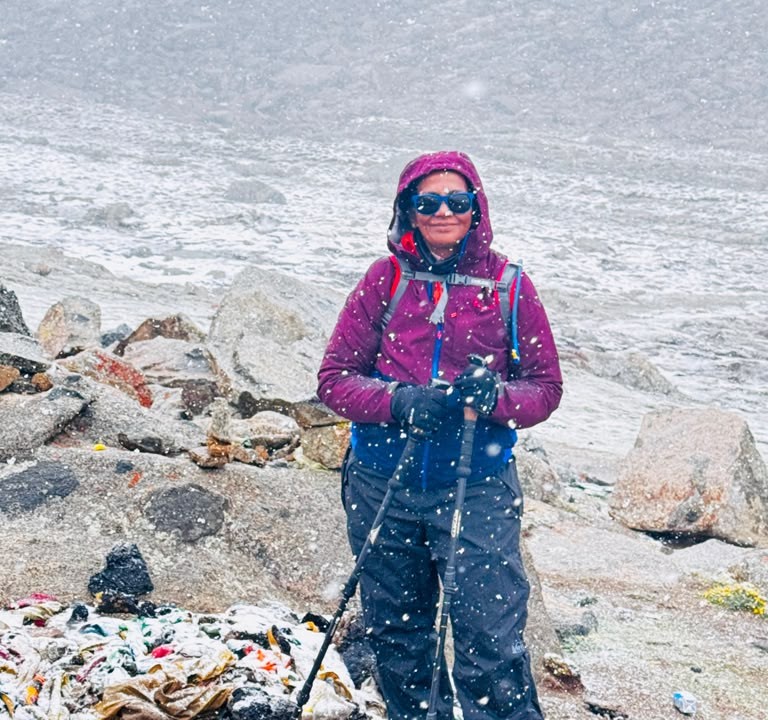
What followed was a decade of scaling to new heights and challenging herself. Each hike started becoming more challenging than the other. Grand Canyon’s South Rim to Phantom Ranch and back, Patagonia, the Berlin Marathon, with her daughter, were some memorable ones Anuradha recalls.
Somewhere along the way, she and a friend noticed a gap. Hiking groups around them were warm and welcoming, mostly easy to moderate, and perfect for a Sunday morning. But for those training for something that demanded hard miles every weekend, there was nowhere to go. That conversation became the Extensive Hiking Group — now 70 to 80 members, co-administered by Anuradha. The group does nothing less than 10 miles of hard hikes only. “This caters to those individuals who are gradually honing their skills, or those who already have a trip in mind — like if you’re planning Kilimanjaro, you want a group going hard every weekend as part of your training.”
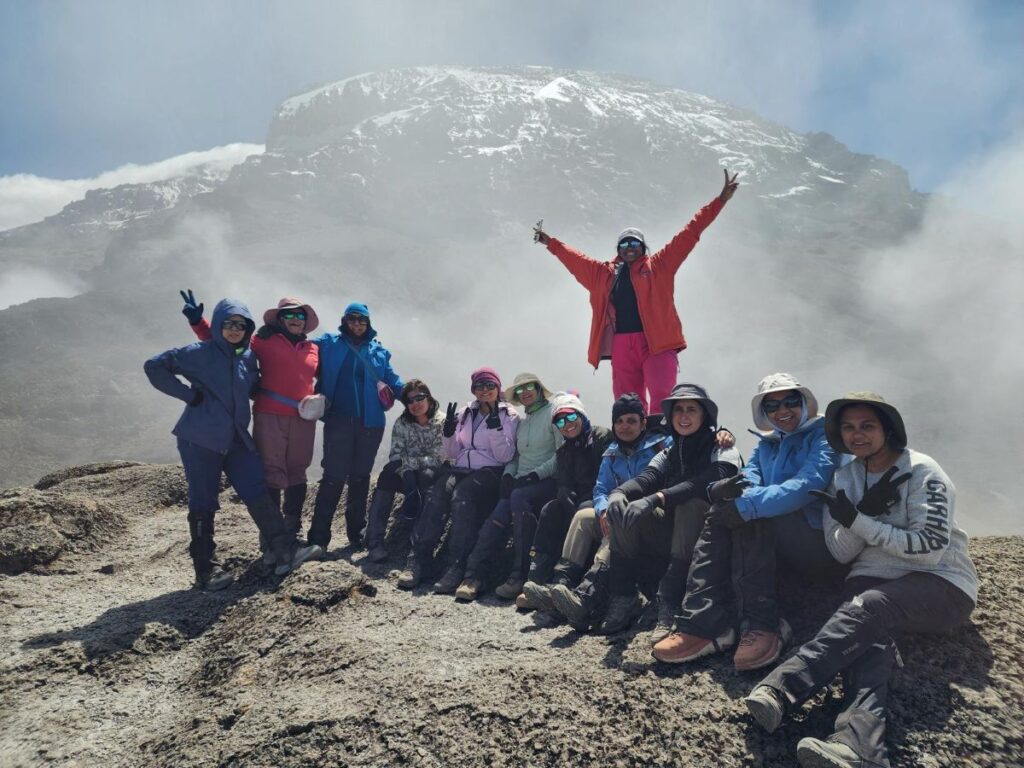
The Kilimanjaro expedition in 2023 was the first major international test. Fifteen women were recruited and trained. Before summiting Kilimanjaro, a qualifying climb up Mount Elbert in Colorado at 14,400 feet was done to test altitude tolerance and experience what it feels like to hike when air is scarce. “Once you cross 12,000 or 13,000 feet, your oxygen level drops almost 50 to 60%. Every 10 steps, you have to wait for a second. You are walking very slowly.” “Nobody understands that unless you do it for the first time. We were doing one hard hike every weekend, so we thought, oh, we’re all good,” Anuradha says on the importance of hiking Mount Elbert.
Eventually, all fifteen summited — a hundred percent success rate that showed what determination and preparation together can achieve.
Anuradha had just returned from Kailash Mansarovar when we spoke — a trip she had wondered, in the months before departure, whether life would actually let her take. She admits that something about that mountain felt different from anything before it. But there was something she always knew about herself. “I always knew I had the mental strength. If I wanted to do something, I would do it. The physical part is not within our reach — anything can go wrong.”
To the South Asian women of Metro Atlanta watching from the sidelines, she has one thing to say. “Your personal growth is as much important to your family as it is to you. If you take care of yourself, you’re going to feel good. That’s how your family is going to feel good too.”
She pauses. Then, almost to herself: “I always thought — I wish I started doing these things much earlier in life.”
Sridevi Reddy: One Step Further
As a child, whenever Sridevi visited her aunt’s village, she would spend time outdoors, exploring the nearby hills, looking up at the mountains and wondering what it would feel like to stand on a summit. She didn’t have the experience or the equipment to find out. Life happened and with it came responsibilities — work, studies, marriage, two children, a move from Chicago to Georgia, and the particular busyness of building a home across two cultures. But the wondering never quite left. It just waited.
Over the last few years, once her children became more independent, she felt what she describes as a strong pull back to the outdoors. She started slowly — Georgia state parks first, Vogel, Amicalola, the trails across the northern parts of the state and Tennessee on weekends when her husband was home and the timing held. She moved from moderate to strenuous quickly. And somewhere on those trails she noticed something. Her energy wasn’t running out the way other hikers’ did. She kept pace, pulled ahead, then began to wonder what would happen if she pushed further.
Most people stop at moderate. Sridevi looked at the trail ahead and thought: what if it isn’t enough?
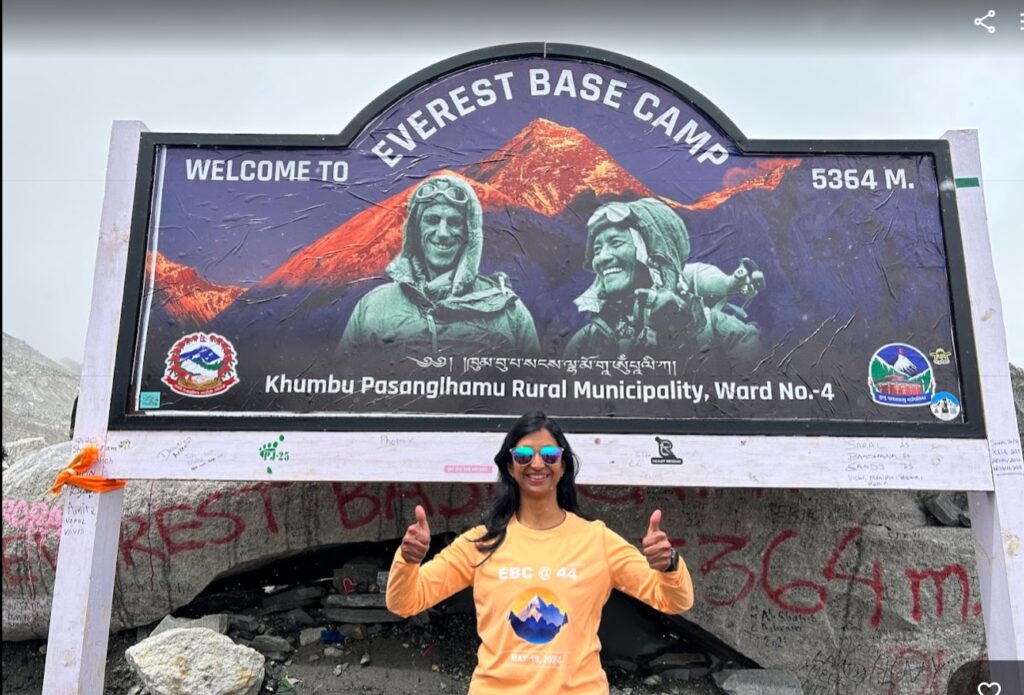
The bucket list she had built through all those years of busyness was finally coming back to her. Grand Canyon down to the river and back — a hike that had lived in her mind since 2002, when she visited as a tourist. The list kept growing: Machu Picchu, Mount Whitney, Mount Elbert, the south face of Everest Base Camp over an eight-day trek. The daydreams became a record of places she had conquered. “I especially enjoy multi-day treks that challenge both body and mind,” she says.
She is clear-eyed about what this kind of progression demands. A good weekly training routine includes two to three hours of cardio, two to three yoga sessions for flexibility and balance, and 15 to 20 miles of walking or running. Gear matters — proper boots, layered clothing, hydration, navigation tools, specialized equipment for altitude. But it is the mental preparation she emphasizes the most.
Sir Edmund Hillary and Tenzing Norgay are her lodestars — two men who summited Everest with far fewer resources than exist today. She is also inspired by adventure documentaries and stories of explorers who push beyond their comfort zones. “They remind me how much we are capable of when we believe in ourselves,” she says.
The hardest part, she says, is not the altitude or the terrain. It is the calendar. Juggling work, two children, and the months of training that serious hiking demands leaves little room for error. On summit nights, atop mountains like Kilimanjaro, when the body is spent and the goal still feels impossibly far, she has learned what she is made of. “Resilience and determination are often more important than physical strength alone. The mindset you develop on a mountain — you carry it back into everything else.”
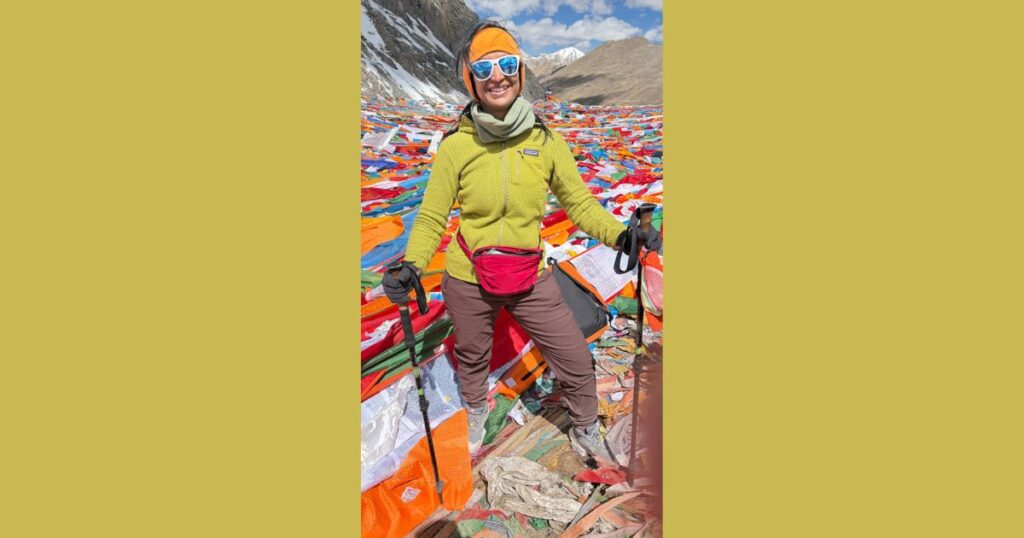
Once she signs up, she does not change. “I have missed important events like weddings for a hike,” she says. Her family knows this. Her husband holds things together when she goes. Her two children have grown up watching their mother leave for mountains and come back, each time scaling higher elevations than before.
When schedules align, Sridevi pulls together small groups for multi-day treks. Fitness level and experience matter, but mindset matters more. “I look for people who are adaptable, positive, and respectful of nature,” she says. “The mountains are unpredictable and conditions can change quickly. It is important to hike with people who can embrace the experience, stay flexible, and appreciate the journey as much as the destination.”
Her most recent expedition was Kailash Mansarovar, traveled from Beijing with a close friend from Chicago.
She started as a regular hiker who loved being in nature. Then, with each trail, she made it a mission to go higher, further, more ambitious. Her boots have since found trails across the United States, Africa, South America, and Asia—each summit not just a finish line but a launching pad for the next.
Warrior Hikers: The Trail, The Tribe, The Fun
The idea was simple because the need was simple. Four friends wanted to hike Georgia’s trails and had no one to go with. Their families were not always interested and their weekends kept filling up with other demands. One day the conversation happened where all four friends expressed the same desire to hike. And Aswini Oliver, the visionary of the group as Lavanya describes her, turned that conversation into something real.
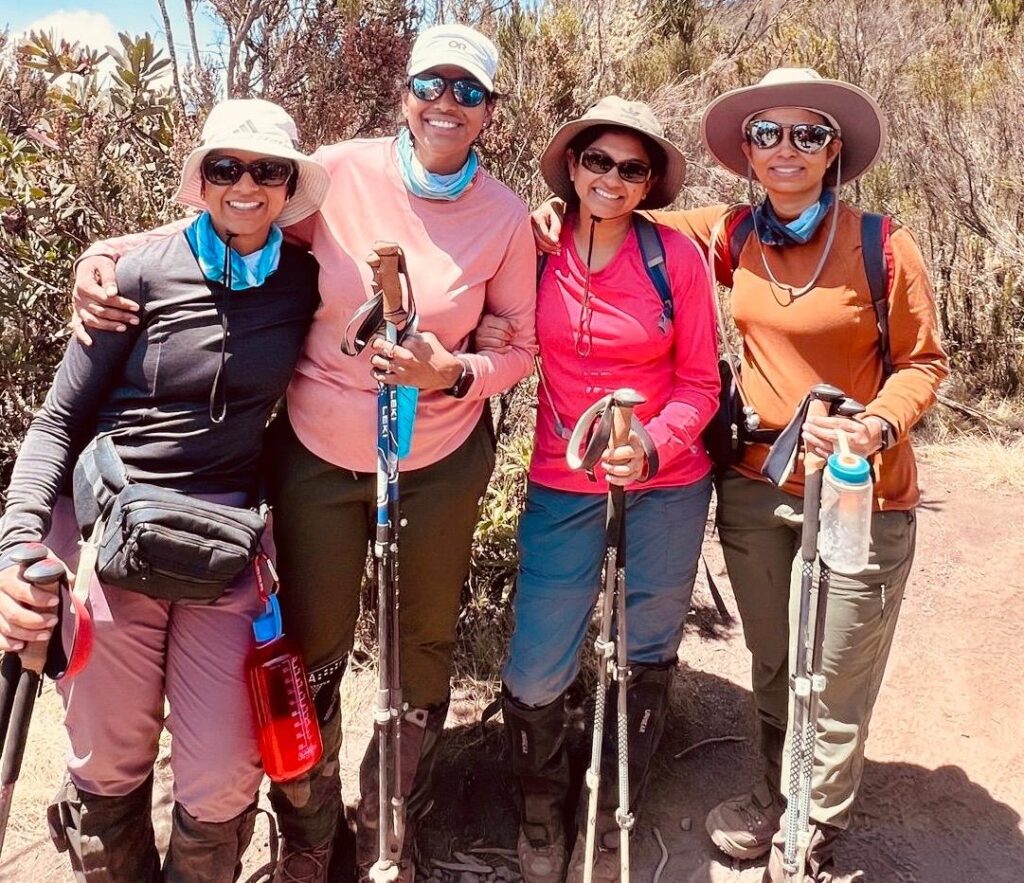
That desire became Warrior Hikers, founded in 2019 by Aswini Oliver along with three other friends, Lavanya Dhanapalan, Raji Balakrishnan, and Yuvi Meiyyappan. They were enjoying this new exploration together, adding members steadily, when COVID arrived and shut everything down. They came back to the trails, masks and all, because the pull of the outdoors was stronger than the hesitation. Today the group has close to 375 members and has become one of Metro Atlanta’s most established South Asian women’s hiking communities.
They were not long into their journey before others took notice. By January 2020, just months after founding, Warrior Hikers was the cover story of 400 Life Magazine and featured in Forsyth News — recognized as a community of Indian women whose shared challenges on the trail were making them stronger and happier. They were featured a second time when the group made it to Kilimanjaro last year.
What makes Warrior Hikers distinct is its flavor. This group is fun, inclusive, and proudly easy-going. “People are here for different reasons and we respect that,” says Lavanya. “We give them the space and we let them be.” Lavanya adds that some women come for fitness goals, pushing themselves on every incline. Others come for the conversation, the company, the photographs, the escape. All of it is welcome. None of it is judged or ranked.
The women who join for the first time often come with their doubts. Can I do this? What if I slow everyone down? Will I be a burden on others? What if I can’t drive to the trailhead? Lavanya has heard every version of this, because she has felt every version of it herself. “I would look up a mountain and say — am I going to climb that? Is that even possible?” The answer, every time, was yes. And the way she knows is because someone told her so, back when she was the one looking up and wondering. “I was a burden once to someone else. It is okay. We don’t look at people like that.” That spirit of paying forward the encouragement you once received has become the unofficial philosophy of Warrior Hikers. The once-hesitant woman who made it to the top becomes the one who slows her pace for the next newcomer and says: if I did it, you can too.
On the trail there is a steady momentum of walking pace and building trust. “Everybody has a story,” Lavanya says simply. “You always feel like, oh, I never knew she was going through so much.” Those moments of unexpected vulnerability are where the lasting friendships form, the kind that don’t dissolve once the hike ends.
And then there are the moments that have nothing to do with growth or transformation or paying anything forward. Last month hiking at Sweetwater Creek, someone looked at the water and jumped in. Completely unprepared, no swimsuit, just the moment and full summer heat. Others followed. They hopped between rocks, laughing, soaking, and entirely unserious. “You should be in a space where the moment allows that,” Lavanya says. “I don’t know how many people do that when they are out with their family. But they would do it in our group. They go rogue a little bit sometimes.”
Warrior Hikers does one hike a month, working their way through Georgia’s state parks this year. But ask Lavanya what keeps people coming back month after month, and she will tell you it has nothing to do with the mileage. “This hike is what they look forward to,” she says. “It’s what gets them going.” The trail may be an hour long on a Sunday morning. But what it gives back to the community of females lasts considerably longer.
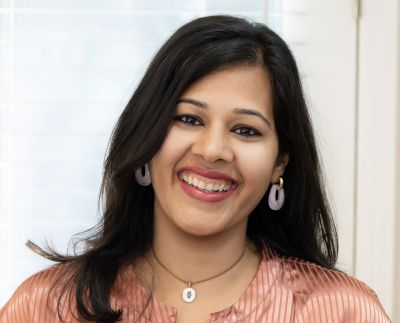
*Shikha Das Shankar is a feature writer for NRI Pulse.

1 comment
Shikha Das Shankar’s inspiring article about Sridevi Reddy’s mountaineering adventure reminded me of the first astronaut Neil Armstrong’s famous sentence, upon reaching the Moon,:
” One small step for man (here, woman), one giant step for mankind!”
–Uma Majmudar, PhD.