



BY JYOTHSNA HEGDE
In a quiet corner of imagination, where memory meets longing and language meets identity, a dream took shape long before it found its name. For Shyam Sundar, that dream began in childhood, in the simple yet profound joys of drawing, storytelling, and building worlds that lived beyond the page.
“A large part of Imagine Tamil actually began from something very personal to me,” he reflects. “From childhood I always had a strong interest in drawing, storytelling, and building visual worlds.” What stayed with him over the years was a single, enduring aspiration. “One dream that I carried for years was that someday I should create a Tamil visual universe, one that feels original, culturally true, and meaningful for children.”
That vision, once a quiet inner calling, began to take on greater urgency as he observed the realities of Tamil families living across the world. In homes spread over more than fifty countries, language exists in a delicate balance between memory and modernity.
“In many homes abroad, children today grow up fully comfortable in English,” he says, noting how it becomes “the language of school, daily life, and almost everything around them.” Tamil, though cherished, often finds itself on the margins. “Parents naturally want their children to stay connected to Tamil, but often they do not know where to begin in a way that feels very natural for today’s children.”
It is this gap, between intention and access, that gave birth to Imagine Tamil.
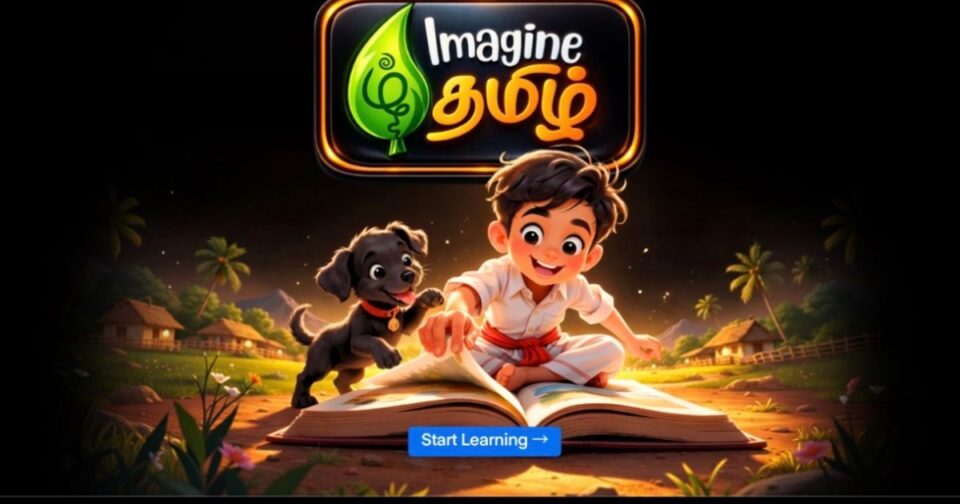
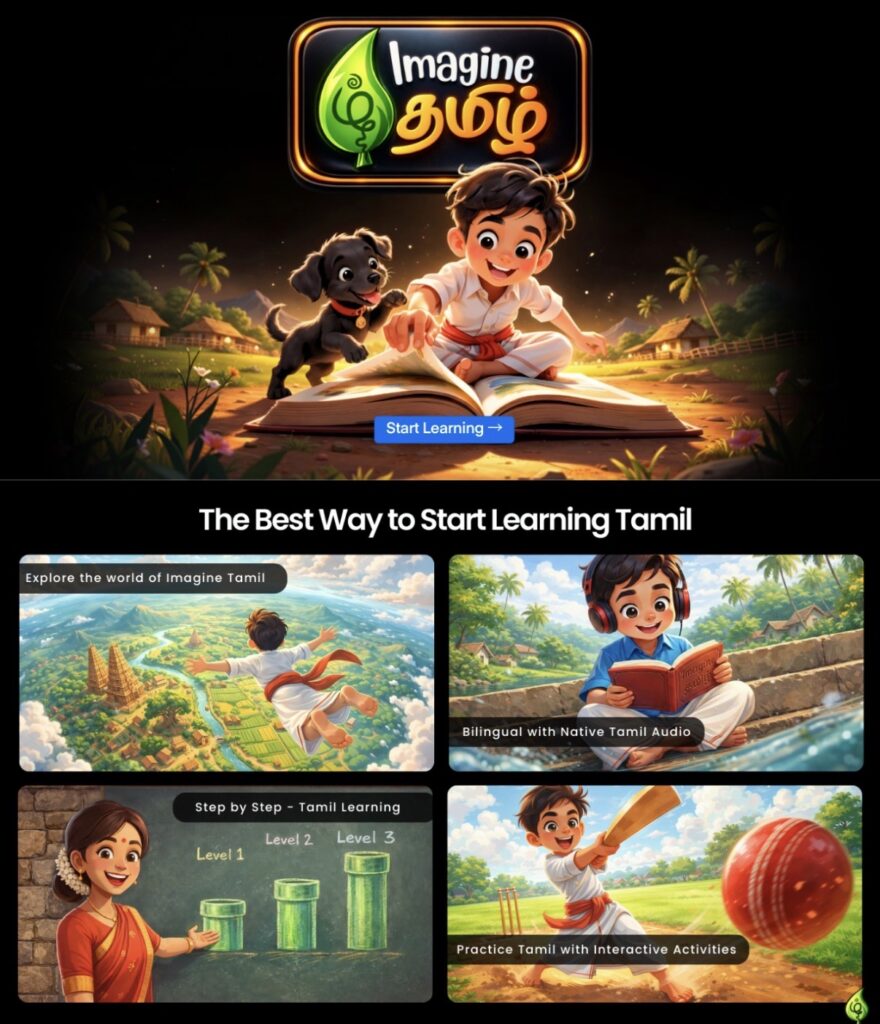
“So that is where Imagine Tamil was created,” he explains, “as a structured Tamil learning platform for kids and beginners so that Tamil does not begin as something heavy or text-filled, but as something very visually welcoming.” The goal was never limited to lessons alone. “The idea was not simply to create Tamil lessons but to build an all-in-one Tamil learning ecosystem where lessons, flashcards, comics, audio, and interactive activities all work together.”
What followed was not a quick launch but a journey of patience and precision. “For almost three years we built this up,” he shares, underscoring the care behind every detail. “We don’t use any stock images… we created everything original.”
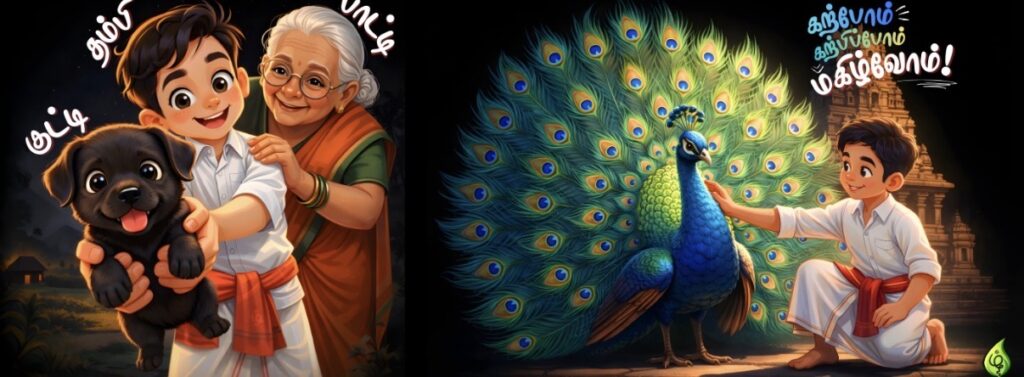
From that commitment emerged a cast of characters who anchor the learning experience in familiarity and warmth. “We created characters such as Thambi… with his black puppy Kutti, and then wise Paati,” he says. These figures are not merely decorative. They are vessels of culture and connection. Through them, children encounter Tamil not as an abstract system, but as lived experience.
The world they inhabit is equally intentional. “Even the scenery is like a Tamil village,” he notes, where language unfolds through everyday life. A lesson on fruits, for instance, does not remain confined to vocabulary. “They are shown inside a Tamil garden… mango, jackfruit, banana,” he explains, extending further into cultural context. “Even how banana leaves belong naturally in Tamil celebrations and meals.”
Such details reveal a deeper philosophy of learning. “Language learning begins with remembering words,” he says, “and visual memory helps children understand meaning faster before they worry about script or pronunciation.” In this approach, words are never isolated. They are always rooted in life.
Yet Imagine Tamil is as much for parents as it is for children.
“So many parents abroad may speak Tamil well but still they need a structured way to teach their kids step by step,” he observes. The platform responds with thoughtful inclusivity. “It includes Tamil script, transliteration, English meaning, and native audio through a simple toggle system,” he explains, allowing both parent and child to move forward together, without hesitation.
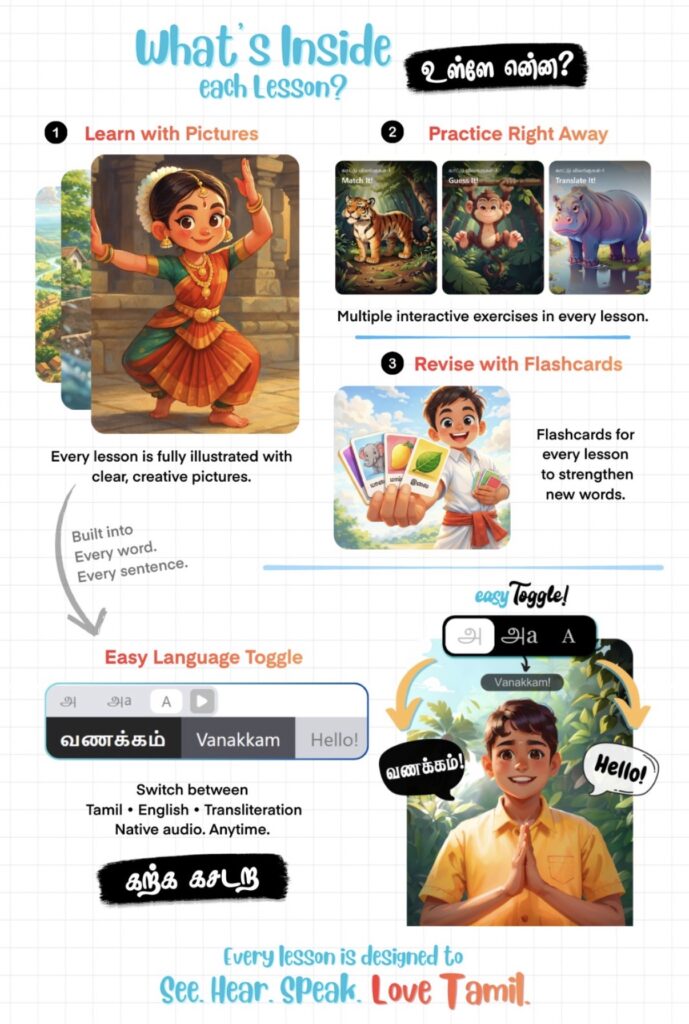
Among its most ambitious offerings is a vast collection of visual flashcards, built entirely from original illustrations. “We proudly claim it as the world’s most comprehensive Tamil flashcards collection,” he says, not as a boast, but as a reflection of the effort invested. Here, vocabulary is not memorized in isolation, but absorbed through context, imagery, and repetition.
This comprehensive design has also made the platform a valuable resource for educators, particularly within diaspora communities. “In smaller places there are volunteer-led Tamil classes where teachers often have to move between different materials,” he points out. Imagine Tamil simplifies that challenge. “It acts as a one-stop Tamil teaching and learning resource,” he says, where everything needed exists within a single, structured system.
Accessibility, too, remains central to its mission. “Tamil families live across more than fifty countries, so accessibility matters,” he emphasizes. Whether on mobile phones, tablets, or laptops, the platform ensures that learning is never out of reach, but always available, waiting quietly for the learner to begin.
And as the future of education continues to evolve, Shyam Sundar looks ahead with both openness and clarity. “AI tools like ChatGPT and Gemini can explain Tamil, personalize lessons, support revision,” he acknowledges. Yet he returns to what he believes will remain unchanged. “Cultural authenticity and strong original creative content will remain the foundation.”
In the end, Imagine Tamil is not just a platform. It is the culmination of a long-held dream, shaped with care and guided by purpose. “It has been built carefully over a period of three years as a long-term Tamil learning platform,” he says.
But beyond its structure and design lies something more intangible, more enduring. It is an invitation.
An invitation for children not just to learn Tamil, but to experience it. To see it, hear it, and feel it as part of their world. And, in time, to embrace it not as a lesson to complete, but as a journey to cherish.
“The idea,” he says, “is for them to gradually fall in love with the Tamil learning journey itself.”
