


BY VEENA RAO
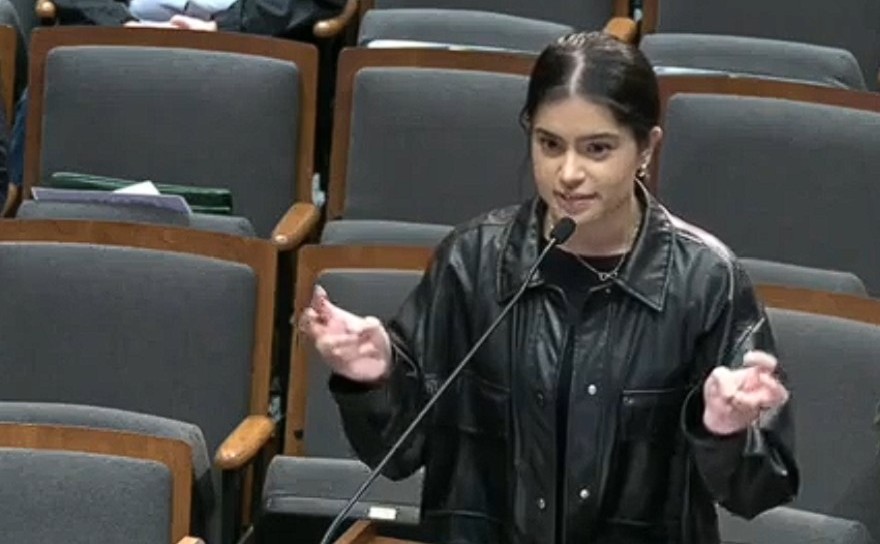
Frisco, TX, March 19, 2026: The heated debate about immigration and changing demographics in this fast-growing Texas city took a sharp turn when Indian-origin resident Neha Suratran spoke out against what she called “misinformation” and “blatant racism” targeting Indian Americans and H-1B visa workers.
Speaking during the public comment period at a recent Frisco City Council meeting, Suratran made it clear she was not there to speculate. “I’m not here to speculate. I am here to present facts,” she said, pointing out that several speakers at earlier meetings had used the word “alleged” without providing proof.
One of her key points was that the city council does not control immigration. “The Frisco Council is not responsible for H-1B visa fraud. That directly goes to a federal bureau,” she said, adding that bringing such complaints to a local meeting only spreads “blatant hate towards the Indian community.”
Suratran said she had spoken with Frisco Police Chief David Shilson and told the audience that there are “no verified reports of H-1B fraud in Frisco.” She warned that misinformation is becoming dangerous. Quoting the police chief, she said, “Misinformation is one of the biggest threats to our country today. It creates divisiveness and hostility.”
She also criticized how opinions are being formed. “People are forming strong opinions based on social media clips, group chats, and viral posts,” she said.
Explaining how the H-1B visa system actually works, Suratran said it is not easy to enter. “You need to have a specialized job, at least a bachelor’s degree, and be sponsored by a U.S. employer,” she said. She also stressed that companies must pay H-1B workers the same or higher wages as American workers. “They are not outsourcing cheaper labor,” she added.
She pointed out that many advanced STEM students in the U.S. are international and said programs like H-1B help keep that talent in the country. “Without programs like H-1B, we are not protecting jobs—we are pushing away talent that our own system helped create,” she said. Citing research, she added, “For every one H-1B worker, approximately 1.8 additional jobs are created for U.S. workers.”
Suratran then addressed stereotypes about the Indian community, sharing data on education, income, and crime. She said Indian Americans tend to have higher levels of education and income and lower crime rates compared to national averages. “If a group is associated with safer communities, stronger schools, and higher economic contribution, why are we afraid?” she asked.
She also responded directly to cultural concerns raised at the meeting. “We also celebrate Thanksgiving, Christmas. We are not forcing a religion onto you,” she said. Addressing misconceptions about her faith, she added, “Hinduism does not convert. We believe everybody goes to heaven, as long as you’re a good person.”
Frisco has seen rapid growth in its Indian-American population over the past decade, especially among professionals in technology and healthcare. Suratran, who said she has lived in the city since 2016, noted that she has “significantly watched a demographic change” during that time.
In recent months, city meetings have become increasingly tense, with some residents linking immigration to local issues—often without clear evidence. Suratran’s speech, now widely shared online, has struck a chord with many who see it as part of a larger national trend.
Her message was simple: stick to facts. “If the word ‘alleged’ continues to be used… assume that it is false unless you do your own research,” she said.
As Frisco continues to grow and change, the debate highlights a larger question facing many communities across the country—how to deal with rapid change while keeping conversations informed, respectful, and grounded in facts.
