





BY VEENA RAO
The Trump administration’s new USCIS policy limiting Adjustment of Status to “extraordinary circumstances” has created confusion and anxiety among immigrants, especially those already living and working legally in the United States. For decades, many eligible immigrants could apply for a green card while remaining in the country through a process known as Adjustment of Status. Under the new policy, USCIS says applicants would generally be expected to return to their home countries and complete the process through U.S. consulates abroad.
What does that actually mean for H-1B workers, students, families, and immigrants stuck in long green card backlogs?
NRI Pulse spoke with immigration attorney Ashwin Sharma of The Sharma Law Office, who believes the change could have sweeping consequences if implemented broadly. In this Q&A, Sharma explains what he says is at stake for families and legal immigrants already navigating the system.
For the average person, what does this change really mean? Is this a major shift or are headlines making it sound bigger than it is?
The headlines are actually underplaying the severity of this disaster. This policy represents the total demolition of a seventy-year-old legal framework.
For the average person navigating the system lawfully, it means you or your spouse or child can no longer assume you get to stay in your home in the U.S. with your family while the government processes your paperwork. The new default expectation is a forced exit to already backlogged U.S. consulates abroad to wait for an unknown amount of time for your immigrant visa.
That completely inverts the entire concept of legal immigration and creates massive instability for law-abiding residents.
Who will feel the biggest impact from this — H-1B workers, international students, families applying for green cards, or someone else?
The absolute heaviest blow falls directly on individuals holding temporary-intent visas like F-1 students, B-1/B-2 visitors, E-2 investors, and J-1 exchange workers. The government is essentially saying these people must leave the country no matter what.
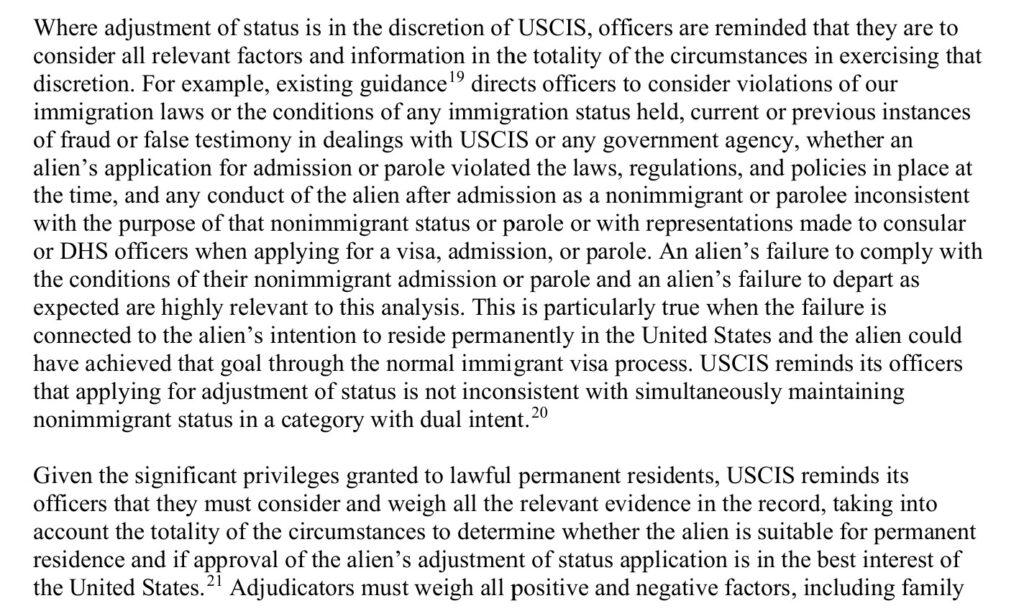
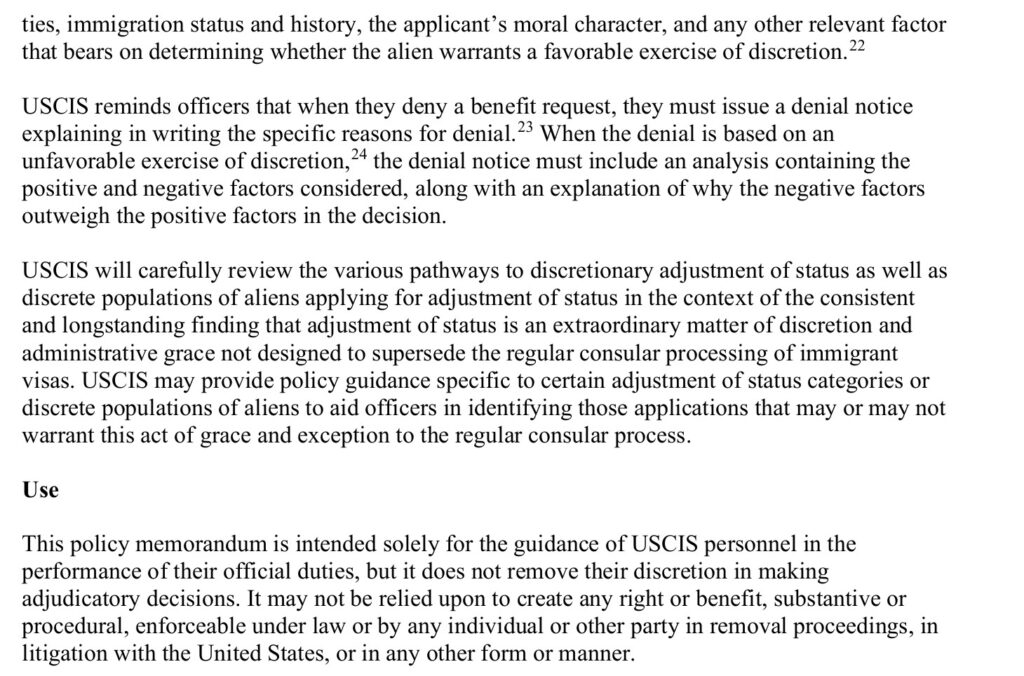
Highly skilled professionals on dual-intent H-1B and L-1A visas and their dependents appear to be impacted slightly less on paper. The memo remains intentionally ambiguous. The exact same type of random subjective discretion can and will easily be used against them, thanks to a buried footnote on page 5 of the memo implying they will need to jump through hoops to secure a favorable exercise of discretion.
USCIS says people can still apply from inside the U.S. in “extraordinary circumstances.” What exactly does that mean?
The phrase “extraordinary circumstances” is just bureaucratic code for whatever an immigration officer wants it to mean on any given Tuesday.
It is an entirely subjective and nearly impossible standard designed specifically to justify mass denials. The administration is setting the bar so ridiculously high that simply following the law and paying your taxes and raising an American family will be casually dismissed as ordinary. They will use that excuse to confidently deny their so-called administrative grace.
Many Indians spend years in green card backlogs while living and working in the U.S. What could this mean for them and their families?
This policy is an absolute nightmare scenario for Indian nationals trapped in the decades-long employment-based backlog.
These families have lived here legally for 10 to 15 years just waiting for their priority date to finally become current. Now, right when that tiny window opens, the administration wants to force them out of the country to process at consulates in India, which are already buckling under historic delays.
It guarantees lost jobs and aged-out children and endless anxiety for families who have already sacrificed so much to build our tech and medical sectors.
Can the government make this kind of change through a policy memo, or could it face legal challenges?
The sad reality is that the government can certainly try to do this because U.S. immigration law is purposely kept free of binding precedent cases. This deliberate vacuum gives the executive branch the terrifying ability to change black into white overnight exactly like they are doing right now.
The administration has quietly slipped other restrictive memos through without much fuss recently. This specific memo is going to be deeply unpopular and widely contested across the entire country.
I fully expect federal judges to step in because the agency cannot unilaterally gut seven decades of lawful immigration policy with a vindictive six-page wish list written for the anti-immigration lobby.
Sharma’s broader view
In additional comments to NRI Pulse, Sharma argued that the policy could create ripple effects beyond family immigration cases and could also affect highly skilled workers and employers.
He said Congress specifically designed H-1B and L-1 categories as “dual intent” visas, allowing professionals to pursue permanent residency while continuing to live and work in the United States. While the administration acknowledges that applying for a green card does not itself violate dual intent, Sharma said a footnote in the memo appears to create additional discretionary hurdles.
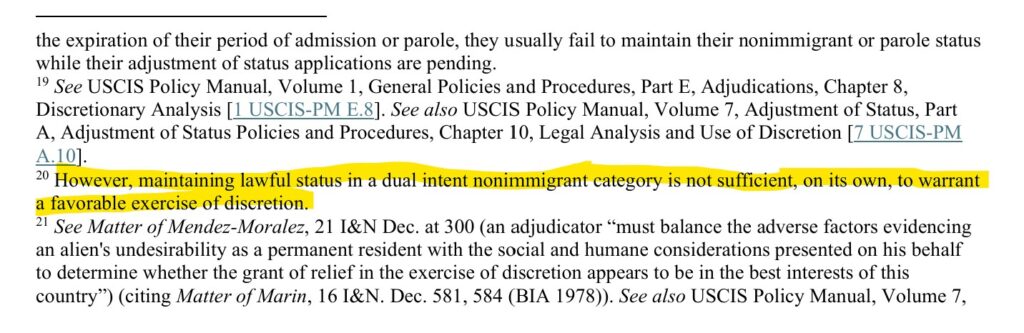
That specific footnote dictates that simply maintaining lawful status in a dual-intent nonimmigrant category is no longer sufficient on its own to warrant a favorable exercise of discretion. The policy now is to require these frequently vetted professionals to affirmatively submit additional discretionary evidence to prove they deserve to stay in the U.S.
Sharma also argued that forcing applicants into overseas consular processing could reduce the practical value of “Dates for Filing” windows and create new uncertainty for workers whose priority dates become current for only brief periods.
He described the policy as “executive overreach” and predicted that legal challenges under the Administrative Procedure Act are likely.
Cover photo: Ashwin Sharma, Esq., founder of The Sharma Law Office, Jacksonville, FL,
www.immigrationfirm.net
