






NRI PULSE STAFF REPORT
MINNEAPOLIS, MN, November 21, 2026 — A 25-year-old man has been charged with attempted murder and carjacking after allegedly strangling a Somali American Uber driver with a seatbelt, running him over with his own vehicle and leaving him critically injured in a roadside ditch in suburban Minneapolis.
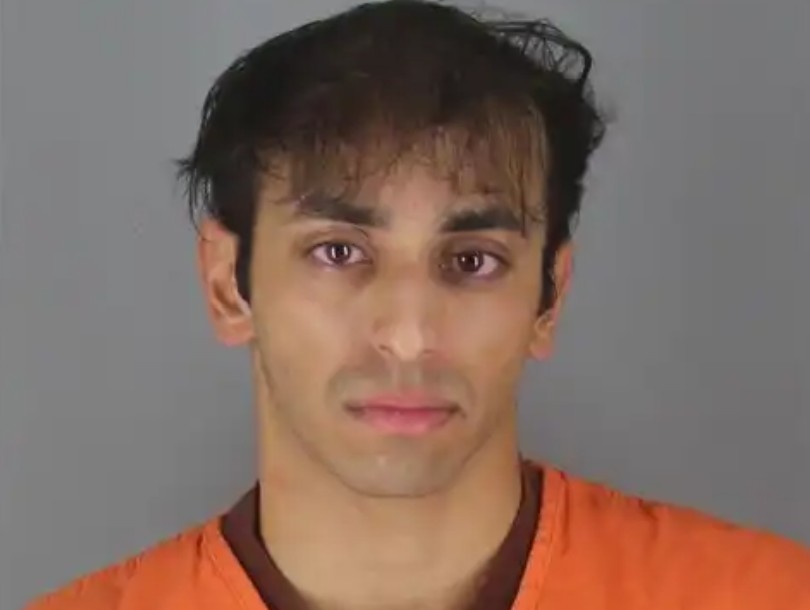
Samit Apurva Patel, a resident of Hopkins, Minnesota, faces one count of attempted second-degree murder and one count of first-degree carjacking in connection with the November 14 attack on Mohamed Yusuf, 51, a father and Uber driver from Blaine.
Yusuf suffered devastating injuries, including broken ribs, a broken leg, spinal injuries, collapsed lungs and severe internal bleeding. He has undergone multiple surgeries and remains hospitalized in critical condition, with doctors describing his prognosis as poor.
The attack has sparked outrage within Minnesota’s Somali American community and raised questions about whether Yusuf was targeted because of his name, religion or ethnicity.
According to court documents, Yusuf picked up Patel shortly before 1 a.m. after the passenger had been drinking with friends at a birthday celebration in Minneapolis.
Yusuf was speaking on the phone with his brother, who is also an Uber driver, when Patel allegedly asked him his name.
When Yusuf identified himself as Mohamed, Patel reportedly responded, “I don’t like that name.”
The brother, who remained on the phone throughout the incident, told investigators he heard an argument between the passenger and driver before Yusuf began screaming for help in Somali.
Yusuf reportedly cried out that he was being strangled with a belt. Moments later, his brother heard him screaming that the passenger was driving the vehicle over him.
Investigators believe Patel used the vehicle’s seatbelt to strangle Yusuf before taking control of the SUV, running him over and abandoning him in a ditch near Hopkins Crossroad and Minnetonka Boulevard.
Police later found tire tracks leading into and out of the ditch where Yusuf was discovered.
The investigation began when Patel’s parents called police around 1:20 a.m., requesting a wellness check after their son returned home appearing intoxicated, confused and emotionally distressed.
Officers arriving at the residence discovered an unoccupied, damaged SUV parked outside with its engine running. The vehicle’s interior contained dirt and debris, and its seatbelt appeared damaged.
Patel allegedly told officers he had done something wrong and asked to be arrested. He acknowledged taking an Uber home but initially claimed he did not know what had happened to the driver.
Police subsequently discovered Yusuf’s phone inside the vehicle, still connected to the call with his brother.
Using location data from Yusuf’s smartwatch and a police drone equipped with thermal-imaging technology, officers located the critically injured driver in a ditch approximately 15 feet from the roadway.
Yusuf was rushed to Hennepin County Medical Center, where he has undergone extensive treatment.
The alleged comment about Yusuf’s name prompted calls from family members, community leaders and the Minnesota chapter of the Council on American-Islamic Relations (CAIR) for the attack to be investigated as a possible hate crime.
However, Hennepin County Attorney Mary Moriarty said prosecutors had concluded that the available evidence was insufficient to prove beyond a reasonable doubt that the assault was motivated by racial, religious or ethnic bias.
Minnesota does not have a separate hate crime statute but allows enhanced sentencing when prosecutors establish that a crime was motivated by bias.
Moriarty emphasized that the decision not to pursue a bias-related sentencing enhancement did not diminish the seriousness of the attack or the concerns of Minnesota’s Somali community.
“My thoughts today are with Mohamed, his family, and the community,” Moriarty said in a November 17 statement. “I completely understand the reaction to this horrific assault and the expectation for this case to be reviewed for bias motivation.”
She added that prosecutors could still seek a sentence reflecting the brutality of the alleged offense if Patel is convicted.
The case has drawn particular attention in Minnesota, home to one of the largest Somali American populations in the United States, where community members have expressed growing concerns about hostility and discrimination.
More than 100 people attended a gathering outside the hospital organized by CAIR Minnesota, calling for accountability and expressing support for Yusuf and his family.
Uber condemned the attack and confirmed that Patel had been permanently banned from its platform.
Patel appeared in Hennepin County District Court following his arrest. Judge Paul Scoggin set bail at $1 million without conditions or $800,000 with restrictions.
Patel posted the $800,000 bond and was released from jail on November 18. He must comply with electronic home monitoring, refrain from alcohol and illicit drug use, and follow other court-imposed conditions.
His defense attorney, Michael Holland, had requested a substantially lower bond, citing Patel’s lack of a prior criminal record, college education and employment in the real estate industry.
Patel’s next court appearance is scheduled for December 16.
Meanwhile, Yusuf’s family continues to appeal for prayers and support as he fights for his life.
Patel has not been convicted, and the charges against him remain allegations.
