




NRI PULSE STAFF REPORT
Norcross, GA, August 13, 2026 — A cardiologist, an Ayurvedic physician, a psychiatrist, an oncology researcher, an ophthalmologist and yoga experts came together in Norcross recently to compare notes on what works across different healthcare modalities — and where the evidence runs out.
“Prevention, Meet Prescription,” organized by Dr. Sudhanva Char and held at Chinmaya Mission Atlanta on August 1, brought physicians and traditional practitioners together for a morning workshop during the Mission’s 75th-anniversary year. The goal was to explore which modality may have a place for which condition, rather than treating healthcare choices as a matter of loyalty to one system.
The program centered in part on AYUSH, India’s collective term for Ayurveda, Yoga and Naturopathy, Unani, Siddha and Homeopathy, and on the idea of integrating traditional systems alongside, rather than against, conventional medicine.
Making the Case for Evidence
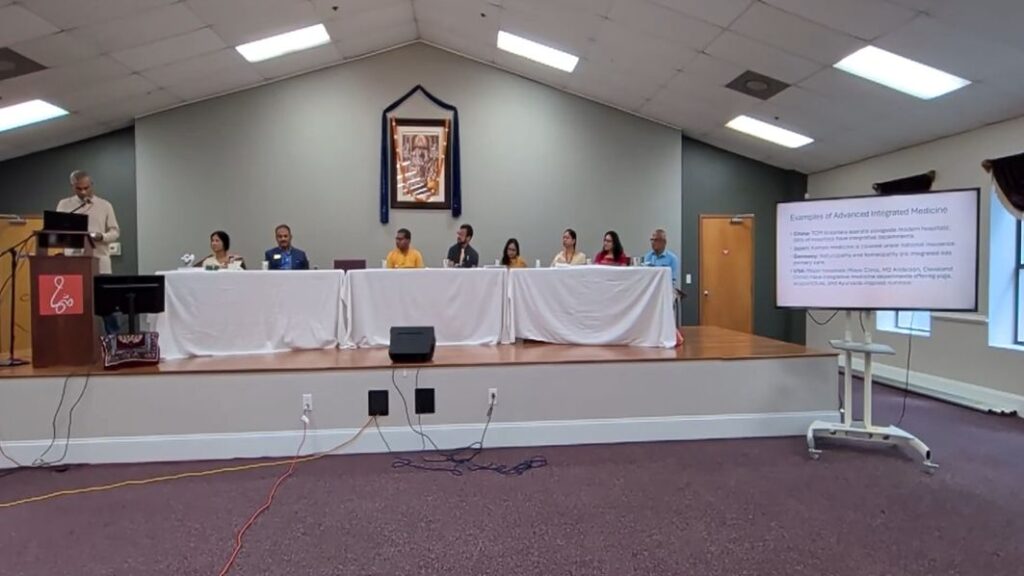
Dr. Char, a yoga teacher and researcher, set the evidentiary bar early, emphasizing that integrative medicine must be backed by research rather than faith or anecdotes.
He pointed to countries already incorporating traditional approaches into healthcare, including China’s hospital-based traditional medicine units, Japan’s Kampo system and Germany’s coverage of homeopathy and naturopathy. He also cited integrative departments at Mayo Clinic and MD Anderson and Indian data showing Ayurvedic diabetes management cutting patient costs by 30 to 40 percent.
His concern, he said, was that many people remain unaware of the options available.
“Messaging is important. Messaging is not there. People don’t know what the options are,” Char said.
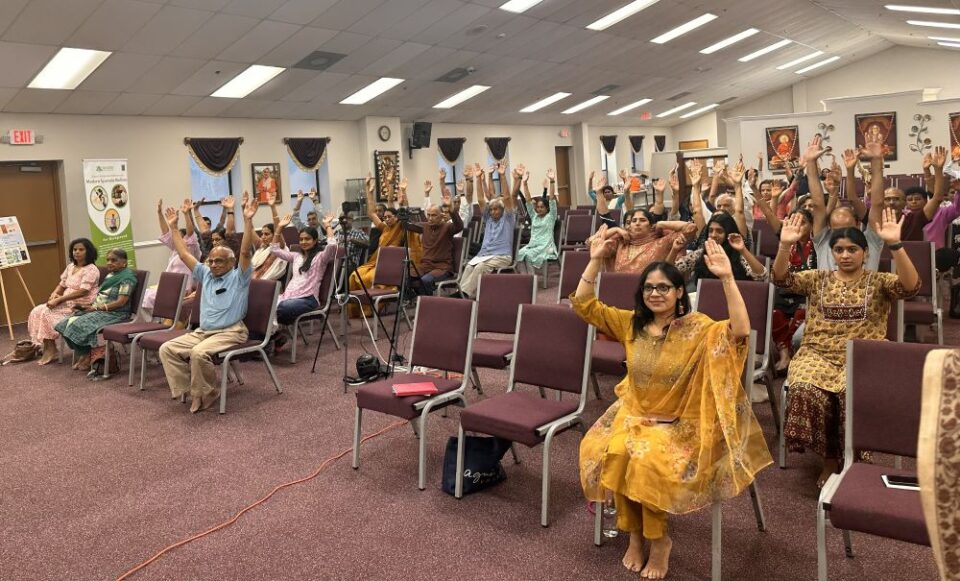
Asked for one practice anyone could try immediately, he led participants through 30 seconds of slow abdominal breathing — requiring no mat, flexibility or age limit.
The Heart of the Matter
Cardiologist Dr. Sreeni Gangasani focused on the high burden of cardiovascular disease among South Asians, noting that South Asians account for 25 percent of the world’s population and 60 percent of its heart disease.
Gangasani said plaque begins forming during the teenage years and that by age 50, most people already have some. He challenged the assumptions that a normal stress test necessarily means a person is in the clear or that being vegetarian and physically active provides immunity from heart disease.
“I have patients whose cholesterol was 150 who still had a heart attack, and patients who exercised every single day who still had one,” he said. “Some things you can control. Some things you cannot.”
He urged participants to know four numbers — Lp(a), waist size, HbA1c and blood pressure — and recommended a coronary calcium scan by age 35 when risk factors are present.
Treating the Whole Person
Ayurvedic physician Dr. Rupali Biradar spoke about identifying root causes and considering mental health and gut health as part of a patient’s overall condition.
She cited examples including an anxious patient whose underlying issue was gut health, a child whose ADHD symptoms eased after dietary changes, and a post-angioplasty patient whose bloodwork improved while classical herbs such as Arjuna and Guggulu were used to support — not replace — beta-blockers and statins.
“I always work on the root condition — considering your mental health, your gut health,” Biradar said. “It may be a different root cause than what you’d expect.”
Her rule, she said, is never to tell patients to stop prescribed medication. Instead, the goal is to improve health to the point where tapering medication, when appropriate, becomes a conversation initiated by the patient’s own doctor.
The Breath as Medicine
Yoga teacher Swati Kumari introduced participants to Panchakosha, or the five sheaths of the body, subtle energy channels in yogic tradition and Bhramari, or humming-bee breathing.
She discussed the physiological effects associated with Bhramari breathing and research into its potential role in lowering blood pressure and anxiety. She concluded by leading the gathering in a shared AUM meditation.
Yoga and the Mind
Psychiatrist Dr. Ranjan Avasthi, who spent a decade running a substance-abuse treatment facility in Atlanta, said it had not initially occurred to him to incorporate yoga into that work.
Research changed his thinking. Avasthi discussed randomized trials examining yoga-based interventions for pain, anxiety and substance use and research involving GABA, the brain’s calming neurotransmitter. He also cited a VA study in which twice-weekly, 15-minute yoga sessions were associated with a drop in veterans’ PTSD severity scores from 73, categorized as severe, to 43, categorized as moderate, over ten weeks.
Avasthi acknowledged that pediatric evidence remains limited. When it comes to encouraging children to practice yoga, he said, watching a parent actually do it can be more effective than being lectured about it.
Presence as Medicine
Oncology researcher Dr. Achyut Saroj described his transition from pursuing new cancer drugs to studying spiritual care as a clinical discipline.
He cited research linking a patient’s sense of spiritual importance with higher anti-tumor T-cell counts and lower end-of-life costs. Saroj also highlighted a cultural gap in spiritual care, noting that the concept of a “chaplain” does not always translate easily for Hindu and South Asian patients.
He pointed to Chinmaya Mission’s Hindu Spiritual Care certification, offered with Chinmaya International Foundation, as one effort to address that gap.
“Listening is the first step in the ascent to the divine — inertia is defeated by the practice of listening, called Shravana,” Saroj said.
A Brother’s Inspiration
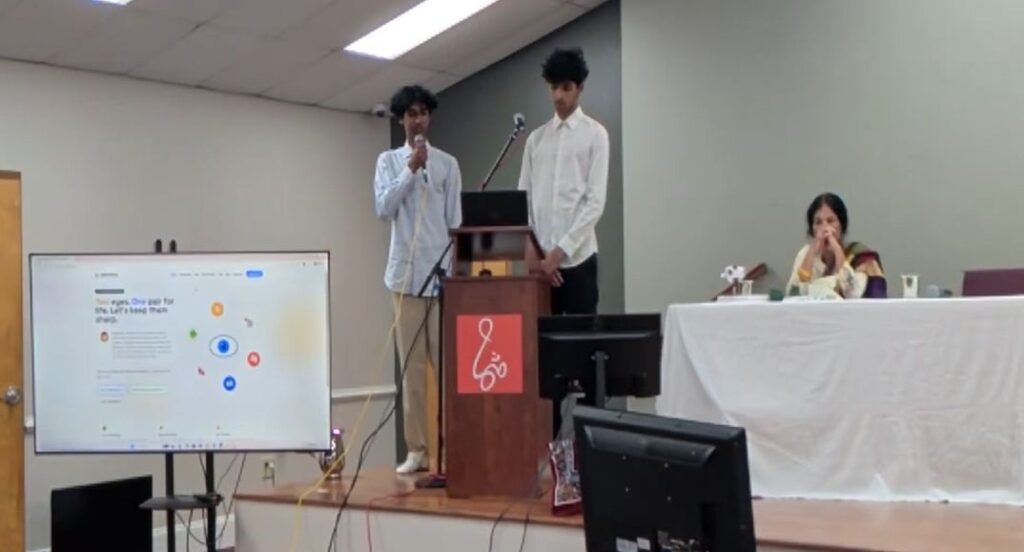
The youngest speakers, Pranav and Rishi Challa, shared their personal experiences with vision therapy.
Pranav, who had been nearsighted since early childhood, spent two weeks in a vision-therapy program in Pondicherry, India, at age 8, performing eye exercises morning and evening. According to the presentation, a year later he no longer needed glasses. He is now 16 and has 20/20 vision in both eyes.
After seeing his brother’s results, Rishi, who had been diagnosed with mild myopia, combined a vision-therapy routine with a school research project and nine months of dietary changes. His next examination showed no myopia, and his project later finished in the top 10 internationally.
The brothers subsequently founded a nonprofit that brings eye-health workshops to students and underserved communities.
Beyond 20/20
Ophthalmologist Dr. Indira Menon followed with a hands-on anatomy session and also addressed the evidence behind traditional eye remedies.
Menon said she had searched for controlled trials supporting several traditional remedies and had not found them, while remaining open to future research.
She also discussed the effects of screen use, noting that it can cut the normal blink rate roughly in half and contribute to dry eyes. She recommended periodically stepping away from screens and focusing on something about 20 feet away to allow the eye muscles to reset, as well as regular eye exams for people with diabetes.
Menon also encouraged participants to register with the national bone marrow donor registry, noting that South Asian patients currently have only a 20 to 30 percent chance of finding a match, compared with roughly 85 percent for Caucasian patients.
Five Minutes a Day
Registered nurse and lifestyle coach Rajitha Bommakanthi presented research she conducted during the COVID-19 pandemic involving Emory-system nurses.
The six-week study used pranayama practices that took less than five minutes a day. According to Bommakanthi’s presentation, participants’ stress scores fell 41 percent while well-being scores increased by roughly 50 percent.
Her takeaway was that even a few minutes of daily practice can give an overloaded nervous system room to recover.
A Common Thread
Despite the different disciplines represented, no speaker argued that patients should choose one healthcare system over another.
The common principle that emerged was to match the tool to the moment: prevention may lean toward traditional approaches, emergencies toward modern medicine, while recovery may provide room for both.
As Dr. Char noted in closing his remarks, the gathering itself demonstrated what could happen when people from different traditions sat down and listened to one another.
The program also acknowledged Krishnamurthy Subramanian and Uma Krishnamurthy for the venue and panelist gifts, Deepa Duddilla for food arrangements, MK Muralidhar and Sashi Pemmasani for audio and video setup, Sainathan Sivasubramanian for emceeing, and Harsha Reddy for organizing the event.
