




BY JYOTHSNA HEGDE
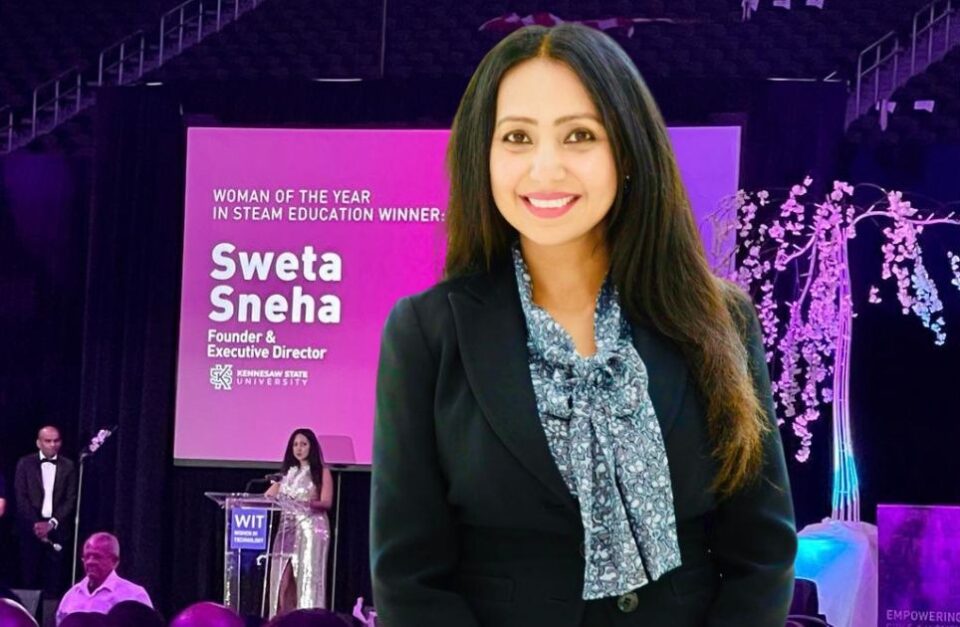
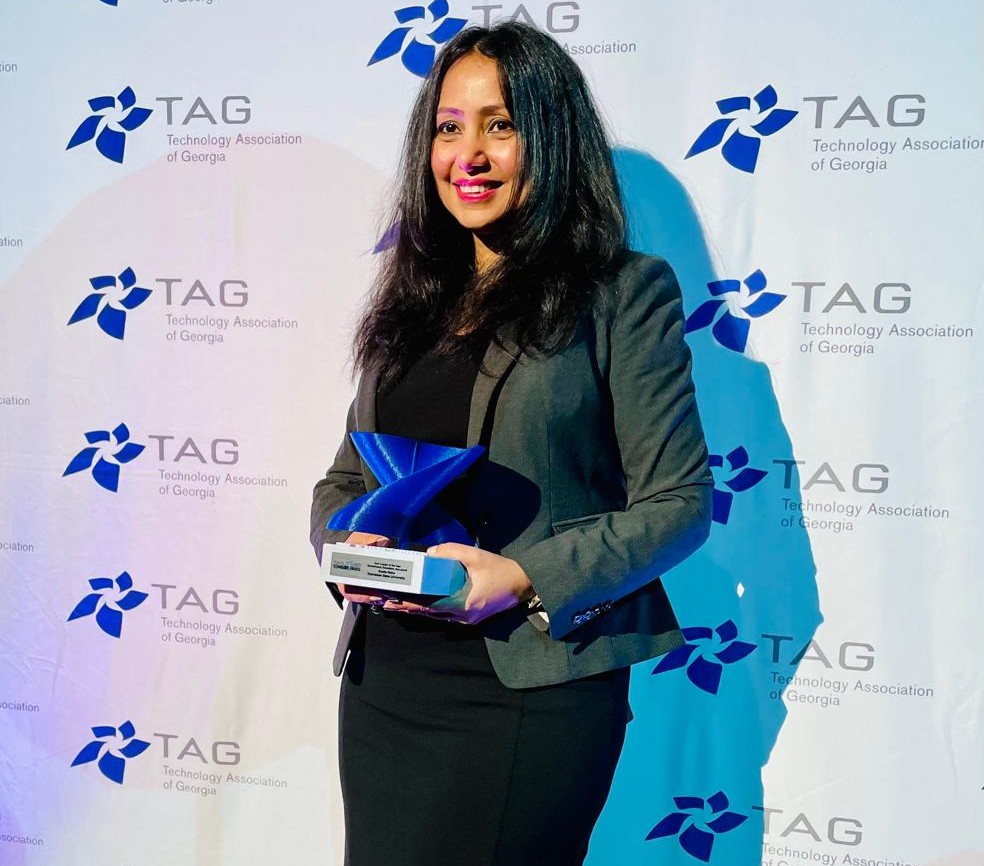
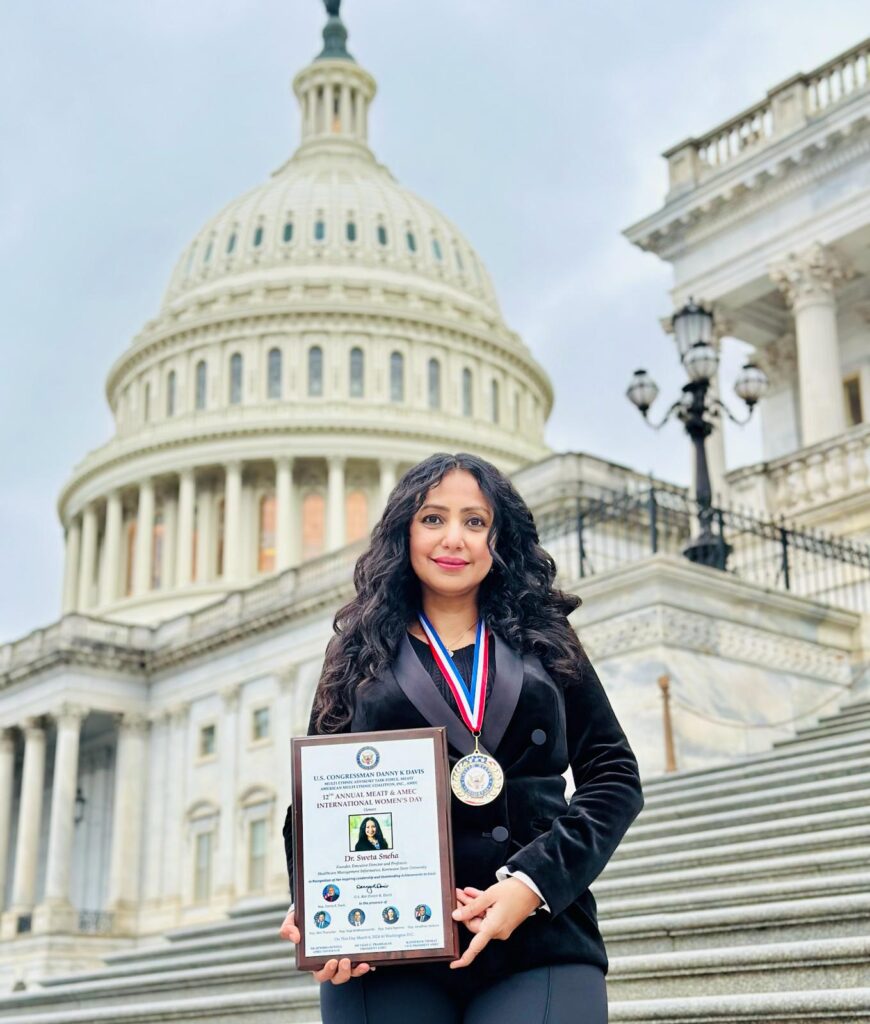
Atlanta, GA, October 8, 2026: Dr. Sweta Sneha has received many awards on stage, earned impressive professional titles, and collected framed recognitions over the years. But what means the most to her are four simple words she sometimes hears from former students, years after they have left her classroom: “You believed in me.”
“Honestly, some of the most meaningful recognition doesn’t come in the form of an award at all,” she says. “It is when a former student reaches out years later and says, ‘You believed in me,’ or when someone tells me that an opportunity changed the trajectory of their career.”
For someone who has built a career across technology, healthcare, research, consulting, entrepreneurship and higher education, it is a revealing measure of success.
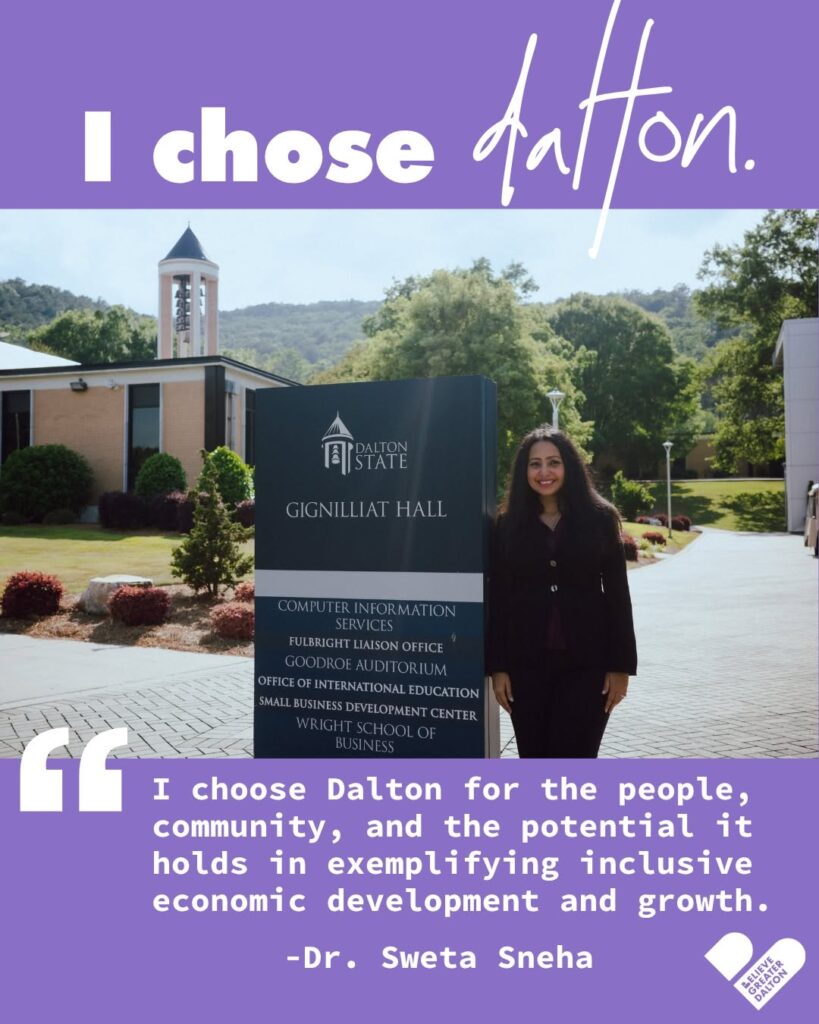
Today, Sneha serves as dean of the C. Lamar and Ann Wright School of Business at Dalton State College. Her appointment marks a significant milestone: she is the first Indian-origin woman to lead a business school in the University System of Georgia.
Her professional record includes more than 100 publications and scholarly contributions, the development of academic programs, industry partnerships and numerous professional honors. But behind those accomplishments is a more personal story: that of a young woman from Patna, India, who came to America after high school, found her footing in an unfamiliar country, pursued a career in a field with relatively few women, and eventually found herself in a position to create opportunities for others.
“Did we change someone’s trajectory? Did we create an opportunity that didn’t exist before? Did we bring people together who otherwise wouldn’t have connected?” she asks. “That’s the impact I’m proudest of.”
The Girl from Patna
Growing up in Patna, Sneha did not have a carefully mapped-out plan for her future. She was curious, interested in science and technology, and wanted to do something meaningful with her life.
Her parents, Dr. C.P. Shrivastava and Mukti Shrivastava, and her grandparents, Snehlata Verma and T. N. Verma, emphasized hard work, humility, resilience, and the importance of leaving something better than one found it.
“I learned that education was not simply about achieving for yourself,” she says. “It was about creating possibilities for others.”
“Technology fascinated me because it was a way of solving problems and creating something that could have an impact far beyond one individual,” she recalls.
She could not have known then where that curiosity would take her.
Sneha arrived in the United States after high school, carrying the hopes and uncertainties familiar to many young immigrants.
“Coming to America was a major transition,” she says. “I came to USA after my high school with ambition and a belief in the possibilities that education could create, but I also understood very quickly that being ambitious and actually building a life in a new country were two different things.”
There was much to learn beyond the classroom. She had to understand a new culture, navigate unfamiliar systems and professional expectations, and find the confidence to speak for herself.
“You are learning the culture, the system, the professional expectations, and yourself at the same time,” she says.
Sometimes, she realized, opportunities had to be created rather than waited for.
Still, she looks back on those early years with gratitude.
“America gave me something incredibly powerful: the opportunity to imagine a future that was bigger than what I could see at that moment.”
At the University of Maryland, College Park, Sneha chose computer science, earning her bachelor’s degree in 2000 with a minor in decision support systems.
She did not enter the field to make a statement about women in technology. She simply liked the subject.
“I was thinking: This is interesting. This is challenging. I want to learn it,” she recalls.
But being one of relatively few women in the field taught her lessons that would stay with her long after graduation.
“It taught me early that sometimes you have to be comfortable being one of the few people in the room,” she says, “and eventually, you have to help make the room bigger so others can enter it.”
It is a thought that has come to define much of her approach to leadership.

Finding Her Way from Technology to Teaching
Sneha began her professional career at PricewaterhouseCoopers, where she learned how organizations worked and how technical knowledge could be translated into practical business solutions.
The experience was valuable, but it also raised questions that went beyond the immediate demands of consulting.
“I wanted to understand not just how organizations use technology, but how knowledge is created, how people learn, and how we can prepare the next generation to solve problems we haven’t even encountered yet,” she says.
Those questions eventually drew her toward academia.
She enrolled in the doctoral program at Georgia State University’s Robinson College of Business, earning her Ph.D. in computer information systems in 2008.
“I realized that education gave me the opportunity to combine everything I cared about: technology, research, leadership, and developing people.”
Her doctoral research focused on mobile networks for patient monitoring, including questions of reliability, power management and communication delays. Although the work was technical, the larger purpose interested her just as much: how could technology improve healthcare and reach people who might otherwise have limited access?
That interest would become an important thread in her career.
When Sneha joined Kennesaw State University in 2008, healthcare organizations were becoming increasingly dependent on data, analytics and information systems. She saw a growing need for professionals who understood both healthcare and technology.
She also saw an opportunity for students.
“What excited me was that this wasn’t just about creating an academic program,” she says. “It was about creating a workforce for a field that was changing rapidly and giving students an opportunity to enter a growing area with tremendous potential.”
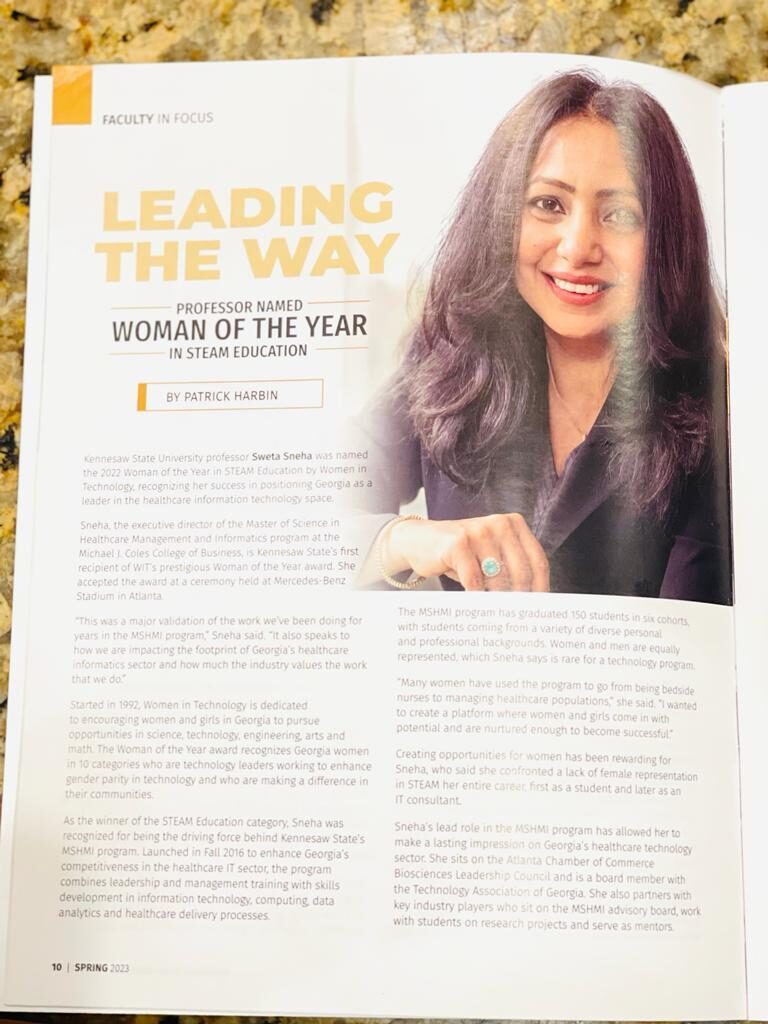
Sneha became founding director and later executive director of the Healthcare Management and Informatics program. She helped develop curricula, build industry partnerships and connect students with organizations working on real-world healthcare challenges.
Students had opportunities to engage with organizations including Wellstar, Piedmont, the Shepherd Center and MagMutual. Sneha also founded and chaired the Digital Health Transformation Summit, bringing together professionals from industry and academia.
Her work extended to securing scholarships, research assistantships and fellowships for students and faculty. Her professional record includes more than 100 academic and industry projects, while her CV lists $100,000 in endowed scholarship fundraising in 2025.
But building something from the ground up, she says, is rarely as straightforward as it may appear when viewed in hindsight.
“Building something from an idea requires much more than having a good idea,” she says. “It requires persistence, relationships, credibility, and the willingness to keep going when the path isn’t obvious.”
Nor does she see such accomplishments as the work of one individual.
“Transformation happens when you connect people around a shared purpose with a vision that is much larger than yourself. You don’t build something meaningful alone. You scale and grow an ecosystem.”
Alongside her work with students and academic programs, Sneha continued her research in health informatics and emerging technologies.
Her scholarly contributions include work on remote patient monitoring, electronic medical records, healthcare data security, telehealth and digital transformation. She is also the author of Revolutionizing Health Monitoring and has contributed to collaborative research involving mobile technology for diabetes management in rural India.
For Sneha, the value of research lies in what it can accomplish outside academic journals.
“I have never wanted research to simply sit on a shelf,” she says.
That practical outlook also informs her views on artificial intelligence, a field whose possibilities excite her but whose risks she believes deserve serious attention.
“The technology itself is fascinating,” she says, “but the more important question is: What are we going to do with it, and who benefits?”
She sees AI’s potential to improve healthcare access, diagnosis, efficiency and decision-making. At the same time, she worries about technologies that may reinforce existing inequalities.
“We have to ask who is represented in the data, who has access to the technology, who understands how it works, and who is accountable when something goes wrong.”
For someone whose career began with a fascination for computers, her questions have increasingly centered on people.
A New Chapter, and a Historic First
After years at Kennesaw State, Sneha began thinking about what she could do with her experience on a broader scale.
Dalton State College offered that possibility.
“For me, Dalton State wasn’t simply the next position,” she says. “It was the next opportunity to create impact.”
As dean of the Wright School of Business, she now has an opportunity to influence not just individual academic programs, but the relationship between higher education and the economic future of northwest Georgia.
The region has deep roots in manufacturing and industry, but its workforce needs are changing. Technology, healthcare, logistics, advanced manufacturing and entrepreneurship are creating new demands for skills and education.
Sneha believes a business school can help students prepare for those changes while supporting the region’s growth.
“I saw an opportunity for the Wright School of Business to be a bridge between talent and opportunity, education and industry, and student potential and regional prosperity,” she says.
Through initiatives such as the Wright EDGE Alliance, she hopes to strengthen relationships with employers and create more opportunities for students to gain practical experience.
“Our students are not simply recipients of an education,” she says. “They are the region’s future talent.”
For Sneha, helping a student find a career is about more than the individual graduate. A good job can bring stability to a family, provide needed skills to an employer and strengthen the surrounding community.
“We are strengthening families, businesses, communities, and the economic future of the region,” she says. “That’s the kind of business school I want to build.”
Her appointment also carries a significance that goes beyond the college.
As the first Indian-origin woman to lead a business school in the University System of Georgia, Sneha knows that her presence in the dean’s office may mean something to young women who are still wondering what is possible for them.
She remembers what it felt like to be one of the few women in a room, and to navigate professional spaces where not everyone shared her background.
“If a young woman of Indian heritage sees me in this role and thinks, ‘Maybe I can do that too,’ then the milestone has meaning beyond me,” she says.
But she is equally clear that representation, by itself, is not enough.
“The more doors that open for you, the more doors you have the ability and the responsibility to open for someone else.”
That belief comes partly from her own experience of being underestimated.
“I think many women, particularly women who have navigated multiple cultures, have experienced moments when they had to prove themselves before they were given the benefit of the doubt,” she says.
Over time, she learned that trying to convince everyone of her worth could become a distraction from the work she wanted to do.
“I couldn’t spend my life trying to convince everyone of my potential. My response has been to focus on the work, build relationships, deliver results, and remain authentic.”
It is advice she now shares with younger women navigating their own careers.
“They don’t have to choose between ambition and authenticity,” she says. “They don’t have to minimize themselves to fit into a room.”
And she believes women who have reached positions of influence have a responsibility to help others move forward.
“We need mentorship, sponsorship, access, opportunity, and people willing to open doors. If I can be that person for someone else, I consider that part of my leadership responsibility.”
The Woman Beyond the Dean’s Office
For all her professional accomplishments, Sneha does not define herself entirely by her work.
Ask her who she is without the dean’s title, the publications, the awards and the professional responsibilities, and she returns to the girl she once was.
“When I think about who I am beyond the titles, I see a young girl from India whose life was transformed by the opportunity education created, a girl who became an immigrant, built a career in America, and eventually found herself in a position to create opportunities for others,” she says.
But there is also Sweta the wife, mother and friend.
She is the mother of two children, a role she counts among her proudest. She speaks of them with affection.
“They are my wings that give me the courage to fly high,” she says.
She is equally appreciative of her husband and the partnership and support they have shared through the different stages of her life and career.
Away from work, she enjoys books, music, being outdoors, discovering new places, good food and a glass of wine with friends.
And she loves “the kind of conversations that can go on for hours.”
These ordinary pleasures matter to her. So do family, friendship, curiosity and laughter.
“Underneath all of that, I’m someone who values family, friendship, curiosity, laughter, and experiences,” she says.
Of course, building a demanding career while raising a family has involved tradeoffs.
There have been evenings and weekends consumed by work, professional travel and family moments she missed. She acknowledges that there were times when her responsibilities demanded more of her than she would have liked.
Those experiences have also deepened her appreciation for the people who have supported her along the way.
“The awards and titles may have my name on them, but the journey has never been mine alone.”
It is an acknowledgment that adds another dimension to her story. Behind the professional milestones are relationships, sacrifices and the everyday negotiations familiar to many working women.
An American Dream That Changed Along the Way
When Sneha first arrived in the United States, her idea of success was relatively straightforward: get an education, build a career and create a good life.
She has accomplished those things. But somewhere along the way, her understanding of success changed.
“Today, success means something much broader to me,” she says. “It means having the opportunity to build, to lead, to learn, and to help others move forward.”
The American Dream, she has come to believe, is not simply about how far one person can go.
“I don’t think the American Dream is a finish line,” she says. “It’s a responsibility that grows as your opportunities grow.”
What would she tell the young girl in Patna who could not have imagined the life ahead of her?
“Dream bigger than the circumstances you can see around you. And don’t be afraid to take the next step before you know exactly where it will lead.”
It is advice drawn from her own journey. The girl who loved science and technology could not have predicted a career in healthcare research, the creation of academic programs or a future leading an American business school.
And yet, looking back, Sneha hopes she will be remembered for something more personal than any of those accomplishments.
“My hope is that my legacy isn’t simply a list of positions, publications, or awards,” she says. “I hope people say that I opened doors, built bridges, developed people, and used education to create opportunity.”
Which brings her back to those four words from former students.
“You believed in me.”
For Sneha, perhaps there is no greater measure of a life spent teaching, building and leading than knowing she helped someone else believe in themselves.
