



BY JYOTHSNA HEGDE*
The winter sun in India drapes the world in gold, slowing time, softening edges, and filling the air with quiet. This January, I carried grief like a stone in my chest, a heaviness that made words fragile. My sister and I moved through days shaped by loss, two daughters navigating rituals, traditions, and ceremonies that, for generations, had been designed with sons in mind.
There was no bitterness in it, only a quiet exhaustion. Somewhere in the stillness between rituals and remembrance, a thought flickered, soft and unspoken, almost guilty: would it have been easier if my parents had a son? I didn’t say it aloud, but grief has a way of making even fleeting thoughts feel heavy.
That afternoon, I sat with my aunt in the warmth of home, surrounded by the familiar perfume of sandalwood and steeped tea. She watched me, her eyes holding decades of unspoken wisdom.
“In times like this,” she said softly, “we forget the strength we carry. Especially women.”
I remained quiet, but something in me shifted. She seemed to sense it.
“Empowerment isn’t new,” she continued gently. “Look at Ardhanarishvara. Half man, half woman, separate in form, inseparable in essence. There is no lesser, no greater. Only balance.” She paused, then added, almost in a whisper: “Yatra naryastu pujyante ramante tatra devata” (Where women are honored, there the divine resides.)”
In that moment, something settled within me. Not an answer, but a quiet reassurance. I listened, and the grief in me softened its edges. Her words rested like seeds in winter soil. When March came and Women’s History Month unfolded, her wisdom bloomed into a deeper understanding. History is never a solo performance. It is a symphony, co-authored by women, whose melodies are sometimes soft, sometimes fierce, but always essential.
The Roots of Remembrance
This month exists because women refused to be invisible. From the strikes of garment workers in 1908 to the first International Women’s Day in 1909, to Women’s History Week in 1980, and finally a month in 1987, history’s tapestry has slowly begun to reflect half of humanity. It is a remembrance and a reclamation, a quiet but powerful acknowledgment that the story of the world has always been written by many hands, even when only a few were named.
The Ancestry of Ambition
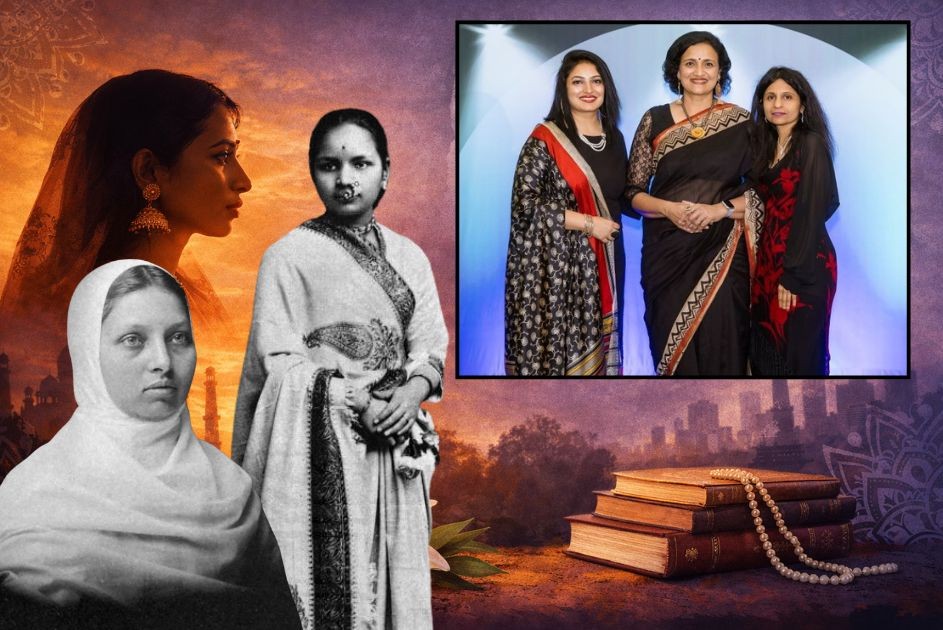
Long before glass ceilings were named, Anandibai Gopalrao Joshi crossed oceans alone in 1883, wrapped in her Marathi saree, shivering through Pennsylvania winters. She carried not only books and ambition, but the unspoken hopes of countless women in India who could not imagine a life beyond tradition. She became the first Indian woman to earn a medical degree in the West, returning not only with knowledge, but with possibility itself.
Long before the language of reform entered public discourse, Pandita Ramabai Sarasvati stood at its forefront with quiet defiance and intellectual brilliance. Born in 1858, she mastered Sanskrit at a time when women were denied formal learning, earning the rare titles of Pandita and Sarasvati from the University of Calcutta. But her legacy extends far beyond scholarship. Witnessing the harsh realities faced by child widows and marginalized women, Ramabai turned knowledge into action. She toured the United States extensively where she raised support, she returned to India to establish Sharada Sadan, a refuge and school for child widows, followed by the Mukti Mission near Pune, which became a sanctuary for destitute women.
Courage did not end with these women. It echoes, generation after generation.
Kamala Harris grew up in California, shaped by the quiet determination of her mother, Shyamala Gopalan, who left India to pursue science and carve a life of purpose. From those beginnings, Harris rose to become the 49th Vice President of the United States, the first woman, the first Black woman, and the first Indian-American woman to hold the office, carrying her mother’s legacy into history itself.
Indra Nooyi’s journey began in Chennai and carried her to the helm of PepsiCo, where she became one of the most powerful business leaders in the world. She led with clarity and conviction, reshaping the company’s vision while holding tightly to her sense of self, balancing global leadership with deeply rooted values of family and humility.
Kalpana Chawla looked to the skies from Karnal and refused to see limits. She became the first Indian-born woman in space, a NASA astronaut whose journey carried her beyond the earth itself. Though her life was tragically cut short in the Columbia disaster, her legacy continues to lift countless dreams skyward and reminds us that aspiration knows no boundaries.
Gita Gopinath’s journey carried her from Kolkata to Harvard and then to the forefront of global economic policy. As the first woman Chief Economist of the International Monetary Fund, she has shaped conversations that influence nations and demonstrated that intellect, when paired with purpose, can quietly reshape the world.
Jhumpa Lahiri gives voice to the spaces in between, the unspoken and the in-between, the longing that defines the immigrant experience. In Interpreter of Maladies and The Namesake, she transforms identity, displacement, and belonging into stories that feel both intimate and universal, reminding us that even the quietest narratives can echo across the world.
Mindy Kaling carved her space in an industry that rarely made room for women who looked like her. From writing and performing on The Office to creating The Mindy Project, she brought humor, intelligence, and unapologetic individuality to mainstream storytelling, reshaping representation with wit and confidence.
Padmasree Warrior built her legacy in the fast-moving world of technology, rising to become the Chief Technology Officer of Cisco and later CEO of NIO U.S. In spaces long dominated by men, she led with vision and innovation, proving that leadership is not defined by precedent, but by courage and clarity.
Reshma Saujani transformed a political loss into Girls Who Code, opening doors for thousands of young girls. It takes form when an immigrant mother builds a home in a land far from her own. It takes form whenever women come together to create, to support, and to rise.
These women did not simply break ceilings. They expanded the sky.
The Immigrant’s Paradox
Behind every triumph lies a quieter story. Many Indian-American women navigate invisible tensions, including the H-4 visa that once limited agency, the delicate balance between tradition and ambition, and the unspoken expectation to be everything at once.
Indra Nooyi once recalled returning home after being named President of PepsiCo, only to be told by her mother to “leave that damned crown in the garage.” It was not a dismissal of success, but a grounding truth that identity is layered and that strength is multifaceted.
Resilience is not just surviving the storm. It is remaining whole and rooted, even as you rise beyond it.
A Community of Strength
The most profound strength of women is rarely solitary. It is collective, shared, and multiplied in the presence of one another.
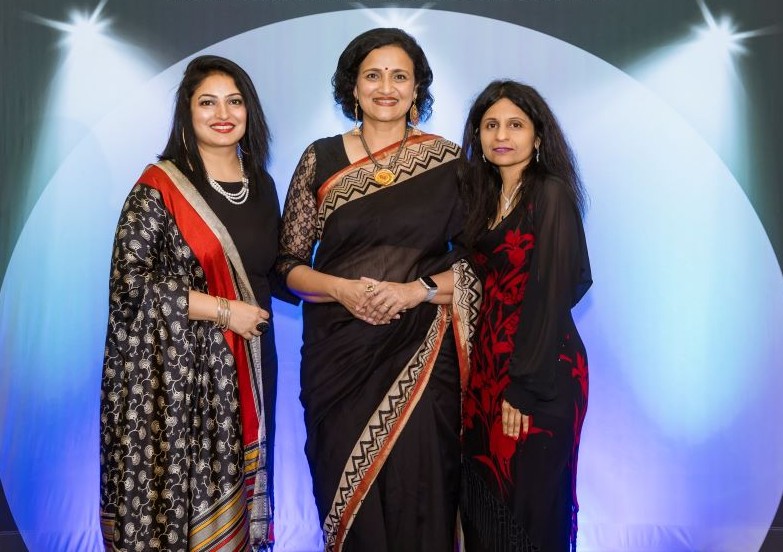
At NRI Pulse, we are an all-women team. This is not simply a structure, but a statement. The publication itself was founded by a woman who, in the midst of personal upheaval, carried the quiet weight of expectations while navigating her own path. Without fanfare, and with a determination shaped by both struggle and dignity, she built something enduring, a space where stories could be told, voices could be heard, and a community could find itself reflected. Today, women’s voices continue to shape the stories we tell, the perspectives we honor, and the narratives we choose to amplify.
March as a Mirror: Ardhanarishvara and the Road Ahead
Women’s History Month is not merely recognition. It is ritual, remembrance, and reclamation. For too long, history’s scales were tipped, leaving half the story untold. Marking this month restores balance and reminds us that the feminine is not an addition, but the pulse, the thread, and the unseen force that binds and uplifts.
Every woman carries within her a universe, and that potential flourishes when space is given to breathe, to stretch, and to shine. We must hold that space for one another so our daughters inherit a world that mirrors Ardhanarishvara, where worth is innate, opportunity is boundless, and no one walks alone.
Progress is a relay. This March, during Women’s History Month, the baton is in our hands. We honor those who came before us, especially the Indian and Indian-American women who have shaped history in ways both visible and unseen, by lifting those beside us, mentoring, building spaces where women lead, and holding culture as a source of strength.
I think back to that quiet moment in January, to two daughters standing where tradition once imagined a son. We did not fill a gap. We stepped into a continuum, into a lineage of women who have always carried more than they were asked to, and often more than they were seen for.
The story of Indian and Indian-American women is still unfolding. Each of us holds the pen, and together we can ensure that Women’s History Month is not just a time of remembrance, but a living, evolving testament that reflects the sacred harmony of Ardhanarishvara, whole and inseparable, so that one day, no daughter will ever wonder if she should have been a son.

*Jyothsna Hegde is the City News Editor of NRI Pulse.
