





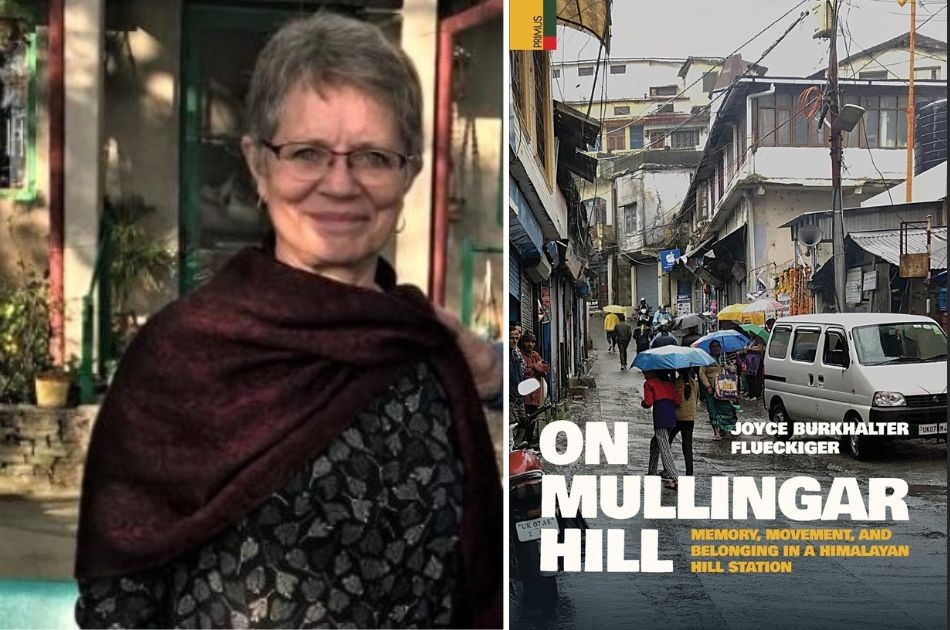
BY JYOTHSNA HEGDE
On Mullingar Hill by Dr. Joyce Flueckiger, published by Primus Books, New Delhi, is an evocative, deeply humane work that gently dissolves the boundaries between academic inquiry and lived experience. Described as a “crossover” book, it succeeds precisely because it refuses to remain confined within the expectations of formal scholarship. Instead, it opens itself to story, memory, and voice, inviting readers into the textured, breathing world of Landour Bazaar in Mussoorie. The result is a work that is as intellectually engaging as it is emotionally resonant.
Stretching geographically from Mullingar to the Clock Tower, and narratively across generations, the book unfolds through a series of interviews and oral histories. Over the course of its pages, Dr. Flueckiger leads the reader along the narrow, winding stretch of Landour Bazaar, moving from one shop to another, from one home into the next. The structure itself mirrors the experience of walking through the bazaar: unhurried, observant, attentive to detail, and filled with unexpected encounters. Each stop along the way reveals a life shaped by migration, labor, adaptation, and belonging.
What distinguishes this work immediately is its insistence on expanding the idea of who belongs in history. Hill stations such as Mussoorie have long been framed through colonial narratives, often privileging the perspectives of administrators, missionaries, and visitors. Dr. Flueckiger quietly but firmly shifts that gaze. Her focus rests on shopkeepers and their families, many of whom have sustained the everyday rhythms of the bazaar for decades, even generations. These are individuals whose stories might otherwise remain undocumented, yet here they emerge with clarity, dignity, and depth.
The narratives themselves are rich and varied. Mohammad Tahir’s recollection of his family’s past, for instance, is layered with memory and movement. His ancestors, once engaged in the delicate craft of bangle-making, found their way to Landour through shifting economic and political circumstances. His father’s work selling sweets and snacks from a tin trunk becomes more than an anecdote; it maps a social geography of the hillside, connecting homes, histories, and communities. Such moments capture the essence of the book: the ordinary rendered meaningful through careful listening and thoughtful presentation.
Similarly, the story of Sonu Ram Bhatia and his son Ranveer, who continue the family tradition of shoemaking, reflects the complexities of rootedness. Though their ancestry traces back to Himachal Pradesh, their sense of belonging is firmly anchored in Landour. “We are doing well here; we are earning well, eating well,” they say with quiet assurance. It is a simple statement, yet it carries within it a profound acknowledgment that home is not merely inherited but lived and chosen.
Perhaps one of the most striking voices in the book is that of Jaswinder Singh, affectionately known as “Smarty Singh.” Standing on the steep incline of the bazaar, guiding vehicles and assisting visitors, he embodies a spirit of care that extends beyond commerce. His reflections on communal harmony are both moving and instructive. In a time when divisions often dominate public discourse, his observation that people of different faiths come together for festivals, weddings, and even moments of grief offers a powerful reminder of shared humanity. “If someone dies, the whole bazaar is closed,” he notes, describing a collective act of mourning that binds the community together. It is in such gestures that the true character of the bazaar reveals itself.
Running through these individual accounts is a larger thematic thread that gives the book its intellectual coherence. Dr. Flueckiger challenges the notion of static communities, presenting instead a landscape defined by movement. “Everyone in the bazaar is an outsider because they all came from elsewhere,” she writes, capturing the paradox at the heart of Landour. This shared condition of outsiderness does not fragment the community; rather, it becomes the basis for a unique form of belonging. The bazaar is “performative and contingent,” continuously shaped and reshaped by the interactions of those who inhabit it.
The idea of movement extends beyond human migration. The author’s evocative description of the Himalayan environment reinforces this sense of constant change. The monsoon fog that shifts and reforms, the thunder that travels across valleys, the terrain that subtly transforms with time, all mirror the fluidity of human lives. Nature itself participates in the narrative, reminding the reader that stability is often an illusion.
Central to the book is its exploration of “home,” a concept that Dr. Flueckiger approaches with nuance and sensitivity. “Home is multiple, context-specific… and gendered,” she observes, drawing attention to the layered and sometimes contradictory ways in which individuals experience belonging. For many, especially women, home is not a singular place but a series of relationships and responsibilities that evolve over time. The distinction between mul nivas and watan further deepens this discussion. Watan, as described in the book, is not merely a birthplace but “the local web of relations that connects you to a place and forms you as a person.” It is an idea rooted in intimacy, connection, and shared experience.
This understanding of home is particularly significant in a place like Landour Bazaar, where migration is both a historical reality and a continuing process. Families have moved into the bazaar from across northern South Asia, while younger generations often move away in search of new opportunities. The proverb “Pahar ka pani pahar ki javani… both go downhill” captures this cycle with poetic precision. Yet the book resists any sense of loss or nostalgia. Instead, it presents movement as an integral part of the bazaar’s identity. As Dr. Flueckiger concludes, “movement itself is part of the heritage of Mussoorie,” shaping an “everyday cosmopolitanism” that is both dynamic and enduring.
What makes this work especially compelling is its tone. Despite its ethnographic foundation, it never feels overly academic or distant. Dr. Flueckiger writes with clarity, empathy, and a quiet affection for the people and place she describes. Her own connection to Landour, having spent part of her childhood there, adds a layer of personal insight that enriches the narrative without overshadowing it. She remains, throughout, a careful listener and an attentive guide.
The book also succeeds as a literary experience. Its pacing, its attention to detail, and its ability to move seamlessly between anecdote and analysis create a reading experience that is immersive and reflective. One does not simply read about the bazaar; one walks through it, pauses at its shops, listens to its voices, and gradually comes to understand its rhythms.
In the end, On Mullingar Hill is more than a collection of stories. It is a meditation on how communities are formed, sustained, and transformed. It asks important questions about identity, belonging, and memory, while offering no simplistic answers. Instead, it presents a world in which these concepts remain fluid, negotiated, and deeply human.
In capturing the spirit of Landour Bazaar with such sensitivity and depth, Dr. Joyce Flueckiger has created a work that is both intellectually significant and profoundly moving. Long after the final page, the reader lingers as though held in a quiet drift of mountain mist, still listening to voices that echo softly along the winding paths on Mullingar Hill.
