



BY JYOTHSNA HEGDE
Atlanta, GA, June 2, 2026: State Senator Greg Dolezal, Republican candidate for Lieutenant Governor of Georgia, recently spoke with NRI Pulse about affordability, education, public safety, healthcare, housing, economic development, and his vision for Georgia’s future. Dolezal faces former State Senator John F. Kennedy in the upcoming Republican runoff election.
The interview was facilitated by Karthik Bhatt, Chairman of the Advisory Committee of the Georgia Republican Party.
The following interview has been edited for clarity while
preserving Senator Dolezal’s responses.
Why are you running for Lieutenant Governor, and what do you see as the
primary responsibility of Georgia’s Lieutenant Governor?
I’ve been in the state Senate for the last eight years, and the lieutenant governor presides over the state Senate, so I’ve had the opportunity to watch, over the past four years in particular, Burt Jones lead the state Senate in a way that I thought was very good for Georgia, in a way that I thought was very positive for the conservative movement. The lieutenant governor really has the ability to kind of usher legislation through that process, in addition to just presiding over the chamber.
I think that we are in a unique moment in American history. The middle class is being squeezed. Georgian families are finding it hard to pay for gas, groceries, and childcare. I think the Republicans need to be the party that steps up and offers the solution to help them find the American Dream, because if we do not, we see what happens in New York with the election of Zohran Mamdani, a Democratic socialist who does not believe in the free-market capitalism principles that have made America so great.
If elected, what legislative priorities would you champion during your first year in office?
I’ve got a lot, but let me just pick a couple. I think that property taxes are out of control in Georgia. Families in my district and around the state are just getting crushed by these property taxes that keep going up and up and up. We took a step this year to right-size that by putting a cap on the annualized increases. But I believe that we need to move towards no property taxes in Georgia on the primary home for Georgians.
The primary wealth creation tool in America for the last 100 years has been the middle class being able to purchase a home, usually in their 20s historically. A family would buy a home and build equity through that home and ultimately retire off that equity. And that is becoming very, very difficult. In today’s America, the average age of a first-time homebuyer is 41 years old.
Metro Atlanta leads the nation in private equity groups and hedge funds using foreign investment money and buying single-family homes in Atlanta and usually turning them into rental properties. I do not believe that we can allow America to become a nation of renters. I believe that we have to ensure that American homes are for American families.
One other thing that’s a little bit of a deviation from some of the economic policies: I’m a massive believer in universal school choice, the idea that we’re investing in students and not just the education system. Parents are in the driver’s seat of their child’s education. We would allow them to take the state tax dollars that we are investing into their child’s education and use that for whatever education opportunity the parents may believe is best.
I authored a more limited school choice bill a couple of years ago. We now have thousands of students who are able to take advantage of what’s called the Georgia Promise Scholarship. But I want all Georgian students to be able to do that.
Your opponent John F. Kennedy has emphasized his record and experience. What sets you apart, and why should Republican voters choose you in the runoff?
John’s a good guy. He’s my friend. When I went to the Senate eight years ago, he was my assigned Senate mentor. We’ve worked together on a number of pieces of legislation.
If I was looking for differences in our voting record, I would point you to the fact that I have opposed every tax increase that has come before me. These have been things like tax increases on Uber rides, Airbnb nightly stays. There was a billion-dollar marketplace facilitator tax increase that kind of stuck under the radar that got passed.
The other thing I’m hearing from a lot of Georgians is they’re very concerned about the data center expansion and the pace of data center expansion in Georgia. I’m the only person running for lieutenant governor who voted against the tax credits and tax incentives for data centers. We give data centers about $1.5 billion a year in tax incentives, and I voted against that. My opponent did not.
Forsyth County today looks very different from what it did 20 years ago, with many immigrant communities making it home. Do you see that diversity as a strength? What message do you have for these communities?
I would say that I see unity as our strength. I don’t think that diversity for diversity’s sake is ultimately the goal.
I think that the goal is that we see people come together and have cohesion as Americans, that we all are working to pursue the American dream, that we wake up as neighbors, and we wave to each other on our way to work, or dropping our kids off at school, and we learn to live together and love each other as neighbors, but ultimately recognize that we each have a part to play in today’s culture and today’s society.
Part of the American dream has always been called a melting pot, and the idea is that we come here from wherever we came from. I’m a European mutt. My parents and grandparents and great-grandparents have different lineages throughout Eastern and Western Europe.
Whenever my ancestors came, they came here to pursue the American dream. When Karthik came here, he came here to pursue the American dream. He’s a proud American. He sees himself as an American. I see him as an American, and I think that unity between he and I ultimately is the goal and the strength.
And that, I think, is what we need to focus on.
Families are feeling the impact of rising costs. What would you do to make Georgia more affordable?
I already mentioned property taxes, but one of the things that we do in Georgia that’s unique in the Southeast is we take away 5% of people’s income before they even get their paycheck. We have the largest income tax in the Southeast.
Tennessee is at 0%. Florida is at 0%. And I would like to see Georgia move to 0% as well. That would provide immediate relief for Georgia families.
We passed a bill out of the state Senate this year that was putting us on the path to doing that. We weren’t able to get that across the finish line, but that has been an active conversation ever since I got elected. We’ve lowered the income tax now four years in a row. I think we need to do it faster, and I think we need to be more aggressive.
We often hear about teacher shortages and retention challenges. What is your vision for K–12 education in Georgia?
My mom was a public school teacher, and so I watched her love her job, but I also watched her struggle with the frustration of the bureaucracy and essentially the government being in the classroom.
I think we’ve got to get out of the way and let these teachers teach. I think that we have an environment in Georgia where we have teachers being forced to teach to a test because they’re measured by their CCRPI scores.
We have given teachers significant pay raises under the leadership of Governor Kemp. I was happy to vote for all of those, but I think that we’ve got to give teachers a stronger career pathway over time. Right now, their pay essentially freezes after 21 years. I think that their pay scale should continue to increase, and we should allow them to look at teaching not as a 21-year career in Georgia, but as a 40-year career.
My mom taught into her 60s. And if you’ve ever had one of those old-school teachers that’s been teaching for a long, long time, you know they’re some of the best teachers you have because they know what they’re doing.
And they’re also great to have in a school because they help the younger teachers be able to learn some tricks of the trade.
What are your top public safety priorities for the state?
Fund the police, back the police, put the bad guys in jail, throw away the key, get rid of woke judges.
We’ve seen a number of different emphases over the last few years, to either defund law enforcement, to reduce or get rid of mandatory minimum sentences. Charlie Kirk used to talk about, and I think that he was right, that we have an under-incarceration problem in America.
If you look at a lot of these career criminals that have been kind of turnstiled through the criminal justice system and put back on the street, they sometimes commit some of the most heinous crimes. And it’s especially offensive when you see that happen when this person had been previously arrested 15 or 20 times and the judge just didn’t have the guts to put them in jail where they belong.
Georgia continues to grow rapidly. What are the biggest opportunities and challenges that come with that growth?
Governor Kemp has done a great job redirecting a lot of this economic development into rural Georgia, which is frankly on life support in terms of a lot of these small-town economies.
Even when we talk about getting rid of property taxes, for example, one of the things we hear from our friends in rural Georgia is that’s going to be harder for them to do if you try to shift to a consumption tax because they frankly have not very much industry to speak of, not very much retail industry to speak of.
I think that is one of the areas, to ensure that we continue to invest with rural Georgia, where we see companies come in. We’ve got to sell the opportunities that exist in rural Georgia.
Metro Atlanta is going to continue to grow, frankly, by accident, right? Regardless of what we do. It’s a thriving city. People want to be here. We can continue to create the environment for growth in Metro Atlanta, and it will continue to grow probably without some of the specific adjustments and fine-tuning that we may need to do in rural Georgia.
I think, as well, we have to be very mindful of the types of businesses that we attract here. I want to see small and medium-sized companies thrive and grow here. That’s one of the advantages, I think, of getting rid of the income tax. More than half of Georgians work for a small or mid-sized company.
While government tends to focus on landing the big fish, the big flashy hyperscaler, and we’ve been successful in landing some of those, I don’t want to lose sight of the small and medium-sized companies in the process of doing that, because those are Georgia-owned companies, Georgia-grown companies, and I want to make sure that continues to be a thriving space in our economy.
Housing costs and property taxes are a growing concern for many families. What’s the one thing Georgia should do right now to make homeownership more affordable?
We need to ensure that we get Blackstone and Vanguard out of the purchasing of resale single-family homes here in Georgia.
We need to see some deregulation. About 30 to 40 percent, depending on who you ask, of the cost of a new home is in regulation. I wrote the Red Tape Rollback Bill here in Georgia, and we were not able to get that passed, but it would have been the most significant deregulation bill in the state.
A lot of those regulations actually come from the federal government, and we have homebuilders having to chase all these new energy codes and regulatory mechanisms.
There’s some adjustments and things we need to look at as far as our land use in the state. And those are all things that we need to do in addition to addressing the property tax issue as well.
What should the state’s role be in addressing healthcare costs and physician shortages?
I think that the state’s role should be less than what it is. And I think the government’s involvement in healthcare has been one of the primary cost drivers, if not the primary cost driver.
I remember when the Affordable Care Act was passed, and as a small business owner, every year since the Affordable Care Act has been passed, we have had double-digit increases in the insurance costs that we provide for our employees.
So, much like a lot of government programs, it has done the exact opposite of what the name is. It has made healthcare unaffordable.
I am, knock on wood, a healthy middle-aged man with four kids and a healthy wife. And we are forced by the government to purchase more insurance than we need. I don’t need an insurance plan that pays for my annual checkup because I’m able to pay for that out of pocket. But I am forced to pay for insurance that I don’t need.
I would like to see more free-market principles implemented on the healthcare side.
You mentioned the physician shortage. I think that’s a very important question. We have made significant investments as a state in our medical schools to ensure that we have Georgia-trained doctors here in Georgia.
We’ve increased residencies. We’ve done a number of things to expand the pool of Georgians.
This is another area, though, where rural Georgia needs to be talked about frankly a little bit separately from the metro area because there are unique challenges in rural Georgia.
We created, before I got to the General Assembly, the Rural Hospital Tax Credit, something that my family has donated to in the past.
You’ve been one of the loudest critics of tax breaks for data centers. Why do you think those incentives are a bad deal for Georgia taxpayers?
I’m against all crony capitalism and all corporate carve-outs. I think that the role of government is to level the playing field for anyone who wants to compete in our free-market system.
I don’t believe it’s the job of the government to pick out one industry, or one type of building, or one type of job, and say the government’s going to pay this person to create this job. Meanwhile, the rest of us are over here fending for ourselves while the government’s juicing the bottom line for a bunch of trillion-dollar corporations to build data centers.
I would say I’ve been proven right on that because studies have shown us that those data centers would actually be coming to Georgia about 70% of the time either way.
You introduced legislation to ban Sharia law in Georgia courts. Why was that issue important enough for you to take up?
If you look outside of Dallas, Texas, there’s an Islamic tribunal that adjudicates, in really a parallel legal system, family law cases and business law cases under the precepts of Sharia law. Before that ever happens in Georgia, I want to ensure that we do not allow that to happen (in Georgia). We have one Constitution. We have one law framework here in Georgia that we need to follow. I do not want to see any parallel legal systems get set up in Georgia.
That bill would ban all foreign laws from being able to supersede the Constitution in these tribunals and these parallel legal systems. I think that it’s important, essentially, to stop the problem before it comes to Georgia.
It’s very similar to the Riley Gaines Act. When I wrote that bill, we had seen things happen a little bit here in Georgia, but largely in other states. We wanted to ensure that we protected female sports. I think it’s very similar to protecting Georgians from Sharia law.
What is one issue facing Georgia that isn’t getting enough attention?
I think that the next generation is losing sight of the American Dream. I think that they think that’s something that their grandparents talked about, that they think that somehow has changed, that they can’t participate in it.
As America turns 250 years old this year, we need to think about how do we cause the next generation to fall in love with the American Dream again, to participate in the upside of free-market capitalism, to feel like they do have the opportunity to live a better life than their parents lived.
I think that that’s kind of lurking under the waves a little bit, if you will, and it’s why you see Zohran Mamdani get elected. It’s because he took a message to the next generation of government grocery stores and rent control. And when you’ve got young people that can’t afford to buy food and can’t afford rent, they tend to fall prey to Pied Pipers like Mamdani.
We have to make sure that does not happen here in Georgia.
If elected, what would success look like after four years as Lieutenant Governor?
I get a little jealous because they call Florida the free state of Florida. And we’ve done a number of great things here in Georgia, and Governor Kemp has done a great job, and Burt Jones has done a great job as our Lieutenant Governor. I want to build on that so boldly and so aggressively that people all over America say, ‘What is going on in Georgia?’ And they start calling it the free state of Georgia, to where everybody looks at us and says, ‘We want to be just like that state.
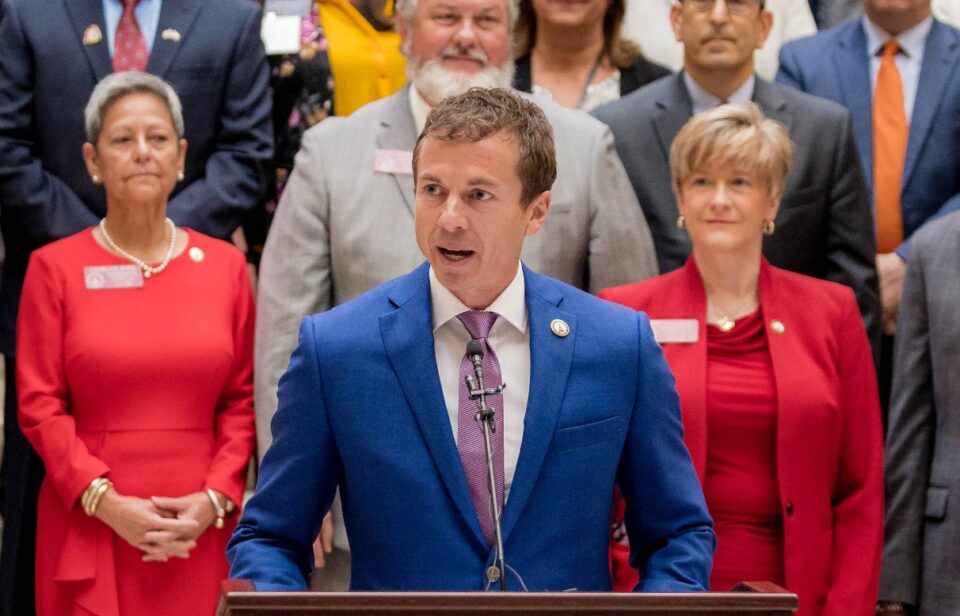
Cover photo courtesy: Greg Dolezal for Lt. Governor
