





NRI PULSE STAFF REPORT
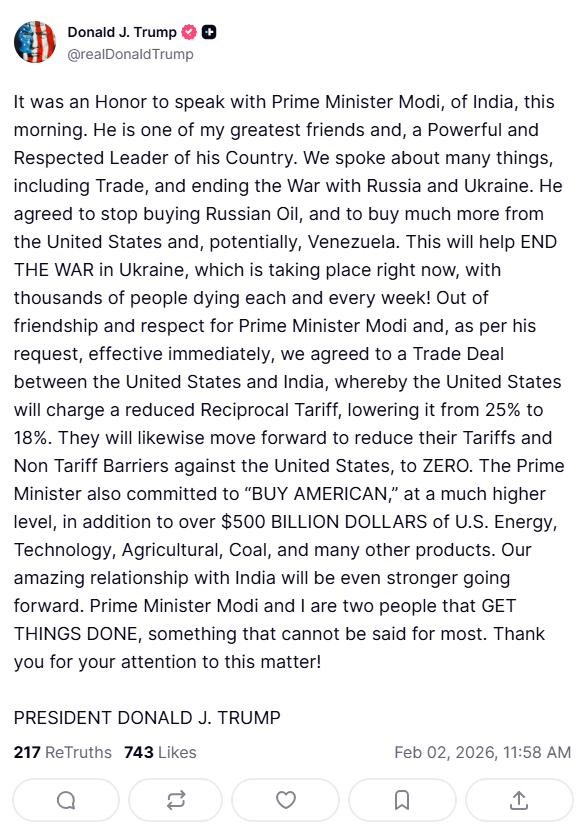
Washington, DC, February 3, 2026: The United States and India this week announced a new trade understanding following a conversation between U.S. President Donald Trump and Indian Prime Minister Narendra Modi, signaling a reset in trade relations after months of tariff disputes and diplomatic strain.
While both leaders described the announcement as a “trade deal,” officials on both sides have since clarified that the agreement remains a framework understanding, with several high-profile claims yet to be formally confirmed or documented.
Current Status of the Agreement
While both leaders announced the deal on social media platforms — Trump on Truth Social and Modi on X — the agreement has not yet been formally published.
India’s Commerce and Industry Minister Piyush Goyal said on Tuesday that a joint statement outlining the broad contours of the deal is expected within the next two to three days.
Officials have described the current arrangement as a “framework agreement” or a “leaders’-level understanding,” rather than a finalized, legally binding trade pact. Negotiating teams from both countries are said to be in the final stages of detailing and “papering” the agreement before it is officially signed.
At present, no full fact sheet, tariff schedule, or negotiated legal text has been released by either the White House or India’s Ministry of External Affairs. Most available information comes from public statements and social media posts by the two leaders.
What Has Been Confirmed
Tariff Reductions on Indian Exports
The most clearly confirmed element of the deal concerns U.S. tariffs on Indian goods.
- The United States will reduce tariffs on many Indian exports from levels that had climbed to about 50 percent down to roughly 18 percent.
- This includes the removal of a 25 percent punitive surcharge imposed in 2025, which Washington had linked to India’s continued purchases of Russian oil.
Indian officials have publicly welcomed the tariff rollback, describing it as relief for Indian exporters and manufacturers.
Expanded Market Access Discussions
Both sides have acknowledged that the deal includes expanded market access for U.S. goods in India, including in sectors such as agriculture, energy, and technology. However, officials have not released detailed product lists or tariff schedules.
Claims Made by President Trump That Remain Unconfirmed
Several of the most sweeping assertions connected to the deal have come only from President Trump and have not yet been confirmed by the Indian government.
Russian Oil Purchases
President Trump stated that India had agreed to stop buying Russian oil and would instead increase energy purchases from the United States.
However:
- Indian officials have not publicly confirmed any commitment to halt Russian oil imports.
- Russian officials have said they were not informed of any such decision by New Delhi.
- Analysts note that Russian crude currently accounts for a significant share of India’s energy imports, making an immediate halt unlikely without a formal policy announcement.
Zero Tariffs on U.S. Goods
Trump also claimed that India agreed to reduce tariffs on U.S. imports to zero.
So far:
- Indian statements have not confirmed a blanket zero-tariff policy.
- No official tariff schedules or exemptions have been published.
Large-Scale Purchase Commitments
The U.S. president further said India would purchase hundreds of billions of dollars’ worth of U.S. goods, including energy and industrial products. These figures have not been independently verified, and no binding purchase commitments have been released.
What Comes Next
Officials from both countries say the agreement is still being finalized, with a joint statement expected shortly that may clarify timelines, sector-specific commitments, and enforcement mechanisms.
Until formal documents are released, analysts say the announcement should be viewed as a political framework rather than a completed trade treaty, with several key elements — particularly those related to Russian oil and zero tariffs — remaining claims rather than confirmed policy changes.
For now, the tariff rollback provides immediate relief to Indian exporters, while broader geopolitical and energy questions raised by the announcement remain unresolved.
