


From Slumdog Millionaire to this year’s Homebound, India’s Oscar journey reveals a persistent Western fascination with stories of poverty—while a new generation of filmmakers and global stars like Priyanka Chopra are redefining the country’s cinematic image.
BY NAMITA DOGRA SUDAN*
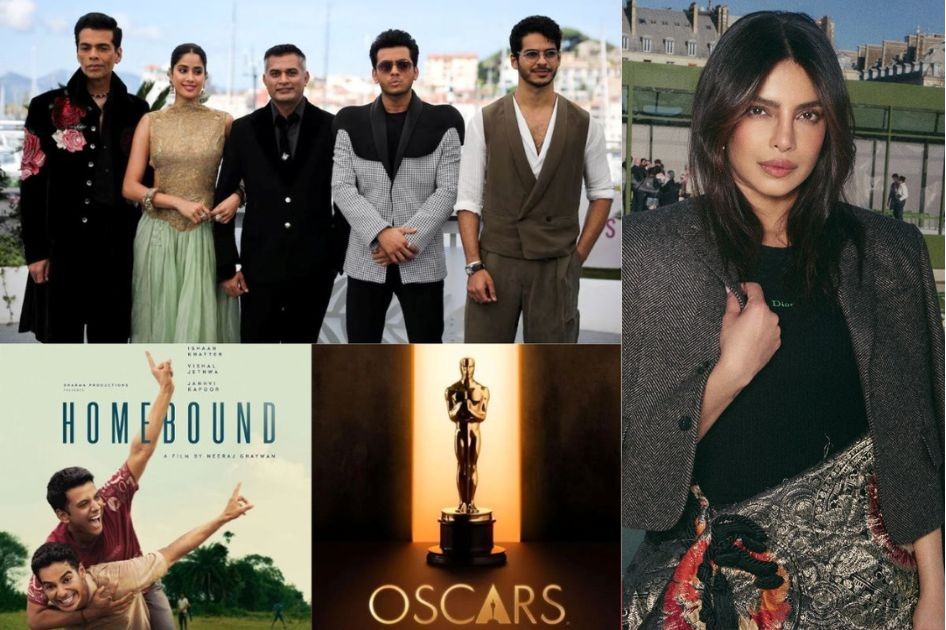
As the 98th Academy Awards take place tonight in Los Angeles, the conversation around India’s representation in global cinema is more relevant than ever. This year, all eyes were on Neeraj Ghaywan’s “Homebound”, which made it to the Oscar shortlist but unfortunately failed to secure a final nomination—once again sparking the debate about whether the “poverty and caste” narrative is the only ticket to Hollywood’s attention. Produced by Karan Johar and executive-produced by Martin Scorsese, the film follows the harrowing journey of a Dalit youth and his Muslim friend during the pandemic. On the other hand, tonight features Priyanka Chopra Jonas as a presenter—a woman who has redefined India’s international image. Unlike the “struggle” films often sent for awards, Priyanka represents a modern, powerful India.
The Statistical Bias: A Pattern of “Struggle.”
Since India began submitting films in 1957, a clear pattern has emerged: the “Western Gaze” only validates Indian stories when they serve as a form of “Poverty Tourism.” The data is undeniable: 100% of India’s final nominations in history have come from films about poverty, rural struggle, or colonialism.
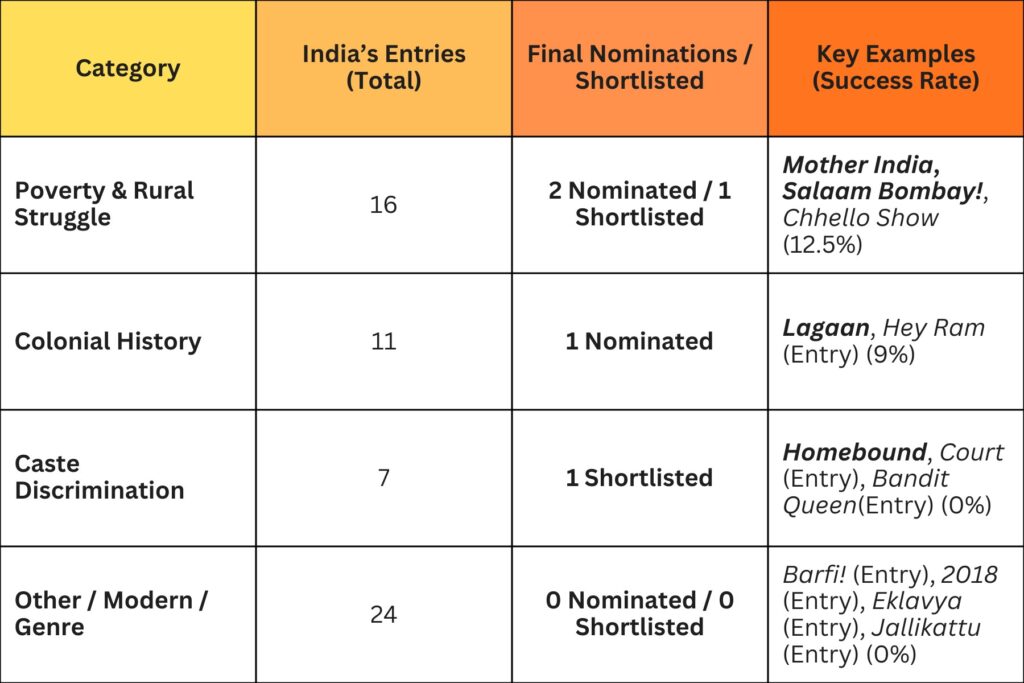
This year’s entry, Homebound, proves that this “Struggle Subscription” is still active. While the film was not a major commercial hit in India, its focus on systemic cruelty and caste made it a “safe” choice for the Film Federation of India (FFI) to send. The Academy shortlisted it because it satisfied their requirement for “authentic” Indian pain, confirming that the Oscars are often looking for social scars rather than cinematic innovation.
The exclusion of films like the 2024 entry 2018: Everyone is a Hero—a modern, high-octane survival thriller—proves the point. Even when India presents a story of modern resilience and technical brilliance, it is often ignored because it doesn’t satisfy the Western appetite for “gritty realism” and “victimhood.”
The Slumdog Paradox: A Rejected Script
The term “Poverty Tourism” found its ultimate mascot in the 2008 sweep of Slumdog Millionaire. Interestingly, the film’s most pivotal role—the game show host—was first offered to Amitabh Bachchan. As the real-life host of Kaun Banega Crorepati, Bachchan’s refusal was a statement in itself. He chose not to lend his face to a Western narrative that depicted the game show—a symbol of Indian aspiration and middle-class hope—as a rigged, “murky” business.
Writing on his blog, Bachchan noted that the British seem unable to escape the mindset that India is forever their “once and future colony.” He argued that while every nation has a “dirty underbelly,” the West only chooses to point its cameras at India’s grime, while ignoring its growth. By awarding 8 Oscars to a British director’s vision of Indian slums, the Academy signaled that it prefers the “tourist” version of India—a chaotic landscape in need of a Western “Millionaire” escape.
The Double Standard: Europe’s Art vs. India’s Documentary
The Academy operates on a clear double standard. European winners are often “frivolous” or “stylistic,” while Global South films are expected to be “educational.”

When a French director makes a film about a breakup in a beautiful cafe, it’s a masterpiece. When an Indian director does the same, the Western critic asks: “But where is the struggle?”
The “Lagaan” Hangover: Why We Missed the Roar of RRR
While both Lagaan and RRR are set in the colonial era, they speak different languages. Lagaan speaks the language of the ‘Noble Victim’—a narrative the West finds comfortable and familiar. RRR, however, speaks the language of the ‘Mythic Hero.’ It subverted the gaze by refusing to let colonial suffering be the ‘aesthetic.’ Instead, it used that history as a launchpad for a superhero epic. The FFI, stuck in a ‘Lagaan hangover,’ sent a quiet rural drama called “Chhello Show” (The Last Film Show) in 2022 instead of RRR. Why? Because Chhello Show—a movie about a poor boy in a village—fits the “Oscar brand” of poverty that the committees are used to. But the world didn’t want another sad story; they wanted the roar of RRR. By the time Naatu Naatu won an Oscar for Best Song, it was clear: the global audience is ready to see a powerful India, even if the award committees are still looking for a struggling one.
The New Beacon: Priyanka Chopra and the Power Shift
However, if we look away from the “International Film” category, there is a brighter side to tonight’s 98th Academy Awards. Standing on that stage as a presenter is Priyanka Chopra.
While the FFI and the Academy are busy debating which Indian “struggle” to shortlist, Priyanka has spent the last decade building a platform based on power, not pity. She didn’t rely on her Bollywood superstardom to carry her; she started from scratch in Hollywood, proving her worth in action, thrillers, and global dramas. When Priyanka stands on that stage tonight, she isn’t representing a “former colony” or a “developing nation”—she is representing a modern, high-tech, and influential India. She is proof that India can dominate the global stage without having to sell its scars.
Conclusion: From Pity to Power
The data shows a clear bias: 100% of India’s nominated entries are stories of struggle. But as we watch the Oscars tonight, we see a growing disconnect. On one hand, we have the “Poverty Tourism” of the film submissions—a loop the FFI and the Academy can’t seem to quit. On the other hand, we have the success of individuals like Priyanka Chopra and the global roar of RRR, which demand respect through sheer excellence.
The Academy may still be looking for the “Slumdog,” but the world is starting to see the “Superpower.” Tonight, as we wait for the results, we should remember that our true global impact isn’t found in the frames of a sad story, but in the hard work of those who refuse to be defined by their grime. The beacon is being held high; it’s time the Academy finally catches up to the light.

*Namita Dogra Sudan is the entertainment news editor and video news producer of NRIPulse.
