


BY BINDU MANOJ*
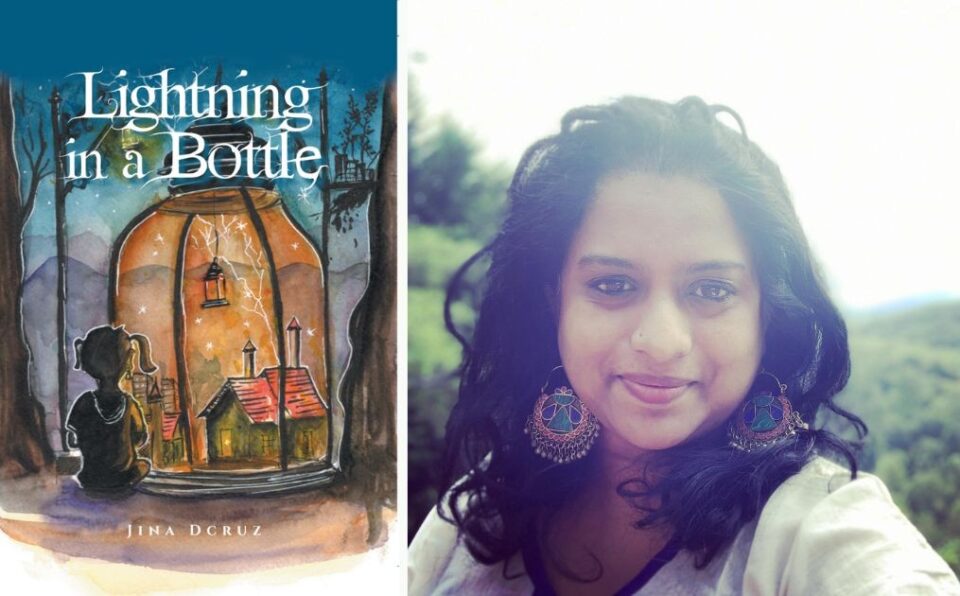
Atlanta-based Indian American poet Jina DCruz’s debut poetry collection, Lightning in a Bottle, was recently named a 2025 American Writing Awards Finalist in Poetry, Reader’s Choice Book Award, and received the Author Shout Recommended Read Award. The collection weaves together themes of identity, migration, grief, belonging, womanhood, and cultural memory—stories shaped by the diasporic experience and the quiet, complicated beauty of living between worlds.
Jina Dcruz wears many hats, and I have long since stopped counting them. As you come to know her, as a friend, a writer, and the incisive health scientist she is, you begin to notice a common thread running through every incarnation of her: a longing, a soul that feels intensely, for herself, for those she loves, and for the world at large.
In her prelude, Jina mentions that these poems were composed over fifteen years, tracing “the evolution of a poet, a woman, and a human being moving across continents and through life’s many turns.” It is this perceptiveness, paired with an uncommon honesty that catches you by the throat, page after page. You see yourself in her words. You sense a kinship in the shared experiences. You recognize someone who has given voice not only to what she has felt, but to what many of us, especially women, have lived through and rarely found words for.
The Immigrant’s Heart
Her poems do not follow a linear path, yet they are beautifully interconnected. She opens with Agua, evoking the helplessness and quiet confusion of a young mother in an unfamiliar land, while her two-year-old son has already made it his own, inhabiting its languages with ease, “with a smile only a child can conjure.” From there, she moves to The Lunchbox, once a vessel of parental love carried from home, now transformed into something that marks her as an outsider, even a potential criminal, in a foreign land. How does one surrender the tastes and aromas of childhood and still call a strange place home?
Food as Memory, History, and Identity
Food, in Jina’s world, is far more than nourishment. It is a conduit to the past, a keeper of history, and a bridge between old cultures and new ones. In Unmarked History, dosas, chutney, sambar, and fish fry become sacred; reminding us as she writes, that food is “more than sustenance. It’s the heartbeat of our memories.”
Finding Ground in Foreign Soil
The journey of becoming, of learning to belong without quite knowing where one is going, continues in poems like Monkey Bar and Dandelion-ed. There is no resolution here, and she does not pretend there is. Instead, she offers something far more honest: the quiet acknowledgement that she is still learning, still evolving, still reaching.
The Fabric of Memory and Feeling
Memories are rarely linear. One thought layers upon another, and with it the full weight of emotions. Jina’s poems seem to rise from what seem like random recollections—hers and those of the people around her—yet there is nothing accidental about them. A silken thread runs through each poem, woven from the same loom, guided by the same hand, shaped by the same heart. She is deeply moved by everyone and everything that passes through her life.
In Her Stories, she asks:
“Do you think of the countless women
whose stories drifted away,
lost in the margins of history,
their voices silenced
by the weight of his stories?”
This question echoes earlier in To Break the Glass Ceiling, which captures the quiet, unrelenting anguish of a feminist who cannot look away from inequity. In Covid Echoes, the health professional in her surfaces, carrying the collective weight of a world in crisis, speaking with others like her of a time “when normalcy breathes again.”
The Tender and the Melancholic
A gentle melancholy runs through some of these poems, and those who know Jina will recognize it as part of her beautiful interior landscape. The pale solitude of Tea, the “dismembered doll and the broken cane” in A Broken Kaleidoscope, the quiet grief of Silent Conversations, and the almost helpless question posed in Home, reveal a woman of profound empathy, who carries the pain of others as naturally as her own.
The Whimsical and the Wonderstruck
And yet, what I love most about this collection is the seemingly whimsical. It comes as no surprise that her love language includes macchiatos, brownies, and other small, comforting things. Even here, existential questions slip in almost unbidden. This is the Jina I know, incapable of remaining on the surface of anything for long.
A Voice Worth Returning To
What endears these poems to me most is the simplicity of her language; spare, precise, never overwrought. Jina has an extraordinary ability to hold the full weight of a theme with the lightest of touches. She never loses gravitas, yet she never reaches for it.
Her own words, from I Long to Be a Poem, capture it best:
“Flowing effortlessly through every punctuation,
Standing strong, a masterpiece on its own.”
That is exactly what this collection is. Lightning in a Bottle is not merely a debut—it is a declaration. Here is a poet who has been quietly gathering her storms for fifteen years, and in this anthology, she finally lets the lightning speak.
I, for one, am listening and waiting, impatiently, for the next bottle she uncorks.
*Bindu Manoj believes a well-worn book is the best kind of retreat. She calls herself a relentless reader and a reluctant city dweller. When the pages run out, she fantasizes about disappearing into the hills forever. She calls Atlanta home, though her soul has permanently been left behind somewhere along the backwaters of Alappuzha.
