


NRI PULSE STAFF REPORT
Sugar Land, Texas, December 29, 2025: What began as a moment of celebration for a Texas Hindu community has become a symbol of a broader unease now gripping many Indian Americans, according to a detailed report by The New York Times.
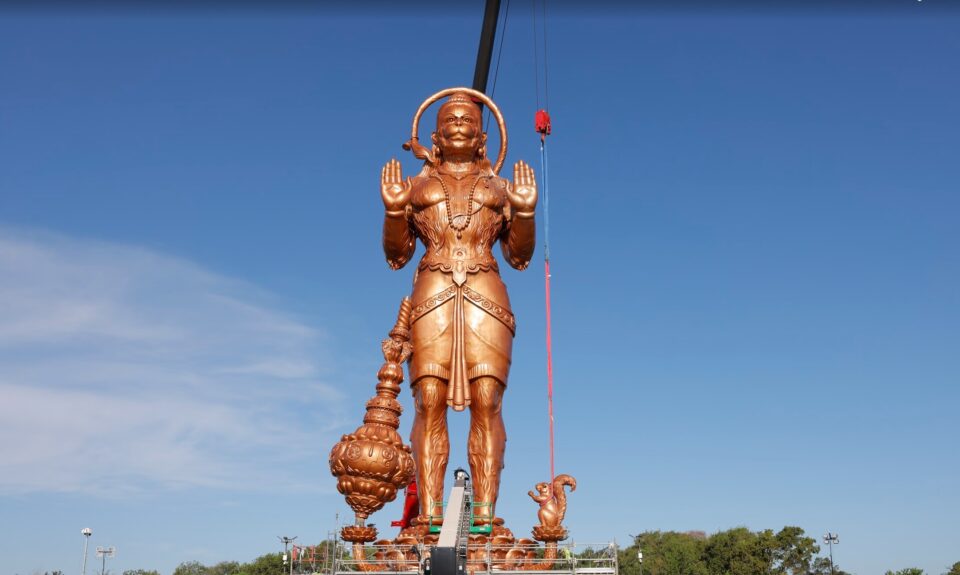
The newspaper recounts how Srinivasachary Tamirisa, a retired OB-GYN who emigrated from India five decades ago, watched with pride as a towering 90-foot statue of Hanuman was consecrated at a Hindu temple he helped establish in Sugar Land, a Houston suburb. Priests chanted, flower petals rained down from a helicopter, and both “Vande Mataram” and “The Star-Spangled Banner” were played, reflecting the dual identities many Indian Americans embrace.
But outside the temple walls, conservative Christian protesters gathered, denouncing the statue as a “demon god.” Right-wing politicians amplified the backlash online, with one U.S. Senate candidate declaring Texas a “Christian nation” and questioning why a Hindu statue should be allowed at all.
According to The New York Times, Tamirisa was deeply shaken. After a lifetime of professional success, civic participation, and naturalized citizenship, he found himself facing open hostility toward his faith — and, by extension, his place in American society. “I thought this was heaven on earth,” he told the paper. “Now I question why I am here.”
A Wider Climate of Hostility
The episode, the Times reports, reflects a broader surge in anti-Indian rhetoric in the United States. While crude racism often circulates on social media, the paper notes that more polished attacks have also come from prominent political figures.
Stephen Miller, a key architect of former President Donald Trump’s immigration policies, has accused Indians of exploiting immigration rules. Ron DeSantis has criticized the H-1B visa program, which many Indian professionals rely on, calling it “chain migration run amok.” Indian Americans also expressed discomfort when JD Vance publicly said he hoped his Hindu wife might one day convert to Christianity.
This shift is striking, the Times notes, given the extraordinary success of Indian Americans since immigration laws changed in 1965. Indian Americans have among the highest median household incomes in the country, high levels of educational attainment, and a strong presence in medicine, technology, finance, and academia. They have also risen to prominence in business and politics, leading companies such as Google and Microsoft and emerging as a growing voting bloc.
Visa Uncertainty and a Chilling Effect
Despite generally positive public views of Indian Americans, the combination of political rhetoric and tightening visa policies is already having tangible effects, according to The New York Times. The paper reports that while Indians became the largest group of international students in the U.S. last year, arrivals of Indian students fell by 44 percent this year.
The Times highlights the story of Sai Sushma Pasupuleti, a doctoral student in electrical engineering at the University of Houston. Once confident she would find work in the U.S. after graduating, she now finds employers turning her away as soon as they learn she is not a U.S. citizen. Despite her academic achievements and cutting-edge research, she faces the possibility of leaving the country she hoped would shape her into a global technical leader.
A Turning Point for Migration
Citing experts, The New York Times describes Indian Americans as “poster children” of America’s skilled legal immigration system — a system now under strain. The paper argues that as economic pressures grow and immigration becomes a polarizing political issue, even highly skilled, legal migrants are increasingly being cast as competitors rather than contributors.
The consequences, the Times warns, could be significant. American universities invest heavily in training foreign students who may be forced to leave. U.S. companies risk losing talent to Europe or back to India, where economic opportunities are expanding rapidly and major American firms are investing billions.
Questioning Belonging
For many Indian Americans, the report suggests, the moment has triggered difficult self-reflection. Some are seeking Overseas Citizen of India status as a backup plan. Writers like Suketu Mehta, quoted by the Times, say that for the first time in decades, their sense of belonging in the United States feels uncertain.
The New York Times concludes that the backlash against Indian immigrants — symbolized by protests against a Hindu statue — reflects not strength, but insecurity. America’s historic openness to global talent, the paper argues, has been one of its greatest sources of power. Turning away from it may leave the nation poorer, weaker, and more isolated — and cause many who once saw the U.S. as a destination of hope to look elsewhere instead.
— Reporting based on and credited to The New York Times
Cover photo credit: statueofunion.org.
