





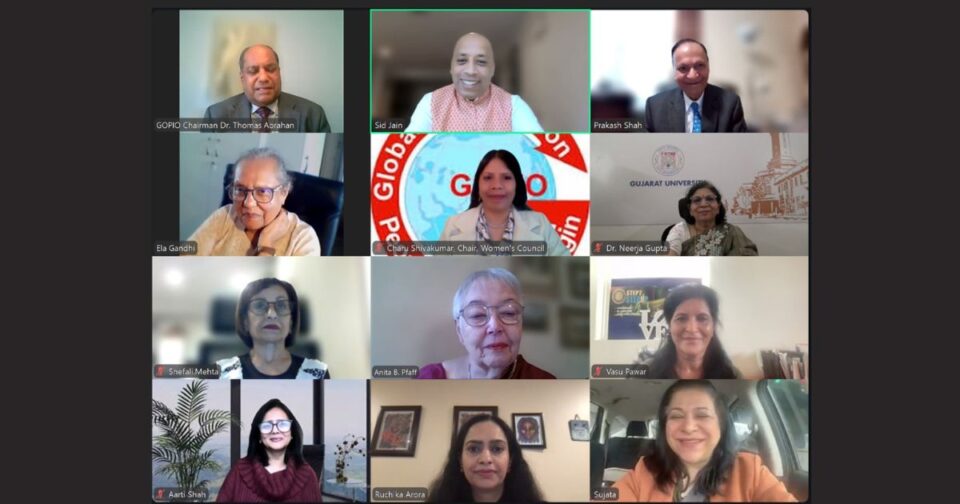
New York City, NY, March 17, 2026: In a rare and symbolic moment for the global Indian diaspora, descendants of two of India’s most iconic leaders—Mahatma Gandhi and Netaji Subhas Chandra Bose—shared a common platform for the first time during a virtual webinar hosted by the Global Organization of People of Indian Origin (GOPIO) Women’s Council on March 14.
The webinar, titled “Indian Diaspora Women: Leading and Transforming the Social, Educational, Political, and Corporate Spheres,” brought together participants from across continents, including North America, Europe, Africa, and the Asia-Pacific region. Organized by GOPIO Women’s Council Chair Charu Shivakumar of Southern California, the event focused on the evolving role of diaspora women in leadership and social change.
GOPIO Chairman Dr. Thomas Abraham opened the session by highlighting the organization’s global advocacy efforts and longstanding push for dual citizenship for people of Indian origin. GOPIO President Prakash Shah outlined upcoming initiatives, including monthly webinars and the organization’s biennial convention scheduled in Mumbai in December 2026.
The session was moderated by Dr. Neeraja Arun Gupta, Vice Chancellor of Gujarat University, who framed the discussion around the theme “Give to Gain,” emphasizing mentorship, collaboration, and community building among women leaders.
Chief guest Ela Gandhi, granddaughter of Mahatma Gandhi and a veteran political figure in South Africa, reflected on her experiences in the anti-apartheid movement and her work advocating for women’s participation in democratic processes. She spoke candidly about the “triple burden” many women face—balancing professional responsibilities, household duties, and childcare—and called for greater societal support to achieve gender equity.
Joining her on the panel was Professor Anita Bose-Pfaff, daughter of Netaji Subhas Chandra Bose, who shared insights from her life as a scholar in Europe navigating questions of identity, gender, and cultural belonging. She highlighted both the progress made in women’s education and the persistent barriers in professional spaces, while also recalling her father’s progressive views on women’s leadership, including the role of Captain Lakshmi Sahgal in the Indian National Army.
Connecticut State Senator Prof. Sujata Gadkar-Wilcox spoke about her historic election as the first Indian American and first Asian American woman to serve in the Connecticut Senate. She pointed to structural and cultural barriers that continue to limit women’s participation in politics and stressed the importance of grassroots movements to drive systemic change.
Other speakers included Dr. Aarti Shah, board member at NVIDIA and other organizations, who emphasized the importance of values-driven leadership and introduced the concept of the “Four E’s”—Energy, Energetic Edge, and Execution—as key to professional success. Ruchika Arora, associated with the Miss India USA platform, shared her journey and recited a poem underscoring the need for gender justice, aligning her message with the United Nations’ 2026 theme for women’s empowerment.
Throughout the discussion, speakers highlighted the need for stronger global networks to mentor the next generation of women leaders. Themes of resilience, cultural identity, and spirituality emerged as common threads, with panelists emphasizing universal values that transcend borders and religions.
Writer Dr. Bhuvan Lall noted the historic nature of the event, observing that it was likely the first time descendants of both Mahatma Gandhi and Netaji Subhas Chandra Bose had appeared together on a public platform—a sentiment GOPIO leaders described as a milestone moment.
The session concluded with a vote of thanks by GOPIO International General Secretary Siddharth Jain, who reiterated the importance of recognizing women’s contributions globally and encouraged continued engagement through the Women’s Council’s initiatives.
Founded in 1989, GOPIO is a non-partisan, nonprofit organization with chapters in over 36 countries, focused on strengthening connections within the global Indian diaspora and fostering collaboration across communities.
