


NRI PULSE STAFF REPORT
Phoenix, AZ, December 20, 2025: Republican Ohio gubernatorial front-runner Vivek Ramaswamy on Friday issued a sharp warning to conservatives about what he described as a growing strain of ethnic and ancestry-based nationalism on the political right, calling it “un-American at its core.”
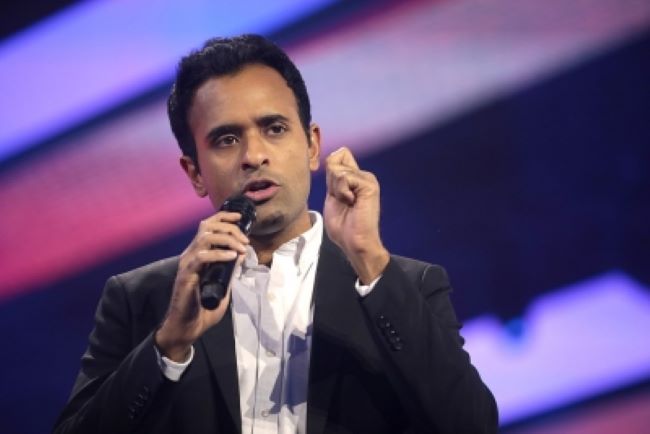
Speaking at AmericaFest, a high-profile conservative conference organized by Turning Point USA, Ramaswamy urged activists to reject the idea that ancestry or “heritage” determines who qualifies as a “real” American.
“The idea that a ‘heritage American’ is more American than another American is un-American at its core,” Ramaswamy told the crowd, according to a report by The New York Times. He added that while online spaces often glorify lineage as strength, “our true strength is what unites us across that diversity.”
Ramaswamy, a wealthy entrepreneur and former 2024 Republican presidential candidate known for his outspoken criticism of left-wing “woke” ideology, has increasingly found himself targeted by far-right groups that promote what he has described as “blood and soil” nationalism — a phrase historically associated with Nazi ideology and now echoed by some white nationalist movements.
In an opinion essay published earlier this week in The New York Times, Ramaswamy wrote that his social media feeds are “littered with hundreds of slurs,” many of them anti-Indian in nature. On Friday, he went further, saying that anyone unwilling to clearly denounce hate directed at any ethnic group “does not have a place as a leader at any level in the conservative movement.”
In the opinion essay, Vivek Ramaswamy argued that conservative leaders must draw clear and uncompromising boundaries against extremist rhetoric, particularly from figures associated with the so-called “Groyper” movement. He wrote that leaders should condemn such behavior “without hedging,” saying that individuals who praise Adolf Hitler or use ethnic slurs — including derogatory language directed at Vice President JD Vance’s wife, Usha Vance — have “no place in the conservative movement.” Ramaswamy said the issue was not about “clutching pearls,” but about preventing the gradual normalization of what he called “un-American animus.” He compared the spread of online extremist rhetoric to “toddlers testing their parents’ limits,” arguing that responsible Republican leadership requires setting firm boundaries for followers before hateful ideas gain legitimacy.
His remarks come amid renewed scrutiny of bigotry within mainstream conservative circles. In recent months, racist and antisemitic text messages exchanged by young Republicans surfaced publicly, while conservative commentator Tucker Carlson drew backlash for conducting a friendly interview with Nick Fuentes, an openly racist and antisemitic figure. The controversy led to resignations from senior officials at the Heritage Foundation after its president declined to criticize Carlson.
Ramaswamy said the issue has become deeply personal, particularly as intolerance toward Indian Americans has surged online. “It isn’t really about defending Jews, Indians, or any other minority group,” he told The New York Times in a text message. “It’s about defending the essence of America itself.”
Attendees at AmericaFest offered mixed reactions. Corbin Wills, a 25-year-old student from Arizona Christian University, praised Ramaswamy’s unequivocal stance, warning that the Republican Party risks marginalization if it allows extremists to dominate its image. Others, including longtime conservative activists, argued that fringe figures should be ignored rather than publicly confronted.
Researchers tracking online extremism say anti-Indian rhetoric has moved from fringe internet spaces into more mainstream discourse. Raqib Hameed Naik, executive director of the Center for the Study of Organized Hate, told The New York Times that the volume and intensity of such rhetoric is unprecedented. According to his group, posts on X containing anti-Indian slurs or calls for deportation reached hundreds of millions of views earlier this year.
The debate also highlights ideological rifts within the Republican Party. Vice President JD Vance, a leading figure in the “national conservatism” movement, has argued that defining American identity solely by adherence to founding ideals could dilute national cohesion. Ramaswamy, in contrast, has insisted that citizenship is rooted in shared civic values — including belief in the Constitution, the rule of law, and equal opportunity — rather than bloodlines.
The issue gained additional prominence in 2024, when national elections featured two Indian American Republican candidates — Ramaswamy and Nikki Haley — as well as a Democratic ticket led by Kamala Harris, who is of Black and South Asian descent. Advocacy groups say Indian Americans, now the largest single-origin subgroup within the Asian American population, have faced increased hostility amid debates over immigration and skilled-worker visas.
Despite the backlash, some lawmakers across party lines have welcomed Ramaswamy’s stance. Representative Ro Khanna, a Democrat, said he applauded the Republican candidate for confronting intolerance rather than “pandering” to it.
The New York Times report notes that Ramaswamy’s warning underscores a broader reckoning within American conservatism: whether the movement will draw firm boundaries against extremist ideologies, or risk allowing them to reshape its future.
This report is based on coverage by The New York Times.
