





BY VEENA RAO*
Atlanta, GA, January 22, 2026: South Asians are developing type 2 diabetes at much higher rates than other groups—often at a younger age and sometimes even at body weights considered “normal”—and the reasons go beyond diet and exercise alone, according to leading doctors and researchers who spoke at an Indiaspora webinar held Wednesday night.
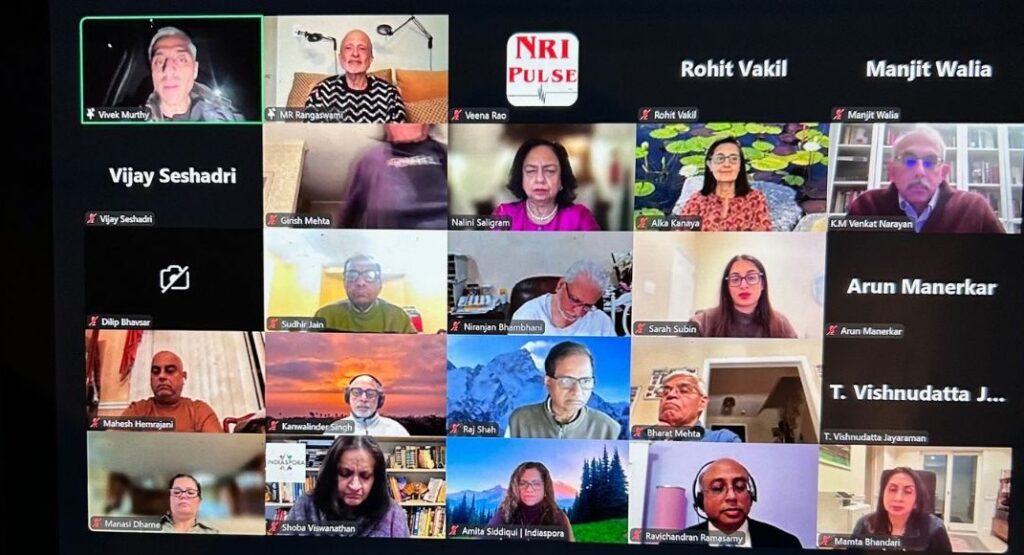
The one-hour virtual program, titled “Sweet Truths: Diabetes in the South Asian Community,” brought together former U.S. Surgeon General Dr. Vivek Murthy and three experts who focus on diabetes in South Asian populations: Dr. K.M. Venkat Narayan of Emory University, Dr. Ravi Chandran Ramaswami of NYU Grossman School of Medicine, and Dr. Alka Kanaya of the University of California, San Francisco, best known for leading the landmark MASALA study of South Asians in the United States.
The session was moderated by Dr. Nalini Saligram, PhD, founder and CEO of Arogya World, a public health nonprofit that works on preventing lifestyle-related diseases through large community programs in India and among the diaspora. The webinar concluded with a lively audience Q&A, with participants asking questions about diabetes screening, diet, fasting, medications, and long-term complications.
The webinar opened with remarks from Indiaspora founder M.R. Rangaswamy, who described Indiaspora as a nonprofit network connecting a global Indian diaspora of roughly 35 million people across the United States and several other countries. He said the diabetes discussion was the second in Indiaspora’s health series, following an earlier session on heart health, and was chosen because of diabetes’s growing prevalence and early onset among South Asians. Citing alarming trends, Rangaswamy noted that Indians and South Asians account for some of the highest diabetes numbers globally, with projections continuing to rise, and that South Asians are significantly more likely than people of European ancestry to develop type 2 diabetes—often at a younger age—making awareness, prevention, and early action critical.
A risk that doesn’t always “look” like diabetes
Dr. Murthy opened with a message that many South Asian families are likely to recognize: diabetes diagnoses are becoming increasingly common across generations, both in India and among immigrant families in the United States.
“If you think about your own family—whether in India or in the diaspora—you’ve probably seen more and more people being diagnosed with diabetes. That’s not a coincidence,” Dr. Murthy said. One of the biggest challenges, he noted, is that diabetes risk in South Asians is not always obvious.
Many people assume they are at low risk if their body mass index (BMI) is below 25, which is commonly used to define “overweight.” But Dr. Murthy cautioned that this measure does not work the same way for South Asians.
“You can’t always tell by looking at someone whether they’re at risk,” he said. “For South Asians, diabetes risk often increases below the BMI cutoffs we typically use.”
He explained that visceral fat—fat stored deep inside the abdomen around vital organs—plays an important role. South Asians, he said, tend to develop this type of fat more easily, which can lead to insulin resistance and higher diabetes risk even in people who appear lean.
Dr. Murthy also shared a personal experience. Despite having a BMI under 25, he noticed that his hemoglobin A1C, a long-term blood sugar measure, was slowly rising. He said he reduced refined carbohydrates, increased protein intake, and stopped eating late at night. What made the changes last, he added, was doing it together with friends.
“This work is hard to do alone,” he said. “But when you make these changes together, it becomes much more sustainable.”
Biology vs. lifestyle
Dr. Venkat Narayan, executive director of Emory’s Global Diabetes Research Center, said diabetes risk in South Asians must be understood through two main lenses: biology and environment.
Lifestyle factors—such as diet, physical activity, stress, sleep, and highly processed modern foods—clearly matter. But Dr. Narayan said biology also plays a major role and has not been studied enough in South Asian populations.
“We have to pay attention to the biology, not just behavior,” Dr. Narayan said. “Otherwise, we won’t solve this problem.”
Dr. Venkat Narayan pointed to three biological patterns that are often seen in South Asians with diabetes: the pancreas may produce less insulin, muscle mass tends to be lower, and fat is more likely to build up in the liver. Together, these factors can raise diabetes risk even without obvious obesity.
Dr. Narayan stressed that although countries like India carry a large share of the world’s diabetes burden, much of the research used to guide treatment is still based on studies of Western populations.
“A quarter of the world’s people with diabetes are Indians, but only a tiny fraction of diabetes research focuses on them,” he said. “That mismatch has to change.”
Why diabetes raises heart disease risk
Dr. Ravi Chandran Ramaswami focused on what happens after diabetes develops, especially when it comes to heart disease.
He explained that diabetes changes how the body processes sugar. Instead of being used efficiently for energy, glucose can be diverted into harmful chemical pathways. Over time, this leads to inflammation and damage to blood vessels and heart muscle.
“Glucose essentially gets hijacked into pathways that don’t produce energy,” Dr. Ramaswami said. “And over time, that damages both the heart muscle and the blood vessels.”
These changes increase the risk of heart attacks, strokes, and other complications. While keeping blood sugar under control helps slow this damage, Dr. Ramaswami said it may not fully prevent long-term complications, highlighting the need for treatments that go beyond glucose control alone.
Prevention works—but may be less effective in India
Dr. Alka Kanaya summarized decades of research showing that lifestyle changes—healthy eating and regular physical activity—can significantly reduce the risk of developing type 2 diabetes.
However, she noted that similar prevention programs in India have not worked as well as they have in some other countries. One possible reason is that lifestyle changes improve how the body uses insulin but may not fully fix problems related to insulin production, which appear to be more common in South Asians.
“Diet and exercise absolutely help—but they don’t seem to fully correct the insulin secretion problem we see in South Asians,” Dr. Kanaya said.
Even so, she emphasized that prevention is still effective and worthwhile, especially when changes are realistic, long-term, and supported by family and community.
A1C vs. fasting glucose: testing questions in South Asians
The panel also addressed common confusion around diabetes testing.
Dr. Kanaya said hemoglobin A1C testing is convenient because it does not require fasting. However, she explained that some South Asians may have higher A1C levels for reasons unrelated to blood sugar alone.
“That’s why I often recommend fasting glucose as a simple, inexpensive screening test—regardless of BMI,” she said.
She said fasting glucose can be used for routine screening, with A1C or repeat tests done if results are elevated.
Diet, timing, and moderation
When asked about diet advice, Dr. Kanaya urged moderation rather than extreme or trendy diets. She recommended cutting back on refined carbohydrates, increasing fiber intake, ensuring enough protein—especially for vegetarians—and avoiding late-night eating.
“The timing of meals matters more than people realize,” she said. “Late dinners and nighttime snacking keep insulin levels high when the body should be resting.”
Dr. Narayan added that people respond differently to the same foods and that tools like continuous glucose monitors may one day help tailor diets more precisely. Both speakers emphasized that good sleep is an often-overlooked but important part of metabolic health.
The GLP-1 moment
The panel also discussed GLP-1 medications like Ozempic and Mounjaro, which have dramatically changed the treatment of diabetes and obesity.
Dr. Narayan described them as among the most important advances since insulin but warned that cost, access, and proper long-term use will determine how much impact they truly have.
“These drugs could save millions of lives globally—but only if they are used appropriately and made accessible to those who need them most,” he said.
Dr. Kanaya raised a concern especially relevant for South Asians: loss of muscle mass. Because South Asians already tend to have lower muscle mass, she said, weight loss from these drugs could pose long-term risks.
“My concern is what happens to muscle mass in a population that already has less of it to begin with,” she said.
Audience questions and closing message
During the audience Q&A, participants asked about intermittent fasting, whether diabetes can be reversed, links between diabetes and dementia, and the role of alternative therapies. Panelists said early diabetes can sometimes be reversed with sustained lifestyle changes, but long-term prevention and management require consistency and evidence-based care.
The webinar closed with a broader call to improve diabetes research and healthcare delivery in regions where the disease burden is greatest. While South Asians face higher biological risk, speakers agreed that diabetes is not inevitable—and that early screening, informed lifestyle choices, and fair access to effective treatments can greatly reduce complications.
*Veena Rao is the founder and editor-in-chief of NRI Pulse.
