|
|

|
NRIS!
Do you know?
|
|
A March to Remember
|
|
Mahadev Desai is an Atlanta-based freelance writer. Along-term Community News Editor for India Tribune until he left for Florida in 1999, Mahadev is now back on the Atlanta scene, and writes for various community publications. He says he enjoys covering community events, writing ‘profiles’ and ‘humor’ articles. His articles have been published in Khabar, Voice of India, Darpan, India-Today, Woman’s Era, Desi etc.
|
|
MAHADEV DESAI, Publicity Director, Gandhi
Foundation of USA relives the patriotic fervor of the Dandi
Yatra, which was reenacted recently to celebrate 75 years of Mahatma Gandhi’s historic Salt March.
|

|
|
Since childhood I have been fascinated by the famous Dandi march that captivated the imagination of millions across the globe. It gave a fresh lease of life to the stalled Freedom Movement. Mahatma Gandhi, the master strategist and great grassroots communicator (in absence of TV and internet) hit upon a worthy cause. He used the monopoly of the British Salt Tax as a catalyst for his non-violent civil disobedience. On 12th March, 1930, prompted by an “inner voice”, the fragile but iron-willed, 61 year old Bapu (Mahatma Gandhi) clad in a dhoti, and a pair of sandals, staff in hand, set off on a defiant 240 miles walk from Sabarmati Ashram in Ahmedabad to Dandi on the sea that took 26 days. As Gandhi and the volunteers set off from Sabarmati Ashram in Ahmedabad, on the long, arduous march, to the soulful strains of “Raghupati Raghava”, volunteers sprinkled water, leaves and flower petals on the dusty roads, villagers greeted them with loving “namaste” and patriotic shouts of solidarity; and joined the march, children ran out of houses and clambered on rooftops and trees in curiosity and wonder at what Bapu was up to. The triumphant march ended on the morning of 6th April, when Gandhi picked up a lump of salt and boiled it in seawater to make salt. Effects felt across India as thousands made salt or bought illegal salt. This ingenious march of non-violent civil disobedience was to prove a key turning point in the Freedom struggle. This gesture, this symbol of the battle of the right against the might, shook up the pillars of the mighty British rule in India. It marked symbolic emancipation and sent a loud and clear warning to the British, that it was time to leave India
Many years later, what I had heard and read about the Dandi March was reinforced when I saw the acclaimed film “Gandhi”. The picture of defiant Bapu and 78 Congress volunteers on the Dandi march has been one of the most enduring images in my mind.
|
|
|
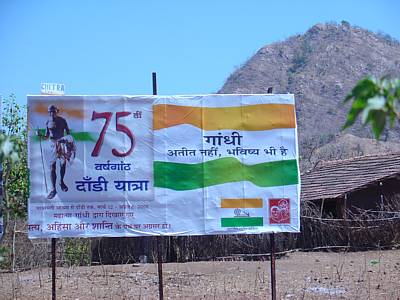
I had the good fortune to be in India and that too in Ahmedabad when the 75th anniversary of the historic Dandi March was re-enacted. Tushar Gandhi, the great grandson of the Mahatma, who is also the Managing Trustee of the Mahatma Gandhi Foundation, Mumbai, suggested the re-enactment of the Dandi March to Congress President Sonia Gandhi, who readily agreed.
So Tushar Gandhi began organizing the “International walk for Peace, Freedom and Justice”, with the theme, ’Gandhi is not the past but is also the future.’ The publicity generated a lot of euphoria. Thousands of people including many from abroad wanted to join the Dandi Yatra but it was not possible to accommodate all. So simultaneous, the day-long global marches were held in countries like the US, Canada, South Africa, among others.
Prior to the Dandi Yatra, Gujarat Vidyapeeth had organized a painting competition for 5-10 yr. old children. Ahmedabad’s well known artists, sculptors, painters spent two days at the Camp in Sabarmati AshramThe exhibits were displayed on 12th March, the day Congress Chief, Sonia Gandhi flagged off the yatra. She also garlanded the Gandhi Statue and requested everyone to take an oath to follow the Gandhi principles of Truth and Non-violence. Ashram Road wore a festive look. Children lined up the route and waved tricolor. Thousands including participants from abroad set off on the march as noted Sarod player Amjad Ali and his sons played the tunes of ‘Vaishnava janato’ and ‘Raghupati Raghava’, and cries of ‘Vande Mataram’ rend the air. Tushar Gandhi, Sonia Gandhi and many cabinet members led the march. A group from Pakistan’s N.W. Frontier Province also participated. The marchers took the same route at the same time and made the same three halts on the way which Bapu had made. At night, they slept in tents. The Congress volunteers presented cultural shows in the evening, showed documentaries, stressed cleanliness, de-addiction and dealt with rural issues.
On the 9th day, former Prime Minister Rajiv Gandhi’s son Rahul Gandhi also joined the Dandi Yatra. Villagers flocked to see him as he walked together with Tushar Gandhi, from Kankanpur to Kareli gam. He appealed to the young generation to play a proactive role in unifying the country. The march continued covering more than 150 villages through six districts in Gujarat, with the media reporting its daily progress.
On the final day, at the concluding ceremony, Congress President Sonia Gandhi said “The great success of the re-enactment of the Dandi Yatra shows that Mahatma is still alive in our hearts. The Yatra has spread the message of spiritualism, friendship and brotherhood. The younger generation should follow in the footsteps of Mahatma Gandhi.”
And Prime Minister Manmohan Singh reminded the significance of the Dandi March, “Gandhi shook the foundations of the British Empire with one pinch of salt, which helped us get Independence.” And on a happy note, he announced a Rs. 10 crore development package for the Sabarmati Ashram. He also announced the conversion of the route between the Ashram and Dandi as a heritage route. He further said that all the places where Gandhi stayed overnight during the Dandi March in 1930 would be turned into ‘heritage sites’ and a library dedicated to Gandhian studies would be built at Dandi. The government would erect statues of Gandhi and the 78 marchers who walked with him as a fitting memorial at Dandi.
Stressing the importance of the march, Tushar Gandhi said, “The main objective of this is to regenerate the spirit of sacrifice that was evident in the former Dandi march. New generation should not forget the Gandhi philosophy of ‘Truth and non-violence’.
Twenty-seven-year old Greg Eckart who came all the way from Hawaii to participate in the yatra claimed he is a changed person after completing the yatra. That goes fro me too! I was among the lucky onlookers on that memorable day. It was a sight to behold and treasure. I felt the exhilaration, the ‘do-or-die’ spirit and patriotic fervor of that day when Bapu had initiated his nation-stirring march.
|
|
|


