
|
|

|
|
Dr. Mala
Chakravorty
|
|
Mala Chakravorty has a Ph.D. in American
Women's fiction from I.I.T. Delhi, and
Master's degrees in English and American Studies from Delhi University and Smith College, Massachusetts. She has worked in the School of Women's Studies, Jadavpur University, Kolkata, and Women's Studies Program at the University of Hawai'i at Manoa, Honolulu. She switched from academics to Information Technology in 1999, and is currently working as a
Business Development Manager with NIIT Technologies, Inc. Atlanta, Georgia. Apart from her academic articles, Mala's short stories have been published in Sulekha.com and BAGA annual magazines.
|
Subhash Ghai’s objective to use the backdrop of the nationalist struggle to present an immortal love story across social-cultural barriers lacks conviction says
Mala.
Author/Producer/Director:
Subhash Ghai
Music: A R Rahman, Ismail Darbar
Lyrics: Javed Akhtar, Blaaze (English)
Cinematography: Ashok Mehta
Screenplay: Sachin Bhowmick, Farukh Dhondy, Margaret Glover, Subhash Ghai
Action: Tinu Verma
Choreography: Saroj Khan, Shaimak Davar, Daksha Seth
Make-up: Vikram Gaikwad, Mickey Contractor
Costume: Neeta Lulla
Cast: Vivek Oberoi, Antonia Bernath, Isha Sharwani, Polly Adams, Michael Maloney, Caroline
Langrishe, Amrish Puri, Zarina Wahab, Yashpal Sharma, Rajat
Kapoor, Vivek Mushran, Hrishita Bhatt, Vikram Gokhale, Om Puri, Sushmita Sen.
|
 |
|
Showman Subhash Ghai is back with his new offering,
Kisna: The Warrior Poet, which he describes as the most adventurous love story ever told on screen. Kisna is a fictional tale, not an episode from history. Ghai’s last film, Yaadein (2001), was a colossal flop. To say that Kisna is a better movie is not much of a compliment: it would be difficult to make anything worse than
Yaadein. Ghai seems to have been under tremendous pressure to make a successful movie, and has spared no effort to be different. My request to him is be to spare his viewers by never attempting a period film again. He should stick to his forté -- urban kitsch.
The story is simple. Kisna's (Vivek Oberoi) family members are servants in the house of a British officer, Peter Beckett. Beckett's daughter, Catherine (Antonia
Bernath), and Kisna are best friends. Enraged by his daughter’s familiarity with natives, Beckett sends her off to England. She returns after ten years and seeks out
Kisna, who is on the verge of marriage to Lakshmi (Isha
Sharwani). The year is 1947. Independence has been declared. The British are on their way out. A group of freedom fighters, led by Kisna’s uncle, Bhairav
(Amrish Puri) and brother Shankar (Yashpal Sharma) kill Beckett and torch his house. Catherine and her mother escape. Hot on their heels are their hunters, aided by a scheming prince, Raghuraj
(Rajat Kapoor), who lusts after Catherine. Kisna gives Catherine refuge, and encouraged by his mother, makes it his ‘dharma’ to escort her to the safety of the British Commission in Delhi. How he escapes the evil pursuers and completes his mission, takes us through three excruciatingly dull hours. En route, Kisna and Catherine fall in love. Catherine wants to take him to England, but Kisna has to return to his own world to fulfill his ‘karma’, which is to marry Lakshmi and raise a family. The odd couple’s love transcends their physical reality and is sublimated to a spiritual level. But that's not the end. Nearly six decades go by. The two women who loved Kisna meet after his death. Lakshmi tells Catherine that though she shared home and hearth with
Kisna, Catherine was his true love, proved by his request to have his ashes immersed in the Gangotri where he first fell in love with Catherine. The movie ends with Catherine’s resolution to do the same on her own death.
|
 |
I fail to understand Bollywood’s obsession with the
Raj. Just because Lagaan (2001), made it to the Oscars, do we really need another movie set in British India? Ghai tells us that he was inspired by nostalgic stories he heard from aged members of the Raj and their respect for India’s culture, divine energies and values of loyalty and sacrifice. He decided to revisit that era and look at our colonizers as more than villains. His objective is to use the backdrop of the nationalist struggle to present an immortal love story across social-cultural barriers, hoping that it would attract the overseas market as well as appeal to the national one. Unfortunately, his delineation of the race and class hierarchies in the Raj lacks conviction. His version of India in the 1940s is packaged in a Cottage Emporium brand ethnicity.
|
|
The nationalist struggle is divested of all dignity and heroism. Freedom fighters are made to look like a bunch of bandits out to loot, kill and plunder for personal gains, or for sheer devilry. Episodes promoting Indian values of loyalty and sacrifice meant to impress Catherine seem arbitrarily imposed on the narrative. The eternal love of soul mates belonging to different worlds is equally contrived, as the lovers have no chemistry of any kind. The film’s epic characteristics are restricted to superficial references to the
Mahabharata. Kisna seems to be inspired by the Lord Krishna, Lakshmi by
Rukmini, Catherine by Radha, Bhairav by Kansa. Kisna’s mission of fighting his own family members to protect Catherine is analogous to the
Dharamyuddha. Unfortunately, the parallels are woefully banal. Admittedly, Ghai has never had any pretensions of making realistic movies, but after all the hype that preceded
Kisna, one expected a better film. A heroic tale Kisna may be, but one more suited to a nautanki style of narration than the big screen.
There are a number of clichéd sequences. What is supposed to be a deserted church in 1947 India, transforms into a MTV style music video replete with semi-clad back-up dancers from Shaimak Davar’s dance school gyrating to video generated pyrotechnics. The mujra episode, borrowed heavily from Umrao Jaan and
Devdas, with Sushmita Sen as the philosophical tawaif and Om Puri as the comic-heroic Hyderabadi middleman, is quite redundant. As is Amrish Puri’s gratuitous villainy. The debauched prince and his attempts to seduce/ravish the heroine have been lifted from Hindi films made some 50 years ago. The repetitive chase sequences with the hero defeating multiple opponents single-handedly and the fragile heroine cowering in fright are too hackneyed to lend any freshness to the narrative.
I am also not sure why the film is called Kisna: the Warrior Poet. Warrior, yes, though - with Chandu-esque scowls and grimaces - more in the Company vein, but a poet? Long straggly wig does not a poet make! We are told that Kisna writes the numerous songs he sings, but he emits very little intensity or sensitivity. Ghai could not draw a performance out of his star that combines the passion and fire of a poet who turns into a warrior. The fault could well lie in the director’s conceptualization of this character than in Mr. Oberoi’s acting prowess.
|
|
|
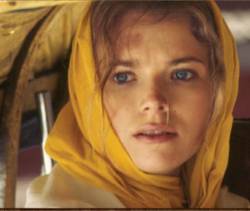
About the other performances, the debutante leading ladies are passable. British actress Antonia Bernath handles a difficult role awkwardly, hampered by a Hindi accent that grates on one’s nerves. Isha Sharvani suffers from a sketchy characterization of an envious
Lakshmi, but her dances are truly awe-inspiring.
I am tempted to say that one can sit through this deadly dull movie just to
watch this unique form of ‘yogic ballet’.
|
|
|
What does stand out in the movie is Ghai’s penchant for grandeur. He creates visual magic with the panoramic splendor of the Himalayan landscape and the sylvan glory of a tiny region in North India called
Devaprayag. He creates the ambience of a historical era by merging the sheer visual beauty of nature with repeated incantations of
'shlokas' and 'mantras' and mellifluous classical music based soundtrack. The cinematographer and choreographers have done an exquisite job energizing the vibrant numbers, and the dance sequences are stunningly beautiful. The attempt is to create an ambience of an idyllic era suffuse with harmony and idealism that was destroyed by hatred and prejudice. Even though the film fails to achieve this lofty goal, it may be worth a glance for its sheer visual magnificence, melodious music, brilliant cinematography and Ms. Sharwani’s immense dancing talent.
YOUR COMMENTS:
Tell us what you
think of this feature.
Post your comments.
Or write to us at contact@nripulse.com.
|

