Mala Chakravorty
has a Ph.D. in American Women's fiction from I.I.T. Delhi, and Master's degrees in English and American Studies from Delhi University and Smith College, Massachusetts. She has worked in the School of Women's Studies, Jadavpur University,
Kolkata, and Women's Studies Program at the University of Hawai'i at
Manoa, Honolulu. She switched from academics to Information Technology in 1999, and worked at HCL Technologies, Inc. and NIIT Technologies, Inc. in Atlanta. She recently moved to Orlando, Florida, where she joined
InfoSource, Inc. as Account Executive. Apart from her academic articles, Mala's short stories have been published in
Sulekha.com and BAGA annual magazines.
New Beginnings: The Journey
(Sancharram)
BOLLYWOOD
GUPSHUP
Writer/Director/Producer:
Ligy J. Pullappally Director of Photography: M.J. Radhakrishnan Editor: B. Ajithkumar Sound Designer: N. Harikumar Music: Isaac Thomas Kottukapally Art Director: Mahesh Vanchiyoor Script Translator: Tommy John Cast: Shruiti Menon; Suhasini V. Nair; KPAC Lalitha; Ammachi; Syam Seethal; Suresh Babu; Amika Trissur; Venu Machat; Sangeeta; Sarada Kozhikode; Leela Ottapallam.
I came across The Journey, a Malayalam film with subtitles, in Blockbuster, released recently by Wolfe Video. Based on true story, The Journey is
Kerala-born-Chicago-bred Ligy Pullappally’s lyrical paean to lesbian relationships in rural India, The film has gathered accolades internationally and in India, receiving the Award for Best Film at the 40th Chicago International Film Festival 2005, and India’s Best Debut Director Award,
Bangalore, an award instituted in the memory of the progressive writer, P.
Lankesh.
Originally titled 'Sancharram,' the film was inspired by an email Pullappally received in 2000 from a young college student in
Kerala. The writer was one of two girls who fell in love and fled to escape the ensuing social persecution. They were eventually forced to return to their respective families, and one of the girls drowned herself soon after. Coincidentally, prior to receiving this email, Ligy had made a short film “Uli” about two girls in rural Kerala and the tragedy that befell them when they fell in love. Moved by the email and the frequency of similar stories that have emerged in all parts of rural and small town India, Ligy wanted to do something help women like these. Soon after, she received the Sunshine Peace Award, a national award recognizing her work as a public interest lawyer and her contribution to women's issues. This enabled her to travel to India and eventually expand that story into her first full length feature film,
Sancharram.
The first Indian film that explored lesbian relationships with any kind of empathy and sensitivity was Deepa Mehta’s Fire (1996), a film that won international acclaim, but unleashed a host of violent protests against its screening in India. Since then, the only film that touched on this taboo topic was a monstrosity called Girlfriend (2004) that presented the universal stereotype of a pathological homosexuality and used it as a vehicle of titillating the homophobic male gaze. Ligy countermands the inherent violence of films like Girlfriend with a positive media representation of alternate sexualities, hoping that her film will reach out to a wider audience, sensitizing them to the fact that homosexuality is not an alien concept that exists in another world, that anyone can face a situation like this. She also hopes to raise awareness about the alarming rate of lesbian women committing suicide within
Kerala, and send young women a message about courage and hope that could eventually help them reach out of the isolation they live and often die in.
The plot of the film is simple. The Journey begins in a small village in
Kerala, with the first meeting between Delilah, a little Catholic girl living with her widowed mother and grandmother, and
Kiran, who moves into her ancestral Nair home with her parents. The girls quickly become best friends, and as they grow older, the reserved, introverted Kiran finds herself attracted to the vivacious, outgoing Delilah, and soon realizes that her love is deeper than that of friendship. The intensity of her feelings shocks her and she tries to suppress them, finding an outlet in romantic poetry that she is encouraged by her literature teacher to publish. Her parents are proud of her talent, without the slightest idea of the source of her inspiration. As Kiran’s feelings strengthen, she finds an outlet in writing letters to Delilah on behalf of one of Delilah’s male suitors. When Delilah learns the truth about the letters, she responds to Kiran spontaneously and the two embark on a secret but joyous journey of their own. In a conservative society that frowns upon public displays of affection between men and women, venerates female friendship and thinks of arranged marriages as the only option, hiding the true nature of their relationship is initially easy. However, the truth eventually comes out, and the entire social structure is shaken up. The loving and protective families turn tyrannical. Delilah’s marriage is arranged quickly, and she is browbeaten to accept this as her fate. Kiran fights back, defying society and her scandalized parents, but is unable to convince Delilah to join her battle. The movie ends with each of them beginning another journey, a conclusion that is tragic yet affirmative.
Set within the lush greenery of rural
Kerala, The Journey is a loving portrayal of family and community, of friendship and love in a tranquil world where Hindus, Christians, Muslims coexist, respecting each other while preserving their own identities. The fragile nature of this idyllic community is soon exposed when the harmony is shattered by two young girls who dare to be flout the norm. Although the film’s central focus is on the same sex relationship, it is also a representation of social mores that define human behavior and relationships and lay down rules for the individual about what is ‘normal’ and ‘abnormal’. The film explores universal issues of the dialectics of social and family pressures versus being true to oneself; of intolerance and persecution of anyone who is ‘different’; and of the individual’s coming to terms with one’s identity on one’s own terms. It is also remarkable for its portrayal of several exceptionally strong women characters, representative of a matrilineal society in a progressive and politically aware state, where women have the right to inherit and own property, to be educated and to work outside the home, even though the larger social structure that defines the social and moral codes is essentially patriarchal and heterosexual.
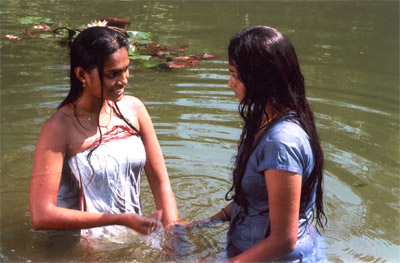
The brave actresses playing Ligy’s two protagonists are excellent in their difficult roles. Suhasini V.
Nair, a television actress, portrays the inner world of the mostly silent Kiran through her eyes and facial expressions. She does a remarkable job of Kiran’s evolution from an anguished girl haunted by demons of her own ‘unnatural’ feelings, to a confident, resolute young woman, determined to live her life on her own terms, flouting social norms and parental expectations. Shrruiti
Menon, a former Miss Kerala, brings out the reckless, fun loving spirit and the vivacity of Delilah with an easy and lovable charm. The two women share a chemistry that makes their early friendship and later romance completely convincing. The supportive cast is also very good. A lot of attention is paid to detail: the differences between the lifestyles in Kiran’s Nair household and Delilah’s Catholic one are created painstakingly. The class, ethnic and religious boundaries that define this community are subtly defined even though the difference in faith is never seen as an issue.
Subtlety is the essence of the film, and its strength. There is much that is shown through beautiful cinematography, play of light and sound, silence and stillness, rather than told through dialogue and narration. Images of light and shade, dreams and reality are juxtaposed to heighten the polarities in the narrative. Physical intimacy between the two women is implicit, but there are no explicitly sexual scenes. The pastoral setting, with its lush foliage, the waterfalls, cliffs, ponds, groves, fields, frequent rains, is used to create an ambience of harmony, with undercurrents of danger lurking just behind. Ligy uses evocative images of startling beauty and poignancy to express her characters’ predicaments. For example, Delilah’s first adult appearance -- offering grapes to
Kiran, is used as an analogy of Eve offering the apple of knowledge to an innocent Adam in the Garden of Eden. There is a beautiful scene of a suddenly mature Delilah joining a group of dancers, desperately trying to catch a glimpse of the anguished Kiran for the first time after her discovery of Kiran’s love for her. The most evocative image is that of a chrysalis turning into a butterfly and emerging from its cocoon -- used as an analogy of Kiran’s final awakening. The final images of the girls walking away, turning around to look at each other, and then fading, are filled with poignancy. Added to the affirmative ending, these images reverberate long after the film is over.
Despite the inevitable comparisons to Deepa Mehta’s Fire, The Journey takes a more progressive approach to homosexuality. Fire too explored the relationship between its protagonists with empathy and sensitivity, but its basic premise was that women turned to each other as a result of abusive heterosexual relationships. The Journey’s premise is that women seek love from women out of choice, and not as a default option for bad experiences with men. It is a natural and conscious breaking off from the socially imposed norm of heterosexuality. At the same time, the film also deconstructs the institution of family as a naturally nurturing, and community as a supportive social structures, by exposing the repression of individualism that is intrinsic to these constructs. An extremely brave effort by a young woman not afraid of the backlash she potentially faces from right wing political organizations, fundamentalist religious groups, and conservative audiences – in fact, all but a small group of liberals and radicals -- when dealing with a subject as controversial and volatile as a positive representation of alternate sexualities. But maybe I am wrong! The fact that the film has won critical acclaim and awards in India perhaps speaks a lot for contemporary Indian society’s openness to hitherto taboo subjects. Definitely worth a watch!
http://www.thejourney-themovie.com
Sancharram has been honored with a number of awards, including India’s Best Debut Director, Lankesh Award 2005, and the Chicago Award for Best Film, 40th Chicago International Film Festival.
Chicago Award for Best Film
40th Chicago International Film Festival
WINNER
India’s Best Debut Director
Lankesh Award 2005, Bangalore, India
WINNER
Special Jury Prize
John Abraham Award, Kerala, India
WINNER
Jury Prize &
Best Musical Score
Kerala State Film Awards