|
BY KAVITA CHHIBBER
India is shining and a lot of what glitters seems to be
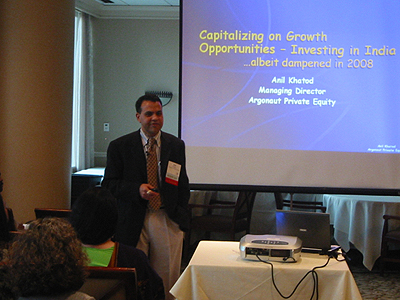
solid gold. That was the message conveyed by Anil Khatod,
Managing Director and lead India partner at Argonaut Private
Equity, a diversified global private equity fund with more
than $3.5 billion under management.
Armed with all kinds of information, and numbers Anil made a
stellar presentation on 19th March at the TiE monthly event
in Atlanta.
So what makes people like him so excited about investing in
India?
The answer to that, he said lay in the fact that in the past
6 years in spite of a 25 percent market correction, the
Indian sensex has provided a 27 percent compounded annual
return. “When I compare that to SNP 500, or the London Stock
exchange index, you can see 2 percent for SNP 500 and 1
percent for London Stock exchange. There is relative
volatility in the numbers but that is why it is so exciting
to look at these markets outside of the mature markets.” Of
course the first thing to remember when you take on emerging
markets, he cautioned, was the fact that the investment has
to be long term because these markets tend to be much more
volatile than mature markets.
Anil quoted from the Goldman Sachs report which indicated
that the Indian economy started a transformational process
from 2003. It also said that if the fundamental structural
change continues in the same vein, the country can sustain a
growth level of about 8 percent in GDP until 2020. There is
tremendous opportunity for productivity growth and at a
sustainable 3 and a half percent, India can overtake not
just some other European economies but also the US by 2045.
Since 71 percent of Indians live in villages, a huge urban
migration is expected over the next 20-30 years leading to
an urbanization bonus.
In the 1990s, the cost of capital and return on equity
leveled each other off and as a result one didn’t create a
lot of value in the business. But in the last 5 years the
cost of equity has come down and the return has gone up
becoming among the highest in the world-in some areas even
higher than China since most Indian organizations had become
so adept at making the most with very little capital. From 3
percent in the 1970s to 4-6 percent in the 1980s and 90s,
India’s GDP in the last 5 years has accelerated to about 8
and ½ percent. Labor productivity is growing and the
interesting thing is that the capital is coming from
internal sources.
While 45 billion have been invested in India last year by
foreign investment, Anil pointed out that it’s just a drop
in India’s trillion dollar economy. India’s savings rate has
come up to 35 percent from the days in the 60s to early
1980s when it was about 15 percent. China’s domestic savings
rate is about 44 percent, So there is more capital that has
become available to go into the economy. There are fewer
dependants in each household and therefore more disposable
income is available. In fact in 1990 the per capita income
was 350 dollars. From 2000 to today, the increase in
disposable income has been close to 300 percent.
India also has a young working force and that gives it
advantage over many aging economies including China whose
one child policy will probably land its people amongst the
aging humanity by 2025. Anil Khatod said by 2016 India is
expected to overtake Italy as one of the larger economies
and follow that up by overtaking France and Germany. “ So
somewhere around 2025, you will find India in the top 6
economies in the world.”
Perhaps the best way to learn about anything is to get hands
on experience. It was extremely enlightening to have Anil
share examples from some of the companies he had invested in
and pursued closely in India, starting with Koutons, a
company that specializes in designer wear for men at a very
affordable cost. It was started by 3 brothers eight years
ago and is today the third largest retailer in India,
earning 7 million in 2004 to stand at 200 million in
earnings today. Starting with 27 stores, the company is
expected to open 3000 by the end of next year. It was their
impeccable organizational skill, a clear understanding of
their customer both in the rural and urban areas and
efficient buying that caught Anil’s attention and his
investment.
Another company that Anil talked about Acme Tele Power had
revenue of a little over 700,000 in 2003 and today it has a
net profit of 150 million dollars. The success story
happened thanks to a simple technology created by Manoj
Upadhyay the 32 year old newest billionaire to join the
ranks, to stabilize power as India added 8.4 million cell
phone subscribers. The green solution was sold to Bharati
Air Tel one of the largest telecom operators The company
ends up with a market capitalization of 3 billion and goes
public shortly.
There are many such success stories that have made India a
financial Mecca for national and foreign entrepreneurship.
In India, 500 billion dollars are earmarked on
infrastructure and civil engineering has suddenly become the
hottest discipline in all the IITs. One such company the
Sriram group in the south has revenue of 300 million but an
order backlog of 5 billion! Many banks are seeing resurgence
as well, said Anil as India gallops on. From struggling with
non performing assets where for example loans to farmers
were not repaid, a bank that Argonaut has invested in, in
Tamil Nadu the percentage of non performing assets has come
down from 8 to 1 percent. The banks today have a much better
asset quality growing at 20-25 percent annually and trading
in a relatively inexpensive way.
Touching on some more points, Anil talked about India’s
foreign trade and foreign exchange that had been stagnant up
to the 1990s but then regulatory pressures started to ease
up, and today from near bankruptcy India has a foreign
reserve of close to 300 billion. He said that when capital
markets start functioning the governance gets better and
better. He recalled the time he first did business in India
in the 1990s when he worked with Nortel Networks and he has
seen the corporate governance scene change dramatically.
Three four years ago IT and healthcare made up 30 percent of
private equity funding but last year they ranked 5and 9th as
financial services raced to number 1, telecom to number 2
and the manufacturing segment to number 3. When economies
thrive, the number of sectors that begin to blossom is also
bigger, he said.
So what pitfalls to avoid when investing in India? Anil said
there are some cardinal rules that one must implement. Do a
thorough background check, hire the best teams to perform
due diligence, do forensic checks if something doesn’t look
transparent. Have the company checked out for fraud. And
above all listen to your gut feel.
Anil pointed out that in spite of all the glitz about India
there is also concern about the risks of investing there.
Issues dealing with political uncertainty with coalition
governments and politics affecting economics, labor reforms,
skilled labor shortage, commodities inflation, were raised
but even then the consensus was that India’s influence on
the world will be quicker and bigger than most people
expect.
Anil said he was happy to say that capital markets in India
had finally taken a step in the right direction-to function
like world class markets. “ There is a lot more
transparency.”
So how should people participate? Anil’s advice was, that
people should invest in what India and China consume because
their economies are growing, and a large number of people
with higher income are entering the market. And with all the
commodity inflation you are also better of consuming what
India and China are producing. It will keep consumption
costs low. There were many jobs in the middle and senior
managements for those who just wanted to go and look for
work opportunity in India.
Anil reiterated that he was very excited to see the
fundamental structural change happening in India and pointed
out that his company’s investment was long term-for years
and not months or weeks. “ When I was growing up in India
the notion was save what you can because we don’t know what
tomorrow is going to be like. That attitude has changed.
Today most people(in India) believe tomorrow will be
better.”
Nandan Sheth, the TiE Atlanta President, along with his
team, with exceptional work done by Ashish Thakur and
support from previous President Harish Mamtani, was very
appreciative of Anil Khatod’s exhaustive presentation.
“I am not aware of many institutional investors in the South
East that can provide a real perspective on Private Equity
investing within markets emerging markets like India, Israel
and Australia, as Anil can.
He gave a very thoughtful perspective on the opportunities
and challenges in the emerging markets that his fund invests
in. His point of view was very mature and tempered, shying
away from the main stream euphoria that you hear when
analysis with zero deal experience talk about these markets.
Some of the key takeaways from his presentation are
important to synthesize:
Do not ignore “staple” industries or “emerging” industries
that service local demand.
Do not be afraid to diversify your portfolio. Asset
allocation strategies are fundamentally unique to each
emerging mark.
Tread with caution. Emerging markets are prone to
significantly more political, economic and inflationary
risks.
Private investors have a variety of options if they want to
participate in these emerging markets.
These are some very insightful lessons from a practitioner
that understands both the business and cultural implication
of investing in these growth markets.”
The response from attendees at the sold out event, inspired
Nandan to invite Anil back later in the year to share a
score card of how his portfolio had performed.
Many drove from far away areas of Georgia to attend the
event on a week day, and comments ranged from, ‘I came from
Athens GA for the presentation. Based on this presentation I
would like to make a commitment to attend as many TiE
Atlanta meetings as I can” , to “’Anil was real. He
obviously has a tremendous command of the nature of these
emerging markets”, and “I want to congratulate the TiE
Atlanta team for maintaining the highest quality possible in
terms of speakers that they have secured in 2008”. An
evening that brought that made TiE shine again in the choice
of speakers, and each month’s event is something to look
forward to.
|